Decoded
Bonsai — the small potted tree at the garden center is not what's meant by 盆栽
The 'bonsai' at the garden center is its own thing — a small potted tree as houseplant. 盆栽 in Japan is a sculptural practice measured in decades. Both exist; they're not the same craft.
The houseplant called "bonsai"
Walk into a garden center in California, or a Christmas market in Germany, or a pop-up plant shop in London. Somewhere on a low table, lined up next to succulents and aloe veras, you'll find a row of small twisty trees in shallow ceramic pots, labeled Bonsai. Most are juniper or some kind of dwarf elm. They cost twenty to fifty dollars. The pot is glazed dark green or unglazed terracotta, and the tree is roughly hand-sized — twelve to twenty centimeters tall, with a curving trunk and a tidy little dome of foliage on top.
You buy one. You take it home. You water it. It dies in three months because you didn't know it needed cold winter dormancy and full outdoor sun. Or it survives, and now you have a small interesting tree on your windowsill that grows slowly, and someone at a dinner party says "ah, you have a bonsai," and you nod.
This is, for most people outside Japan, what bonsai means. A small ornamental potted tree. A category of houseplant somewhere between a fern and a cactus, available cheap, vaguely Asian, slightly mysterious. People give them as gifts. They appear in movies as visual shorthand for Japanese-themed character. They get sold by the millions every year worldwide.
The thing the name was borrowed from is not really a houseplant.
What 盆栽 actually means
盆栽 (bonsai, "tray planting") in Japan is a sculptural discipline practiced over decades. The tree is not the product. The tree is the slow-moving raw material that the practitioner shapes, year after year, decade after decade, by selectively pruning roots, wiring branches into specific positions, removing leaves to redirect the tree's energy, repotting at intervals, and waiting for new growth to take the form intended. A serious bonsai is not finished. It is in the middle of being shaped, with the shaping happening on a timeline measured in human lifetimes.
A few markers of what real bonsai practice looks like:
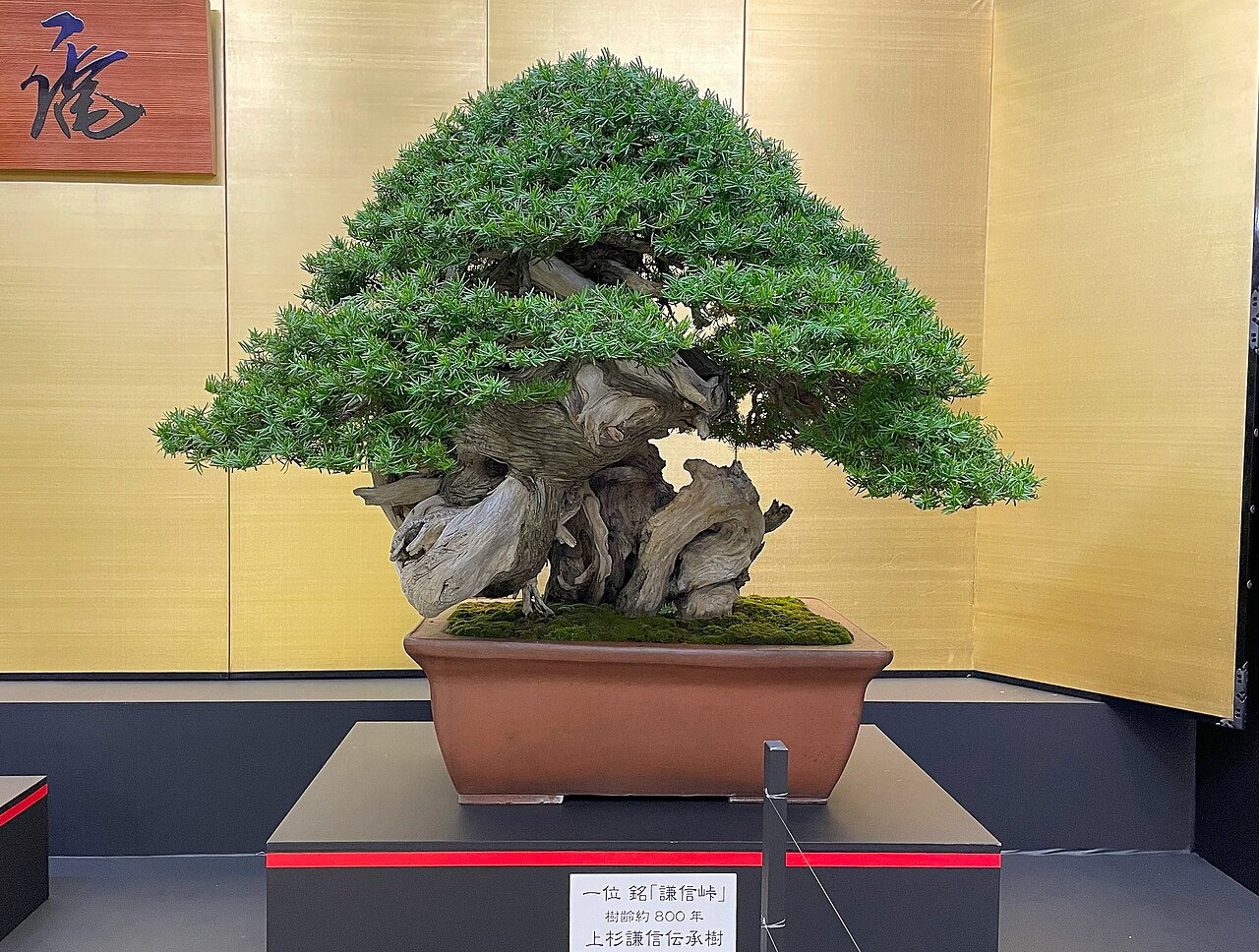
- Age. A respected bonsai is usually at least 30 years old, often 80 or 100. The most famous trees in Japan are 200, 400, sometimes 800 years old, with documented ownership histories spanning generations of practitioners. The tree at the Omiya Bonsai Art Museum in Saitama has trees over 1,000 years old.
- Lineage. Trees pass between practitioners across generations. A tree that has been worked on by a famous master for forty years carries that master's aesthetic decisions, written into the structure of the trunk and branches. The current owner is, in effect, the steward of someone else's accumulated work, with the obligation to continue rather than restart.
- Style categories. The form a bonsai takes is governed by named styles — chokkan (formal upright), moyogi (informal upright), shakan (slanting), kengai (cascade), bunjin-gi (literati), sōkan (twin trunks), and many more. Each style has its own conventions of trunk angle, branch placement, and foliage distribution. Practitioners study these the way a painter studies the conventions of a tradition.
- Pot pairing. The pot is a deliberate aesthetic choice. The dimensions, glaze, color, and shape of the pot are matched to the tree's character and style. Antique Japanese and Chinese pots can cost more than the tree.
- Public exhibition. Real bonsai are shown at exhibitions like the Kokufu Bonsai Exhibition (国風盆栽展, Kokufu Bonsai-ten), held annually in Tokyo since 1934 — the most prestigious bonsai exhibition in the world, where the most distinguished trees in Japan are gathered for one week each February. Trees compete; the best receive named awards. Practitioners spend years preparing trees for a single showing.
- Outdoor cultivation. Real bonsai live outdoors year-round. They need sun, weather, cold winter dormancy, seasonal change. The houseplant on a Western windowsill — kept indoors at room temperature — is not how the tree wants to live.
The small twisty tree at the garden center is a different category of object. It is, more accurately, a dwarfed potted tree — pruned and pot-grown to stay small, sold as decorative greenery, intended for display rather than continuing transformation. There's nothing wrong with that as a thing. It just isn't the same craft as the practice 盆栽 names in Japan.
From Chinese penjing to garden-center plant
The form has a long international history that helps explain the gap.
The earliest ancestor is Chinese 盆景 (penjing, "tray scenery"), which emerged during the Tang dynasty (7th–10th century CE) as a literati practice — miniaturized landscapes including trees, rocks, and water in shallow pots, intended as objects for contemplation. Penjing arrived in Japan during the Heian period (794–1185), brought back by Japanese monks and scholars who had studied in China.
Over the next several centuries, Japanese practitioners refined the form into its own discipline. The Japanese version became more focused on a single tree (rather than the multi-element landscape of Chinese penjing), with stricter aesthetic conventions and a stronger emphasis on the tree's individual character. By the Edo period (1603–1868), bonsai had become a recognized cultural practice among the merchant class as well as samurai, with documented schools and lineages.
The form began moving outward in the late nineteenth and early twentieth centuries, especially after international exhibitions like the 1900 Paris Exposition and the 1937 Paris International Exposition, where Japanese bonsai displays drew Western attention. Servicemen returning from the postwar occupation of Japan brought trees and an interest in the practice back to North America. Bonsai clubs and societies sprang up across the United States and Europe in the 1950s and 1960s, focused initially on serious cultivation.
The commercial mass-market houseplant version emerged later — through the 1980s and 1990s, garden-center supply chains in Europe and North America began producing dwarfed conifers and elms in shallow pots and selling them as bonsai at gift-shop prices. The trees were often grown in tropical Chinese or Taiwanese nurseries, shipped young, and sold within a year or two of starting. The objects sold this way and the multi-decade discipline practiced in Japan share a name and a distant lineage but otherwise diverge into different worlds. Both have their audiences and their place. The houseplant has introduced millions of people to the idea of small potted trees. The traditional practice has preserved a craft of remarkable patience and depth.
Where to see real bonsai
Four places to see the practice in its full form.
-
大宮盆栽村 (Omiya Bonsai Village), Saitama. Established in 1925, when bonsai growers from Tokyo relocated to Omiya after their nurseries were destroyed in the 1923 Great Kantō Earthquake. The village still has six working bonsai nurseries open to public viewing — Mansei-en, Seikō-en, Tōju-en, Shōfū-en, Fuyō-en, Kyūka-en — each with hundreds of trees, often including specimens over a century old. Walking the village in an afternoon gives a sense of the scale and depth of serious cultivation.
-
大宮盆栽美術館 (Omiya Bonsai Art Museum). Adjacent to the village. Opened 2010 by Saitama Prefecture as the first public bonsai museum in the world. The collection rotates around 60 specimen trees on display at a time, including trees over 800 years old. The museum's interpretive panels walk through aesthetic conventions and cultivation timelines in English and Japanese. About 30 minutes from central Tokyo by JR.
-
Takamatsu, Kagawa Prefecture. The Takamatsu region produces roughly 80% of Japan's kuromatsu (black pine) bonsai. Several large pine-bonsai nurseries operate in the Kinashi and Kokubunji districts and accept visitors. The pines grown here are exported to bonsai practitioners around the world; you can see fields of trees in various stages of training, lined up by age — some 5 years old, some 50, some over 100 — before they ship to collectors.
-
The Kokufu Bonsai Exhibition (国風盆栽展), early February in Tokyo. Held at the Tokyo Metropolitan Art Museum in Ueno annually since 1934. About 200 of the most distinguished bonsai in Japan are gathered for one week. Admission is around ¥1,000 in recent years. For anyone interested in the high end of the craft, this is the single most concentrated annual event in the world.
The garden-center bonsai is its own thing — a small living object that brings the suggestion of a tree into a small home, enjoyed by its many owners around the world. Knowing it shares a name with a 1,000-year-old tree at the Omiya museum doesn't take anything away from it. But the 1,000-year-old tree is, separately, also worth seeing.
Frequently asked questions
- Is the bonsai sold at garden centers a real bonsai?
- It's a different category of object. The mass-market bonsai — small twisty trees in shallow pots, sold for $20–50 as houseplants — is more accurately a dwarfed potted tree, pruned to stay small for decorative display. The Japanese practice 盆栽 names is a sculptural discipline carried out over decades, with trees often 30 to 100+ years old (some Japanese specimens are over 1,000). Both exist; they're different crafts sharing a name.
- How old does a "real" bonsai have to be?
- There's no fixed cutoff, but a respected bonsai is typically at least 30 years old, often 80 or 100. The most famous trees in Japan are 200, 400, sometimes 800 years old, with documented ownership histories spanning generations. The Omiya Bonsai Art Museum holds trees over 1,000 years old.
- Can you grow bonsai indoors?
- Real bonsai live outdoors year-round. They need full sun, seasonal change, and cold winter dormancy. The houseplant version sold in the West is often kept indoors at room temperature, which is not how the tree wants to live — and the most common reason garden-center bonsai die within a few months.
- What are the named styles of bonsai?
- The form a bonsai takes is governed by named styles — chokkan (formal upright), moyogi (informal upright), shakan (slanting), kengai (cascade), bunjin-gi (literati), sōkan (twin trunks), and many more. Each has its own conventions of trunk angle, branch placement, and foliage distribution. Practitioners study these the way a painter studies the conventions of a tradition.
- Where can you see real bonsai in Japan?
- The Omiya Bonsai Village in Saitama (six working nurseries open to public viewing, established 1925) and the adjacent Omiya Bonsai Art Museum (opened 2010, ~30 minutes from central Tokyo by JR). Takamatsu in Kagawa Prefecture produces about 80% of Japan's black-pine bonsai, with several large nurseries open to visitors. The Kokufu Bonsai Exhibition (国風盆栽展) in early February at Tokyo's Ueno gathers around 200 of the most distinguished trees in Japan for one week annually.
- Is bonsai Japanese or Chinese?
- The art is originally Chinese — known as 盆景 (penjing) in China, with documented origins in roughly the Tang dynasty (7th–10th century). It traveled to Japan with Buddhism in the Heian and Kamakura periods, where over several centuries it was reshaped into what's now recognized as 盆栽. The two share a common root but evolved into distinct aesthetic traditions: penjing remains more landscape-oriented, often including miniature figures, water, and rocks, while bonsai centered on the single tree as the subject. Chinese in origin, Japanese in current global form.
- Is bonsai cruel to the tree?
- Done correctly, no — properly maintained bonsai trees can live longer than the same species in the wild. Some specimens at the Omiya Bonsai Art Museum are over 1,000 years old, with documented ownership histories spanning multiple generations. The tree is not stunted by neglect; it's kept small through pruning and root work that mimics, in miniature, the shaping forces of mountain wind and shallow soil. Done badly — soil dried out, no light, no winter rest — bonsai can die fast like any living plant. The art's ethics are about the rigor of the care, not about confinement.
Sources
- 大宮盆栽美術館 (Omiya Bonsai Art Museum), Saitama — Saitama Prefecture cultural facility, opened 2010
- 大宮盆栽村 (Omiya Bonsai Village), Saitama — established 1925 by relocating bonsai growers after the Great Kantō Earthquake (1923)
- Takamatsu City pine bonsai industry — 高松市 official record, ~80% of Japan's *kuromatsu* (black pine) bonsai production
- *Penjing* / *盆景* — Tang dynasty Chinese antecedent of bonsai; 大辞林 第四版 entry 盆栽
- Nippon Bonsai Association — *Bonsai Today* journal archive on cultivation timelines and lineage practice
Last reviewed: 2026-05-03
Related reads
Decoded
California Roll vs Sushi — what your local sushi place is actually serving you
The California Roll is an American invention from 1960s Los Angeles. The Japanese sushi (寿司) family it borrowed its name from is broader and built around vinegared rice in many forms.
Decoded
Hibachi — the American 'hibachi' restaurant has nothing to do with what 火鉢 means in Japan
An American 'Hibachi' dinner is a flat-grill steakhouse show. A Japanese 火鉢 is a small charcoal brazier in the corner of a room. Same name, completely different things — here's what each one actually is.
Decoded
The green paste at your sushi isn't wasabi — it's dyed horseradish
The green dab on your sushi plate is, almost everywhere, dyed horseradish — not wasabi. Real wasabi is a different plant, grown in cold spring water, and tastes like a different flavor altogether.
Decoded
Futon — the sofa-bed your American dorm called a futon, and what that name means in Japan
An American 'futon' is a wooden-frame sofa-bed. A Japanese 布団 is a thin mattress that lives in a closet and rolls out onto the floor for the night. Both are real things. The name traveled; the object didn't.
Spotted something off?
Reveal Japan aims for accuracy. If you found a factual error or unclear passage, tell us via Contact. We update articles when readers correct us, and we credit the corrector by request.