Decoded
California Roll vs Sushi — what your local sushi place is actually serving you
The California Roll is an American invention from 1960s Los Angeles. The Japanese sushi (寿司) family it borrowed its name from is broader and built around vinegared rice in many forms.
The California Roll on every Western sushi menu
Walk into any sushi restaurant in any American city, any European mall, any Australian shopping center. Most likely the menu is divided into rolls, and the roll at the top — the one ordered most, the one in every photo — is the California Roll. Avocado, imitation crab, cucumber, sometimes cream cheese, all wrapped in a sheet of nori with the rice on the outside, often dusted with orange roe or sesame seeds, cut into eight pieces, served with a small mound of bright green wasabi-shaped paste and a saucer of soy sauce.
This is, for most people outside Japan, what sushi looks like. A roll. Cut into pieces. Layered with vegetables and a creamy filling. Sometimes deep-fried, sometimes drizzled with mayonnaise-based sauce, sometimes set on fire at the table. The form is so dominant abroad that "sushi" and "rolls cut into pieces" have become near-synonyms in the English-speaking world.
The mental picture has a fixed shape. Rice on the outside. Filling on the inside. A piece you pick up with chopsticks and dip in soy sauce. Maybe with a beer.
The thing that picture is built on is real, and it has a specific name in its actual home country. It is not a roll.
What sushi actually is in Japan
The word sushi (寿司・鮨) comes etymologically from the archaic adjective 酸し (sushi, "sour-tasting") — the same root as 酸っぱい (suppai) — referring to the vinegared rice (sumeshi / shari) that the dish is built around. In modern use, however, "sushi" most often refers to shari + topping (typically fresh seafood) — what comes to mind for most Japanese diners when they hear the word is a piece of nigiri at a counter. The rice is the technical foundation; the seafood is the everyday image.
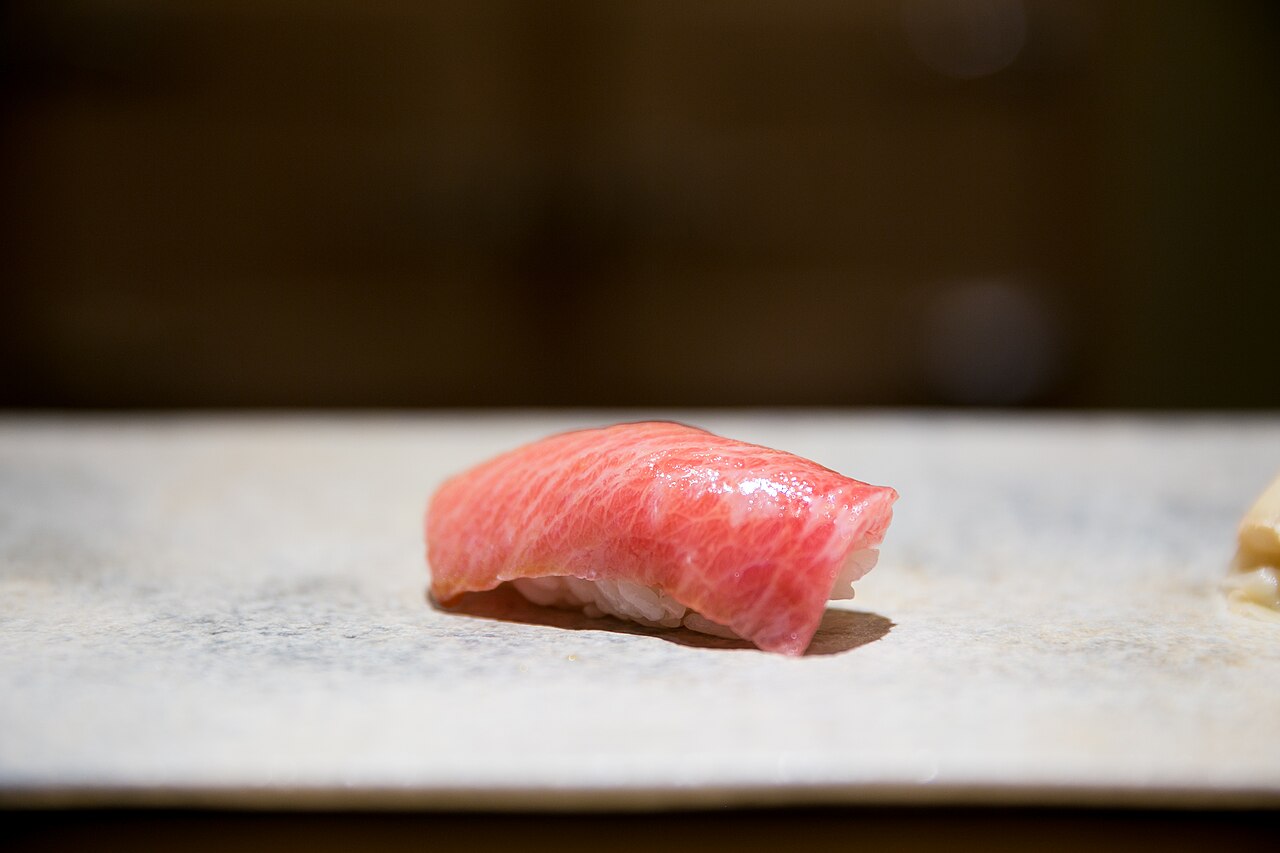
The dominant form at a serious Japanese sushi-ya is nigiri (握り) — a small mound of vinegared rice formed by hand, with a thin smear of real wasabi between the rice and a single piece of topping (this is standard practice, not optional, unless you ask for sabi-nuki / no wasabi). The topping can be raw fish, but it can also be cooked shrimp, simmered kelp, sweet egg omelet, marinated tuna, eel with sweet soy glaze, or a piece of fried tofu pouch wrapped around the rice (inari-zushi). Many sushi pieces have no raw fish at all.
The other forms in the family:
- Maki-zushi (巻き寿司) — rolled sushi. Thin rolls (hosomaki) with one ingredient inside: tekka-maki (tuna), kappa-maki (cucumber), negitoro-maki (chopped fatty tuna with green onion). Thicker rolls (futomaki) with several ingredients: simmered shiitake, kanpyō, tamago, denbu (sweet seasoned cod), kyūri. Futomaki and the seasonal eho-maki are very much eaten as a meal at home — wrapped in nori, cut into substantial pieces, served alongside miso soup as the main dish on a family table.
- Chirashi-zushi — vinegared rice in a bowl, topped with sashimi or scattered ingredients. A common home meal and a staple of Hinamatsuri.
- Inari-zushi — sweet fried tofu pouches stuffed with vinegared rice. Often eaten as picnic food or quick lunch.
- Oshi-zushi — pressed sushi from western Japan, formed in a wooden mold (hakozushi in Osaka, battera in the Kansai region).
The inside-out roll — rice on the outside of the nori — also exists in Japan, called 裏巻き (uramaki). It's seen at modern, creative, or international-leaning sushi shops, and on conveyor-belt menus marked as a foreign-style item. It's not the historic form; it's an arrival from the American sushi tradition that has been integrated, in moderation, into the Japanese repertoire.
What the American-style sushi-roll dinner — eight or twelve pieces of multi-filling uramaki, often deep-fried or sauced, eaten as the entire meal — isn't, is the standard form a Japanese sushi-ya is built around. A serious counter still revolves around nigiri, with maki appearing typically toward the end of a course as a small final round.
How the California Roll happened
The California Roll emerged in Los Angeles in the 1960s, in a sushi bar serving an audience that was new to Japanese food. The two recurring elements in the origin accounts are avocado — used as a substitute for toro (fatty tuna), which was hard to source consistently outside Japan — and the eventual flipping of the roll inside-out, after kitchen staff noticed American customers peeling off the seaweed before eating. Whether the canonical credit goes to a specific chef in LA or to Vancouver-based Hidekazu Tojo (who claims his own independent invention in the early 1970s in his 2017 book Beyond the California Roll) is still contested. The form was emerging in multiple Japanese-American kitchens around the same period.
Through the 1970s and 1980s the California Roll spread across the United States as an entry-level sushi item for diners new to the format, and other inside-out variations followed (Philadelphia Roll, dragon rolls, tempura rolls, spider rolls, and many more) — most created by sushi chefs in North America for the local market.
In Japan, the California Roll appears on some conveyor-belt sushi menus, labeled in katakana as カリフォルニアロール, but it's a niche item — most Japanese diners would recognize the name as American and don't usually order it. The category as a whole — uramaki with multiple non-traditional fillings — is something Japanese sushi cuisine notes the existence of without having particularly absorbed.
Where to find the original sushi
Four entry points, each with a different price and feel.
-
A serious sushi-ya, sitting at the counter. This is the canonical form. Counters of eight to ten seats. The chef in front of you. Nigiri served piece by piece in an order the chef has decided based on what's good that day. Sukiyabashi Jiro and Sushi Saito in Tokyo are the famous ones; almost any city has a respected counter at a more reasonable price (¥20,000–¥40,000 per person at the high end; ¥8,000–¥15,000 at very good neighborhood places). Sit at the counter, watch how the rice is pressed, eat each piece in one bite — wasabi is already inside, between the rice and the topping, applied by the chef. The chef may also pre-brush soy sauce on certain pieces; if so, eat as served rather than dipping.
-
Kaiten-zushi for the everyday version. Conveyor-belt chains like Sushiro, Kura Sushi, and Hama Sushi serve sushi at a pace and price designed for everyday family meals. Base plates start at around ¥150 in recent years (with premium plates at higher tiers), and the menu is wide — nigiri, maki, gunkan-maki, hot bowl items, desserts. Worth one visit on any Japan trip to feel the casual everyday register of sushi as Japan eats it.
-
A morning at Toyosu. The wholesale fish market in Toyosu (which absorbed Tsukiji's fish operations in October 2018) opens to the public early. Walk the public viewing decks, see the tuna auction floor, then eat at one of the small sushi counters in the market's restaurant area — places like 寿司大 (Sushi Dai, opens around 5:30 AM) or 大江戸 (Oedo, operating since 1909). Both serve sushi made from fish that came off the auction floor a few hours earlier; the queues for Sushi Dai in particular can be long, but the omakase set (around ¥4,500) is one of the most concentrated experiences of fresh-from-the-market sushi available to a casual visitor.
-
A roll, made the Japanese way, at home. Futomaki and the seasonal eho-maki are how Japanese families make rolls at home — thicker, multi-ingredient, eaten as the centerpiece of a meal rather than a side. Eho-maki in particular is associated with 節分 (Setsubun, early February) — the tradition is to eat one whole, uncut futomaki facing a specified compass direction for the year, in silence, in one go, for good fortune. If you can be in Japan in early February or attend a home meal at a Japanese friend's place, this is the kind of roll the country actually rolls.
The California Roll is an American invention that has its own place on Western sushi menus and on the Western image of "sushi." Knowing it as an American adaptation doesn't take anything away from it. It just means there's another, separate thing also worth knowing — vinegared rice, hand-pressed, eaten in Japan in a different shape and a different rhythm.
Frequently asked questions
- Is the California Roll Japanese?
- No. It was invented in Los Angeles in the 1960s by Japanese-American chefs as an entry-level item — using avocado as a substitute for hard-to-source fatty tuna, and eventually flipping the roll inside-out so customers wouldn't peel off the seaweed. (A competing claim by Vancouver chef Hidekazu Tojo in the early 1970s exists.) Either way, the form did not originate in Japan.
- Do people in Japan eat California rolls?
- Rarely. The California Roll appears on some conveyor-belt sushi menus as カリフォルニアロール, but it's a niche item that most diners would recognize as American and don't typically order. Japanese sushi cuisine notes the form's existence without having particularly absorbed it.
- What does sushi normally look like in Japan?
- At a serious sushi-ya, the dominant form is nigiri (握り) — small mounds of vinegared rice with a single topping, served piece by piece at a counter. The family also includes hosomaki (thin rolls), futomaki (thick rolls), chirashi (a bowl of rice with toppings), inari (rice in fried tofu pouches), and oshi-zushi (pressed sushi). The American multi-filling inside-out roll is not the standard form.
- Is sushi always made with raw fish?
- No. Toppings can include cooked shrimp, simmered kelp, sweet egg omelet, marinated tuna, eel with sweet soy glaze, or fried tofu pouches (inari-zushi). Many pieces have no raw fish at all. The defining ingredient is the vinegared rice (shari), not the seafood.
- Where can you try traditional Japanese-style sushi?
- A serious counter sushi-ya in any Japanese city. ¥20,000–¥40,000 per person at famous Tokyo names like Sukiyabashi Jiro or Sushi Saito; ¥8,000–¥15,000 at very good neighborhood places. For the everyday register, kaiten-zushi chains like Sushiro or Kura Sushi serve nigiri at family-meal pace and price (~¥150 base plate). Toyosu Market also has small counters that open at dawn.
- Who actually invented the California Roll?
- There are three competing claims, all centered on Los Angeles in the 1960s–70s. The most commonly cited inventor is Ichirō Mashita, a Tokyo-trained sushi chef working at Tokyo Kaikan in Little Tokyo around 1963–64, who substituted avocado for fatty tuna (then hard to source year-round in California) and eventually flipped the roll inside-out to hide the seaweed (which Western diners initially disliked). A second claim names Ken Seusa of Olympic Sushi in Hollywood. A third, more recent, credits Hidekazu Tojo in Vancouver in the early 1970s with the inverted construction. The accounts disagree on the inventor; they agree on the period (1960s–70s), the coast, and the problem being solved — making sushi appealing to North American diners unfamiliar with seaweed and raw fish.
Sources
- Trevor Corson, *The Story of Sushi* (HarperCollins, 2007)
- Sasha Issenberg, *The Sushi Economy* (Gotham Books, 2007)
- Hidekazu Tojo, *Beyond the California Roll* (HarperCollins Canada, 2017) — competing Vancouver-origin account of the inside-out roll
- 大辞林 第四版 entries 寿司・鮨・酸し; sushi etymology from archaic Japanese adjective *sushi* (sour-tasting) + Hanaya Yohei (花屋與兵衛, 1799-1858), credited with the modern hand-pressed nigiri form around 1824
- Wikipedia: California roll — origin and reverse-import history
- 豊洲市場 (Toyosu Market) restaurant directory — 寿司大 / 大江戸 等 sushi counters in the wholesale market building
Last reviewed: 2026-05-03
Related reads
Decoded
Hibachi — the American 'hibachi' restaurant has nothing to do with what 火鉢 means in Japan
An American 'Hibachi' dinner is a flat-grill steakhouse show. A Japanese 火鉢 is a small charcoal brazier in the corner of a room. Same name, completely different things — here's what each one actually is.
Decoded
The green paste at your sushi isn't wasabi — it's dyed horseradish
The green dab on your sushi plate is, almost everywhere, dyed horseradish — not wasabi. Real wasabi is a different plant, grown in cold spring water, and tastes like a different flavor altogether.
Decoded
Sushi — the Japanese dish where the rice is the work, not the fish
Sushi is rice, not fish. The 200-year-old hand-pressed nigiri form is built around *shari* — vinegared rice the chef has been adjusting for hours.
Decoded
Bonsai — the small potted tree at the garden center is not what's meant by 盆栽
The 'bonsai' at the garden center is its own thing — a small potted tree as houseplant. 盆栽 in Japan is a sculptural practice measured in decades. Both exist; they're not the same craft.
Spotted something off?
Reveal Japan aims for accuracy. If you found a factual error or unclear passage, tell us via Contact. We update articles when readers correct us, and we credit the corrector by request.