Decoded
Futon — the sofa-bed your American dorm called a futon, and what that name means in Japan
An American 'futon' is a wooden-frame sofa-bed. A Japanese 布団 is a thin mattress that lives in a closet and rolls out onto the floor for the night. Both are real things. The name traveled; the object didn't.
The American sofa-bed called "futon"
If you went to college in America in the 1990s or 2000s, there is a non-trivial chance you owned, or sat on, or slept on a futon. The American futon is a very specific piece of furniture: a low wooden frame, usually pine or hardwood, with a thick padded mattress that lies flat across the slats. The frame folds in the middle. In its folded position, the mattress angles up against a backrest and the whole assembly works as a couch. You unfold the frame, the mattress flattens out, and now it works as a bed. One piece of furniture, two functions. Cheap (a few hundred dollars), light enough to carry up to a third-floor walkup, easy to assemble from a flat-pack carton.
For most Americans of a certain generation, futon names this object. A convertible sofa-bed. The word lives in IKEA catalogs, college-dorm packing lists, bachelor-pad memes. It is a category of furniture in the way that futon is also a category of green tea, or a category of chair: a familiar Japanese-named thing in the household landscape, whose Japanese-ness is mostly forgotten.
The Japanese 布団 is something else entirely.
What 布団 actually is
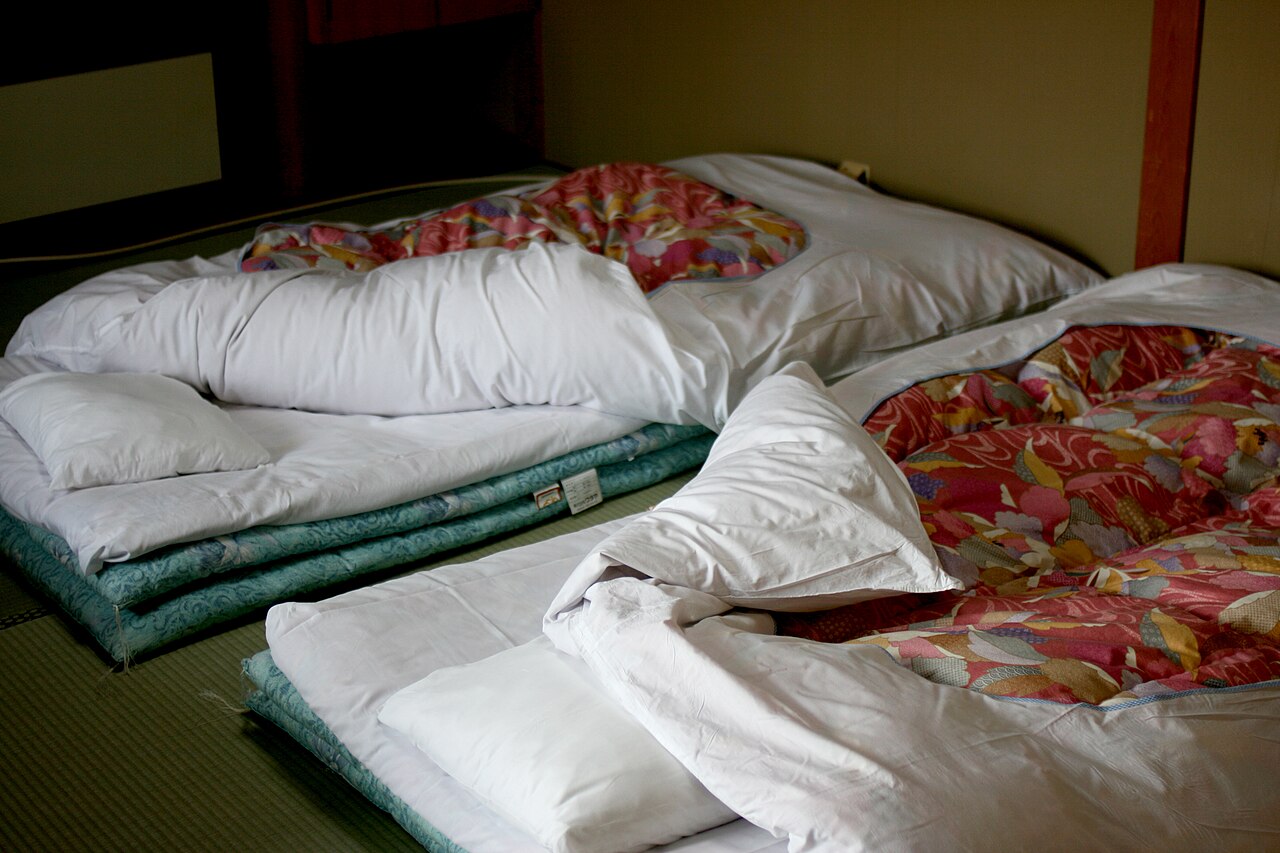
In Japan, 布団 (futon) is a bedding system, not a piece of furniture. It consists of two main components:
-
敷布団 (shikibuton) — the floor mattress. A flat, rectangular mattress filled with cotton wadding or modern poly/wool/synthetic fiber. Thickness varies by type — modern lightweight versions are around 3–5 cm, while heavier traditional or three-layer versions can run thicker. It sits directly on the tatami mat floor of a Japanese-style room. There is no frame. No legs. No box spring. Just a folded mattress unrolled onto the floor.
-
掛布団 (kakebuton) — the covering quilt. A thicker padded quilt — the equivalent of a duvet — that goes over the sleeper. Filled with cotton, wool, or down. Often paired with a flat sheet between the sleeper and the kakebuton, and sometimes with a separate moufu (blanket) underneath in winter.
A traditional Japanese household sleeps on this. Each evening, the futon set is taken out of a closet (oshiire) and unrolled on the tatami; each morning, it is folded and rolled back into the closet. The room then becomes a daytime room again — empty floor, low table, sliding paper doors. The same six-tatami-mat room serves as living room by day and bedroom by night because the bedding is portable and stored away.
The frame is the floor itself. There is no convertible function — a Japanese futon doesn't need to convert into a couch, because the room itself does the converting (the futon comes out for sleep and goes away for the day). And there is no fold-out mattress mechanism, no wooden slats, no metal hinges. The whole point is that the bedding is light, foldable, and stowable.
The American "futon" — wooden frame, thick mattress, fold-out couch function — has none of these properties. It is a permanent piece of furniture. It does not get put away. It does not sit on a tatami floor (it would crush the mat). The mattress is too thick to fold easily and is mounted on a frame that can't go in any normal closet.
How the name became a different object
The Japanese-style bedding system reached the United States gradually through the postwar decades, mostly via Americans who had encountered Japanese homes during the occupation era and through later cultural exchange. Some imported the bedding faithfully — laid directly on the floor, stored away in the morning. But Western homes weren't built for the storage-and-unrolling rhythm: there was no tatami floor, no large oshiire closet, no expectation that a living-room floor would become a bedroom each night.
What caught on instead was an adapted form: a wooden frame that could hold the mattress permanently, fold in the middle to convert between sofa and bed, and stay set up in the room as a piece of furniture. American futon-frame manufacturers began producing this design through the 1980s, and it spread quickly through college towns and apartment markets where the dual-function piece solved a real space problem at a low price. By the 1990s, what Americans bought when they bought a futon was a wooden sofa-bed frame, with the mattress almost an accessory.
Inside Japan, none of this happened. Japanese households kept their existing bedding. The American convertible sofa-bed never imported into Japan as futon — Japanese furniture stores selling sofa-beds use the word ソファーベッド directly. Two parallel meanings developed for the same word, with very little crossover within either market. Most Japanese people are vaguely aware that "futon" abroad refers to a sofa-bed; most Americans who sleep on a futon have never seen a real shikibuton on a tatami floor.
The American futon is its own thing — a piece of furniture that solved a real American space problem and gave a generation of renters somewhere to sit and sleep. The Japanese futon is something different — a portable bedding system that lives in a closet by day and on the floor at night. They share a name and a distant family resemblance, and both work well in their own settings.
Where to sleep on a real futon
Three ways to encounter the Japanese version.
-
Stay one night at a traditional ryokan. This is the most direct experience. At a washitsu-style room in a ryokan, the staff will lay out futons on the tatami floor in the evening (often while you're at dinner) and put them away in the morning. You sleep on a shikibuton directly on the tatami, under a kakebuton. The firmness, the closeness to the floor, the smell of fresh sheets and tatami mat, the absence of a bed frame — all of it together gives the actual sleeping experience the word names. One night in any old onsen town (Kinosaki, Hakone, Kusatsu, Kurokawa) is enough.
-
A traditional futon shop. Long-standing futon makers like 西川 (Nishikawa) — founded in 1566 in Ōmi (present-day Shiga Prefecture), continuously operating for over 450 years — sell shikibuton and kakebuton in their original form. The Tokyo Nihombashi and Kyoto stores have visible craft, with displays of cotton wadding, traditional fabric covers, and seasonal options. Buying a real shikibuton and kakebuton set, vacuum-packing it for travel, and using it on the floor of your home abroad is a practical way to live with the Japanese version.
-
A folk museum or open-air architectural park. Places like the Edo-Tokyo Open-Air Architectural Museum (Koganei, Tokyo) or the Nihon Minka-en (Kawasaki) have preserved traditional Japanese houses with the futon-storage closets, the rolled bedding, and the washitsu layout still set up. Walking through these gives the architectural context — why the bedding is portable, where it lives during the day, how the room transforms.
The American futon and the Japanese futon are both real things in their own settings. The American one is a piece of furniture that an entire generation of American renters have lived with happily. The Japanese one is a way of using a room that an entire country has lived with for centuries. Both worth knowing as themselves.
Frequently asked questions
- Is a Japanese futon the same as the American futon?
- No. The American "futon" is a wooden-frame sofa-bed with a thick mattress that folds out — a piece of permanent furniture. The Japanese 布団 is a portable bedding system: a thin floor mattress (敷布団) and a covering quilt (掛布団) that's rolled out on a tatami floor each night and stored in a closet (押入れ) each morning. Same name, different objects.
- Why doesn't the Japanese futon need a frame?
- Because the floor is the frame. A Japanese futon sleeps directly on a tatami mat, with no bed structure underneath. The room transforms — bedding comes out at night and goes back into the closet in the morning, leaving the room as a daytime space again. The whole bedding system is designed to be light, foldable, and stowable; a permanent frame would defeat the point.
- How did the American "futon" become a sofa-bed?
- The Japanese-style bedding reached the postwar US, but Western homes weren't built for the storage-and-unrolling rhythm — no tatami floor, no large 押入れ closet. American manufacturers adapted the idea into a wooden frame that holds the mattress permanently and folds in the middle to convert between couch and bed. The dual-function piece spread through college towns and apartment markets in the 1980s, and "futon" stabilized in American English as the name for this furniture form.
- Where does the futon go during the day?
- Into a closet called 押入れ (oshiire) — a deep, sliding-door closet built into the wall of a Japanese-style room (washitsu), specifically sized for stacking folded futons. The same six-tatami-mat room then serves as a daytime living space, freeing the floor entirely until evening.
- Where can you sleep on a real Japanese futon?
- At any traditional ryokan with washitsu rooms — the staff lays out futons on the tatami in the evening (often while you're at dinner) and puts them away in the morning. Onsen towns like Kinosaki, Hakone, Kusatsu, and Kurokawa all have ryokan offering this. Established futon makers like 西川 (Nishikawa, founded 1566 in Ōmi) sell traditional shikibuton and kakebuton sets at their Tokyo Nihombashi and Kyoto stores.
- What's the difference between a tatami mat and a futon?
- They're not alternatives — they work together. A tatami (畳) is a thick, woven straw-and-rush floor mat, about 5–6 cm thick, that forms the floor of a traditional Japanese room. A futon (布団) is the bedding — a thin floor mattress (敷布団), a covering quilt (掛布団), and a pillow (枕) — laid on top of the tatami at night and folded away in a closet (押入れ) by day. The futon needs the tatami's slight cushioning and breathability underneath; placing a Japanese futon directly on a hard wood or concrete floor will make it feel painfully thin. Together they form the standard sleeping setup of a washitsu, and have been since at least the Edo period.
Sources
- 大辞林 第四版 entry 布団 (futon) — *shikibuton* / *kakebuton* distinction
- 西川株式会社 (Nishikawa Co., Ltd.) corporate history — bedding maker founded 1566 (Ōmi Province), one of the longest-operating Japanese futon makers
- American futon-frame industry development through the 1980s and 1990s — US furniture retailers' product histories
- JR Hokkaido / various ryokan industry data on traditional bedding service operations
Last reviewed: 2026-05-03
Tools
- Open on Amazon
EMOOR CLASSE shikibuton - floor mattress, made in Japan
A real Japanese floor mattress, made in Japan in EMOOR's long-running CLASSE line - the thing that 'futon' actually means, laid out at night and folded away by day.
- Open on Amazon
FULI foldable shikibuton (Twin)
A roll-up quilted-cotton floor bed - one of the best-reviewed shikibuton on Amazon, a lower-cost way to try sleeping the Japanese way.
Related reads
Decoded
California Roll vs Sushi — what your local sushi place is actually serving you
The California Roll is an American invention from 1960s Los Angeles. The Japanese sushi (寿司) family it borrowed its name from is broader and built around vinegared rice in many forms.
Decoded
Hibachi — the American 'hibachi' restaurant has nothing to do with what 火鉢 means in Japan
An American 'Hibachi' dinner is a flat-grill steakhouse show. A Japanese 火鉢 is a small charcoal brazier in the corner of a room. Same name, completely different things — here's what each one actually is.
Decoded
Bonsai — the small potted tree at the garden center is not what's meant by 盆栽
The 'bonsai' at the garden center is its own thing — a small potted tree as houseplant. 盆栽 in Japan is a sculptural practice measured in decades. Both exist; they're not the same craft.
Decoded
Wabi-Sabi — the Bobby Hill rose your TikTok feed went viral over, and the two-mat tea room it was actually named for
Your TikTok 'it's got wabi-sabi' trend traces to a 2002 cartoon. The thing it borrowed the name from is a tea-room aesthetic forged by a man Hideyoshi later forced to commit seppuku.
Spotted something off?
Reveal Japan aims for accuracy. If you found a factual error or unclear passage, tell us via Contact. We update articles when readers correct us, and we credit the corrector by request.