Decoded
Hibachi — the American 'hibachi' restaurant has nothing to do with what 火鉢 means in Japan
An American 'Hibachi' dinner is a flat-grill steakhouse show. A Japanese 火鉢 is a small charcoal brazier in the corner of a room. Same name, completely different things — here's what each one actually is.
The American "Hibachi" dinner show
You walk into an American "Hibachi" restaurant — Benihana, Kobe Steakhouse, Sakura, your local version. You sit at a long shared table arranged in a U-shape around a giant flat-topped grill. A chef in a tall white hat arrives with a tray of food and a set of metal spatulas. Over the next twenty minutes he chops, flips, juggles, slices an onion into a small smoking volcano, throws an egg into his hat, catches a bowl of fried rice with one hand. The grill in front of you is a large stainless-steel flat surface, gas-heated.
That, for tens of millions of Americans (plus diners in Canada, the UK, Australia, the Philippines, and elsewhere), is what hibachi names. A theatrical dinner show centered on a flat metal grill, ending with a flaming onion ring and a styrofoam container of leftovers.
In Japan, the word 火鉢 (hibachi) doesn't refer to that show, that grill, or that restaurant style. It refers to something much smaller and much quieter.
What 火鉢 actually is (and what 鉄板焼き is)
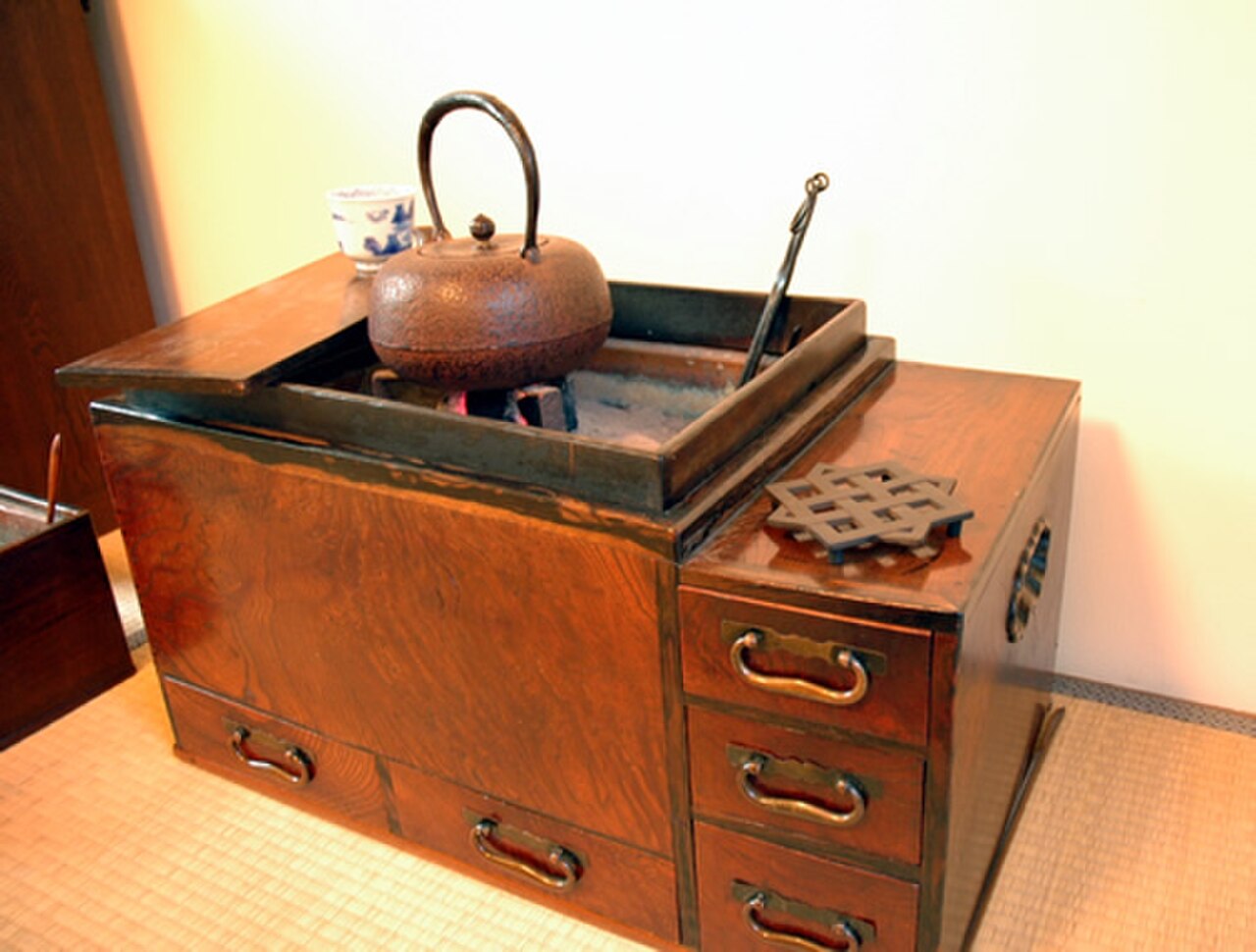
In Japanese, 火鉢 literally means fire bowl. It's a small portable charcoal brazier — a round or rectangular vessel about the size of a large cooking pot, made of ceramic, copper-lined wood, or cast iron, filled with ash, with two or three pieces of glowing charcoal half-buried in it. You place it in the corner of a washitsu (Japanese-style room) on cold days. You sit nearby and warm your hands above it. Sometimes a small iron kettle sits on a metal grate above the coals to boil water for tea, or a piece of mochi toasts slowly on a wire rack.
A hibachi is, in other words, a piece of domestic heating equipment, not a cooking appliance and not a restaurant feature. Before central heating became standard in Japan in the postwar period, hibachi were everyday household objects — every traditional house had one or several. Older relatives sometimes still keep one in storage, and antique pieces are sold at flea markets and folk-art dealers. They sit in tea-ceremony rooms, in old ryokan, in folk-life museums.
A 火鉢 is the size of a stockpot, holds a few coals, and is something you sit next to in winter. It is not where dinner gets cooked.
The thing the American "Hibachi" restaurant uses — the giant flat metal grill where the chef juggles eggs — is a different Japanese restaurant style entirely. Its proper name is 鉄板焼き (teppan-yaki), "iron-plate grilling." Teppan-yaki originated as a postwar Japanese form, often traced to a Kobe restaurant called Misono in the 1940s, and developed through the following decades. In Japan, teppan-yaki is generally a calm, refined experience: a flat grill in front of a small number of guests, premium beef cooked with quiet precision, the chef explaining each cut. There's no juggling, no onion volcano, no theatrical fire.
How the name crossed and split
The name jump happened in mid-1960s New York. Hiroaki "Rocky" Aoki, a Japanese wrestler and entrepreneur who had moved to the United States, opened Benihana of Tokyo in Manhattan on May 4, 1964. Aoki understood American audiences well: he saw that American diners were generally hesitant about unfamiliar food but enthusiastic about show. He took the teppan-yaki cooking format from Japan and combined it with Las Vegas–style theatrics — the chef performing tableside, the synchronized knife-flips, the onion volcano.
The early Benihana menus called this format "hibachi-style" rather than teppan-yaki. The exact reason for the word choice isn't fully documented. The likeliest explanation is that hibachi was already a recognizable word in postwar America (small charcoal grills had been imported and sold to home cooks under that name through the 1950s), while teppan-yaki was unknown. The name was familiar; the show was new. The pairing took off.
Through the 1970s and 1980s, Benihana expanded across the United States, and dozens of competing American "hibachi" restaurants opened in the same format. By the 1990s, "hibachi" had stabilized in American English as the name of this specific dinner experience, with no remaining link to the small charcoal brazier that 火鉢 names in Japan.
Inside Japan, the word kept its original meaning. The American "hibachi" restaurant format never crossed back over — Benihana's own Japanese branches, where they exist, market themselves as teppan-yaki places and skip the name confusion. Two parallel meanings now run on different sides of the Pacific without quite touching.
Real teppan-yaki and a real 火鉢
Two separate "real things" here, and you can encounter both.
-
A Japanese teppan-yaki dinner. This is the actual cooking style the American show borrowed from. The high-end version is found at hotel restaurants and specialty teppan counters — places like Ukai-tei (Ginza, Omotesando, Yokohama), Misono (the original 1940s Kobe restaurant), and many smaller independent counters in any Japanese city. Expect a calm, slow meal: five to eight courses, premium wagyu, the chef explaining each cut. ¥15,000–¥30,000 per person at the high end; smaller teppan counters and lunch sets bring the price down considerably.
-
An actual 火鉢 (Japanese charcoal brazier). Stay at an old-style ryokan in winter and you may find one in a shared sitting area — set with charcoal that warms the room and toasts mochi for guests. Visit a folk-life museum like the Edo-Tokyo Open-Air Architectural Museum in Koganei, the Shitamachi Museum near Ueno, or any of the minka preservation parks across rural Japan, and you'll see hibachi in their original household setting. Antique markets — Tomioka Hachiman-gū in Tokyo on Sundays, the various Kyoto temple markets — sell original Edo- and Meiji-period pieces. Tea-ceremony schools also use a related charcoal-brazier form, furo, in summer practice.
The American "Hibachi" dinner is its own institution — a New York invention from 1964 that a generation of diners genuinely enjoy, with its own conventions, staff training, and birthday traditions. It earned its place. It just happened to take a Japanese word that, in Japan, names something completely different and quieter — a small fire bowl, a few coals, a kettle of hot water, a winter afternoon.
Frequently asked questions
- Is "hibachi-style" cooking actually Japanese?
- The cooking format is — it's based on teppanyaki (鉄板焼き), an iron-plate grilling style that emerged in postwar Japan, often traced to a 1940s Kobe restaurant called Misono. The theatrical dinner-show version (juggling, onion volcano, knife-flips) was created by Hiroaki "Rocky" Aoki at Benihana of Tokyo in Manhattan in 1964, combining teppanyaki with Las Vegas–style theatrics for American audiences.
- Why is it called "hibachi" if it's really teppanyaki?
- Aoki's Benihana branded the format "hibachi-style" rather than teppanyaki because hibachi was already a recognized word in postwar America (small home charcoal grills had been imported under that name through the 1950s), while teppanyaki was unknown. The familiar word stuck, even though the actual Japanese 火鉢 has nothing to do with restaurant grilling.
- What is a 火鉢 actually used for in Japan?
- Heating a room. It's a small portable charcoal brazier — a ceramic, wood, or cast-iron vessel filled with ash, holding a few pieces of glowing charcoal. Before central heating became standard in postwar Japan, every traditional house had one or several. You sit next to it on cold days and warm your hands above it. It's not a cooking appliance.
- Where can you experience real teppanyaki in Japan?
- Hotel restaurants and specialty teppan counters. Misono (the original 1940s Kobe restaurant) is still operating, and chains like Ukai-tei (Ginza, Omotesando, Yokohama) serve the high-end version. Expect a calm, slow meal — five to eight courses, premium wagyu, the chef explaining each cut. ¥15,000–¥30,000 per person at the high end; lunch sets and smaller counters bring the price down.
- Where can you see an actual 火鉢?
- In folk-life museums (the Edo-Tokyo Open-Air Architectural Museum in Koganei, the Shitamachi Museum near Ueno), at old-style ryokan in winter (often set up in shared sitting areas), or at antique markets like the Tomioka Hachiman-gū flea market in Tokyo on Sundays. Tea-ceremony schools also use a related charcoal-brazier form (furo) in summer practice.
- Is hibachi Chinese or Japanese?
- The 火鉢 itself is Japanese — a traditional charcoal brazier dating back at least to the Heian period (8th–12th century), used for heating rooms and warming hands. What American restaurants call "hibachi-style cooking" is something else: teppanyaki (鉄板焼き), grilled meat and vegetables on a flat iron griddle, popularized in the US by Benihana in 1964. Neither version is Chinese. The confusion comes from the name traveling across the Pacific while the actual hibachi object stayed in Japan.
- What's the difference between teppanyaki and hibachi?
- Different objects, different functions. A hibachi (火鉢) is a charcoal-burning heating brazier — a ceramic, metal, or wood vessel holding glowing charcoal, used for warmth and occasionally for grilling small things over a small grate. A teppan (鉄板) is a flat, heated iron griddle — a cooking surface, not a heating device. The American "hibachi restaurant" uses a teppan, often gas-heated, never the actual hibachi brazier. Real teppanyaki in Japan is most famously found in upscale Kobe-beef restaurants, where the chef sears prime cuts inches from the diner — quietly, without spinning eggs or onion-volcano theatrics. The performance version is, almost entirely, an American addition.
Sources
- 大辞林 第四版 entry 火鉢 (hibachi)
- Benihana corporate history — Rocky Aoki opened *Benihana of Tokyo* in Manhattan, 4 May 1964
- Teppan-yaki — postwar Japanese restaurant form, often associated with Misono (Kobe, 1945) per the restaurant's published history
- Industry coverage of the American hibachi-grill restaurant format — *NY Times*, *LA Times* dining archives 1970s–2000s
Last reviewed: 2026-05-03
Tools
- Open on Amazon
Round handmade shichirin charcoal grill (diatomaceous earth, made in Japan)
The real Japanese tabletop charcoal grill - the small charcoal cooker that 1950s America actually imported under the borrowed name "hibachi". Not the teppan griddle of the steakhouse show.
- Open on Amazon
IPPINKA rectangular shichirin/konro grill (made in Japan)
A long konro shape made for skewers - the form used for yakitori, with a metal grate and a wood base to sit on the table.
- Open on Amazon
IPPINKA Kishu binchotan charcoal (Product of Japan, 3 lb)
Kishu binchotan - the clean, near-odorless white charcoal that real Japanese charcoal grilling runs on.
Related reads
Decoded
California Roll vs Sushi — what your local sushi place is actually serving you
The California Roll is an American invention from 1960s Los Angeles. The Japanese sushi (寿司) family it borrowed its name from is broader and built around vinegared rice in many forms.
Decoded
Futon — the sofa-bed your American dorm called a futon, and what that name means in Japan
An American 'futon' is a wooden-frame sofa-bed. A Japanese 布団 is a thin mattress that lives in a closet and rolls out onto the floor for the night. Both are real things. The name traveled; the object didn't.
Decoded
The green paste at your sushi isn't wasabi — it's dyed horseradish
The green dab on your sushi plate is, almost everywhere, dyed horseradish — not wasabi. Real wasabi is a different plant, grown in cold spring water, and tastes like a different flavor altogether.
Decoded
Bonsai — the small potted tree at the garden center is not what's meant by 盆栽
The 'bonsai' at the garden center is its own thing — a small potted tree as houseplant. 盆栽 in Japan is a sculptural practice measured in decades. Both exist; they're not the same craft.
Spotted something off?
Reveal Japan aims for accuracy. If you found a factual error or unclear passage, tell us via Contact. We update articles when readers correct us, and we credit the corrector by request.