Decoded
The green paste at your sushi isn't wasabi — it's dyed horseradish
The green dab on your sushi plate is, almost everywhere, dyed horseradish — not wasabi. Real wasabi is a different plant, grown in cold spring water, and tastes like a different flavor altogether.
The green paste at every sushi place
You sit down at a sushi place — anywhere, any country, any price point. Plates arrive. Next to the soy sauce dish, there's a small mound of bright green paste, smoothly piped, the color of new lawn. You scrape a little onto your chopsticks, dip it into soy sauce, swirl, take a bite of nigiri. The heat shoots through your nose and tears come to your eyes. That, you think, is wasabi.
Almost none of it is the real thing.
In every English-language cooking show, every supermarket sushi tray, every gas-station rice ball, every airline meal: the same green paste. Out of squeezable tubes, in plastic packets, on rice from kaiten-zushi conveyors, on grocery-store spicy tuna rolls. The form is so universal that wasabi in English now functions almost as a flavor word — wasabi peas, wasabi mayo, wasabi popcorn — referring to that pungent green-paste heat as a category of taste.
What real wasabi is
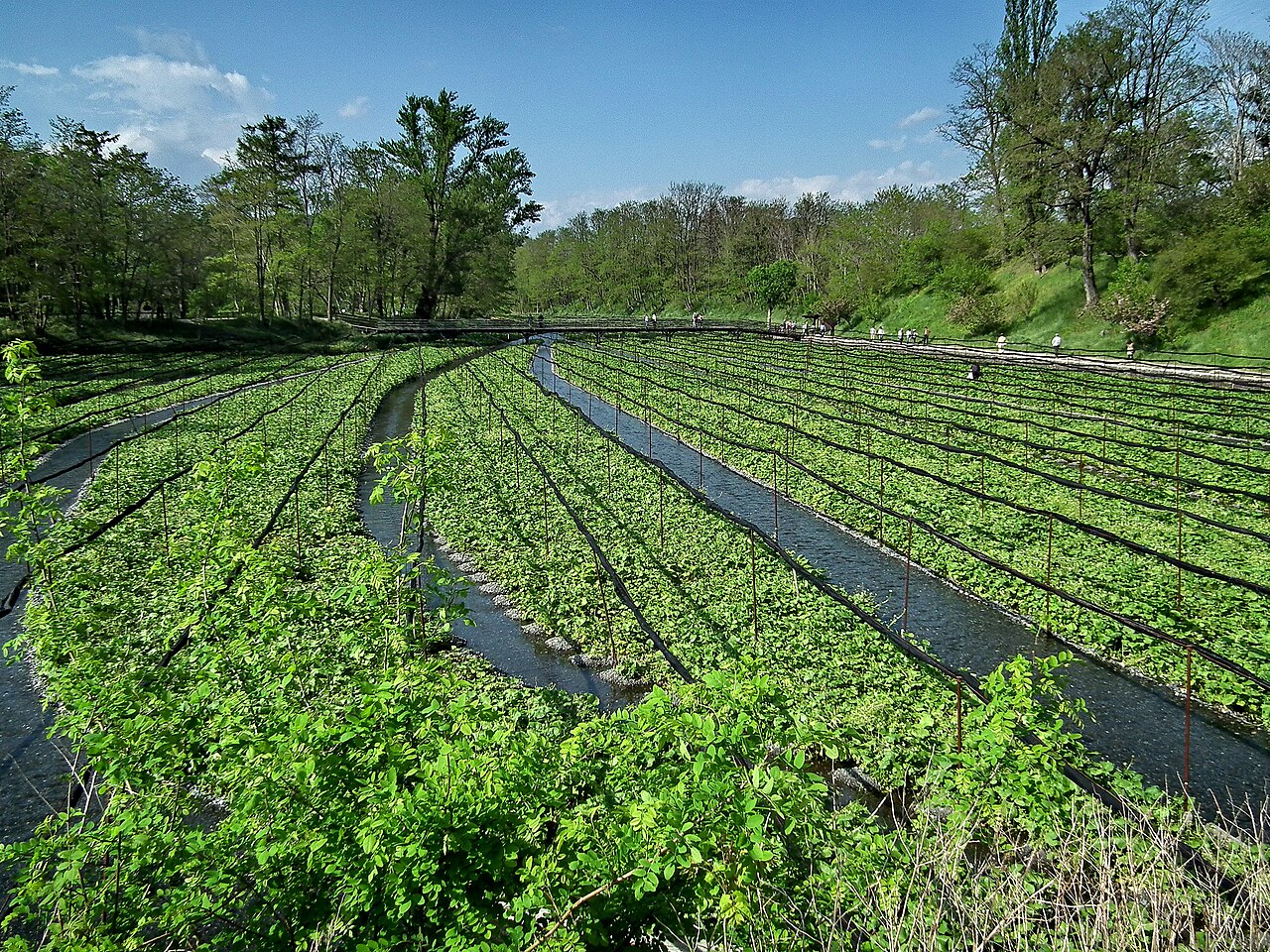
Real wasabi — 山葵 (wasabi), botanical name Wasabia japonica — is a flowering plant of the brassica family (related to mustard greens, broccoli, and horseradish, but distinct from any of them). It grows wild in cold mountain stream beds in mountainous Japan. The edible part is the rhizome, a knobby green stem about the length of an adult finger, slightly larger at one end, covered in small bumps where leaves once attached.
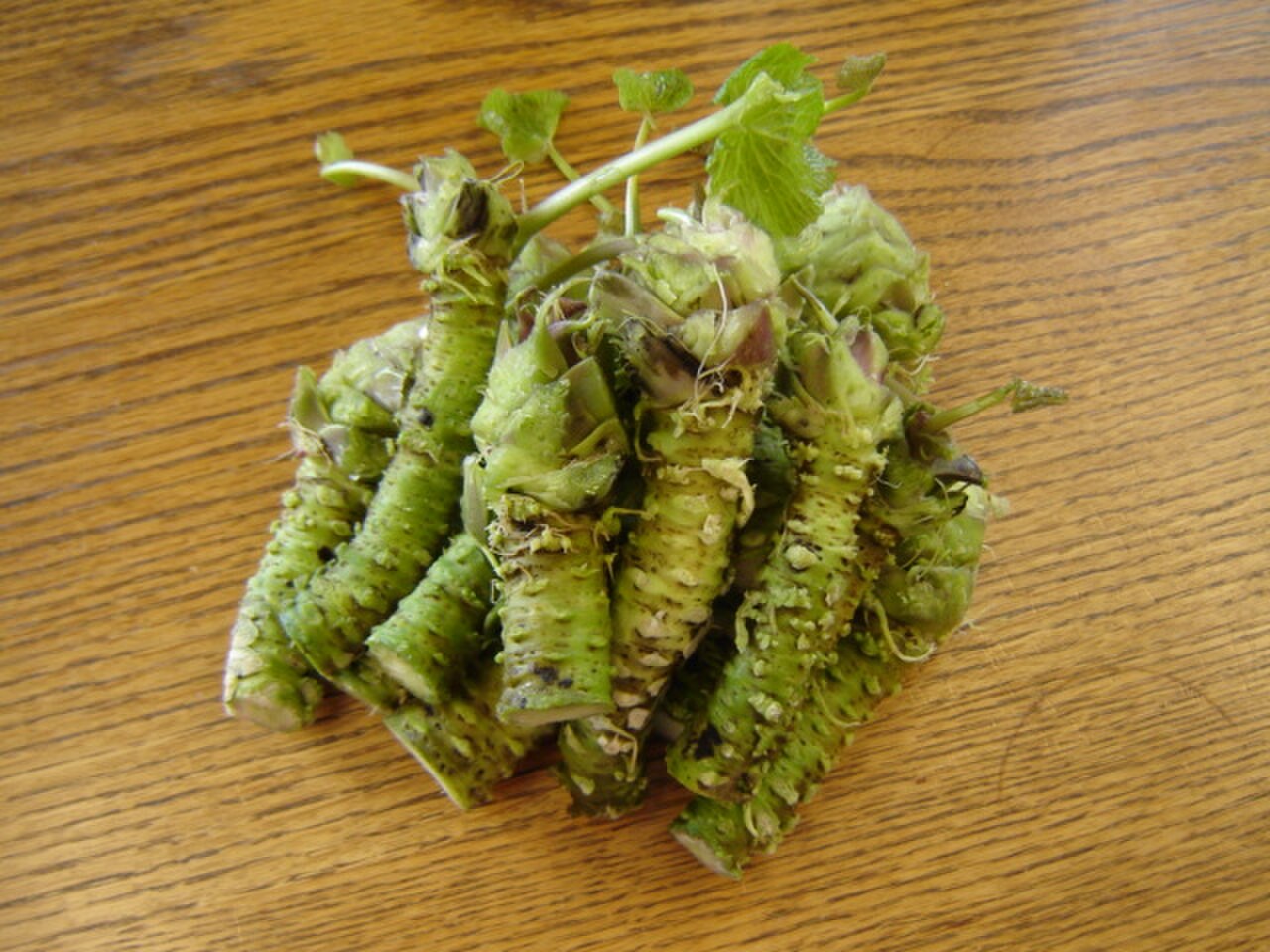

To use it, you take a fresh rhizome and grate it on a fine grater — traditionally a sharkskin grater (samegawa-oroshi), which produces a softer, fluffier paste than a metal grater. The freshly grated wasabi is a pale, slightly mossy green, looser in texture than the supermarket paste, almost foamy. The flavor is strikingly different from horseradish-based imitations:
- Mild, not sharp. Real wasabi has a slow, fragrant heat that rises into the nose for about thirty seconds, then disappears. It does not punch you in the face.
- Slightly sweet. There is a hint of grassy sweetness, almost like very fresh leafy greens.
- Aromatic. A real fresh rhizome has its own distinctive smell, closer to a root vegetable than to a sinus-clearing condiment.
- Brief. The flavor compounds in real wasabi are volatile; once grated, they begin breaking down within about fifteen minutes. That's part of why it's served freshly grated, in small portions, right when you're about to eat.
The green paste in most tubes and packets is 西洋わさび (seiyō-wasabi, "Western wasabi" — i.e., horseradish), often blended with mustard powder, cornstarch as a thickener, and green food coloring (typically chlorophyll or FD&C dyes) to mimic the color. Industry surveys consistently estimate that around 99% of the wasabi served outside Japan and roughly 95% of the wasabi served inside Japan is this horseradish substitute rather than real Wasabia japonica. The horseradish version is its own thing — punchy, cheap, shelf-stable — and many people genuinely prefer its sharper kick. It's not without merit. It just isn't, botanically or culinarily, the same plant.
The reason real wasabi is rare is agricultural. Real Wasabia japonica requires cold, clean, flowing water, a specific temperature range (about 8–18°C year-round), partial shade, and around eighteen months from planting to harvest. The growing conditions exist in only a few places in the world — primarily certain mountain valleys in Japan, with smaller production in parts of Taiwan, Oregon, British Columbia, and New Zealand. Wholesale prices for fresh wasabi rhizome run roughly USD 100–250 per pound, depending on grade and season. A single rhizome at retail can cost ¥2,000–¥6,000. At those numbers, mass-market sushi simply can't use it; the horseradish substitute fills the slot.
Why horseradish became the global stand-in
The substitution happened because of supply, not deception. Real wasabi was always rare, even in Japan. Until the late nineteenth century, it was grown in small mountain villages and consumed locally; the Edo-period sushi tradition that ended up at sushi counters in Tokyo used real wasabi when it was available and worked around it when it wasn't.
The horseradish substitute emerged in the early twentieth century. Horseradish (Armoracia rusticana) had been introduced to Japan from Europe and was cheap to grow. When dried, ground, mixed with mustard powder, and dyed green, it produced a paste that resembled wasabi visually and delivered a similar (sharper, simpler) sinus heat. By the postwar period, this powdered substitute — dissolved in water at the table, eventually pre-packaged into tubes — had become the dominant form of "wasabi" served in everyday Japanese restaurants. It traveled with sushi as sushi went global.
In the 1960s through 1980s, as sushi restaurants opened across the United States and Europe, the supply problem was even worse. Real wasabi could not be grown at scale outside Japan, could not be reliably shipped fresh, and was prohibitively expensive. The horseradish-and-mustard substitute was the practical solution, and it became the global standard. What people came to recognize as "wasabi flavor" — the sharp, clean horseradish punch — was the substitute's flavor, not the real plant's.
The result is a worldwide green-paste market in which the original plant is essentially invisible. Most professional chefs outside Japan have never tasted fresh wasabi. Most people who think they don't like wasabi have actually only tasted horseradish substitute. Many people who do like the substitute might find the real plant disappointing — the heat is gentler and the flavor more vegetal, less aggressive. (Both versions have their fans; neither is wrong.) But the two are not the same plant, the same flavor, or the same price tier.
Where to taste real wasabi
Four ways to taste the real plant, in order of accessibility.
-
A 100% real-wasabi tube from a Japanese supermarket. The easiest entry point. Products labeled 「本わさび100%」 or 「本わさび使用」 — like S&B 「本生 本わさび」 or 金印わさび's pure-wasabi line — are made entirely from grated Wasabia japonica. They cost several times more than ordinary horseradish-based tubes (which are usually labeled simply 「わさび」), but the taste is much closer to fresh-grated. Reading the label carefully is the only way to tell.
-
A serious sushi-ya, anywhere in Japan. A counter sushi place at the higher end of the price spectrum (¥15,000+ per person) will almost always use real, freshly grated wasabi — placed by the chef between the rice and the fish, not on the side. The taste of nigiri made this way — rice, real wasabi, fish — is meaningfully different from grocery sushi. Names like Sukiyabashi Jiro, Sushi Saito, Ginza Kyubey, and many smaller respected counters across Tokyo, Osaka, Kyoto, and regional cities will serve real wasabi by default. (A polite question — honwasabi tsukatte imasu ka? — is fine if you're unsure.)
-
大王わさび農場 (Daio Wasabi Farm), Azumino, Nagano. The largest wasabi farm in Japan, founded 1917, set in the cold mountain spring water of the Northern Alps foothills. Visitors can walk along the wasabi fields, watch the cultivation rows, eat real-wasabi soba (with freshly grated rhizome on the side), buy fresh wasabi rhizome to take home, try wasabi ice cream and wasabi beer. About 2.5 hours by train from Tokyo via Nagano shinkansen + local line. Free entry to most of the grounds; small fees for some tasting experiences.
-
Izu Peninsula, Shizuoka. The other major Japanese wasabi-growing region, particularly the Amagi-Yugashima valleys. Smaller-scale, with traditional terraced wasabi fields (tatamiishi-shiki) — a method that uses layered stones to slow water flow, creating ideal growing beds. Several local restaurants serve fresh-grated wasabi with their soba and grilled river fish.
If you want to bring fresh rhizome home: chilled wasabi rhizomes are sold at major depachika (department-store food halls) and at the farms themselves, packed for travel. Refrigerated, a fresh rhizome lasts about two weeks. Grate only what you need, in small amounts, just before eating — once grated, the flavor begins breaking down within fifteen minutes. The grater itself, a fine sharkskin or ceramic oroshi, is sold at kitchenware shops like Kappabashi in Tokyo.
The horseradish version on your sushi plate is, in many ways, the version most people will go on enjoying — cheap, shelf-stable, sharp, recognizable. It earned its global place. The original plant is a quieter, rarer thing, growing in cold water in the same country that gave it its name, and worth tasting at least once on its own terms.
Frequently asked questions
- Is the green paste at chain sushi or supermarket sushi real wasabi?
- Mostly no. Industry estimates suggest about 99% of "wasabi" served outside Japan and roughly 95% inside Japan — at chain sushi, kaiten-zushi, supermarket trays, and casual restaurants — is dyed horseradish-and-mustard paste. Higher-end counter sushi-ya (around ¥15,000+ per person, in Japan) almost always use real Wasabia japonica.
- What does real wasabi taste like?
- Milder and slower than horseradish-based paste, with a fragrant heat that rises into the nose for about thirty seconds and then disappears. There's a hint of grassy sweetness, and it doesn't punch you in the face.
- Why is real wasabi so expensive?
- It requires cold, clean, flowing water, partial shade, a narrow temperature range (8–18°C year-round), and about eighteen months from planting to harvest. Those conditions exist in only a few places in the world. Wholesale prices run roughly USD 100–250 per pound.
- Can you find real wasabi outside Japan?
- Yes, but it's uncommon. Some farms in Taiwan, Oregon, British Columbia, and New Zealand grow Wasabia japonica commercially, and well-stocked Japanese grocers sometimes carry tubes labeled "本わさび100%". Most everyday "wasabi" abroad is still horseradish-based.
- How can I tell if a tube of wasabi is the real thing?
- Read the Japanese label. "本わさび100%" or "本わさび使用" means real wasabi. Generic "わさび" alone usually means a horseradish-and-mustard substitute. Real-wasabi tubes cost several times more.
- What is wasabi made of?
- Real wasabi is made from the grated rhizome of *Wasabia japonica*, a flowering plant of the brassica family (related to mustard greens, broccoli, and horseradish, but distinct from any of them). The bright green paste sold in most tubes and packets — both inside and outside Japan — is not actual wasabi: it's a mixture of grated horseradish (*Armoracia rusticana*), mustard powder, cornstarch as a thickener, and green food coloring (typically chlorophyll or FD&C dyes). Industry estimates suggest around 99% of wasabi served outside Japan and roughly 95% inside Japan is this horseradish-and-mustard substitute.
Sources
- Wasabia japonica — botanical entry, Royal Horticultural Society plant database
- *Wasabi: A Cultural and Botanical History*, kitchen-industry interviews; Real Wasabi Co. supply data
- 大王わさび農場 (Daio Wasabi Farm), Azumino, Nagano — 1917 founded, public visitor site
- Izu Peninsula wasabi cultivation — Shizuoka Prefecture official tourism record; Amagi-Yugashima production zone
- Industry analysis: 99% of wasabi outside Japan and ~95% inside Japan is horseradish-and-mustard substitute, repeatedly cited by Japanese culinary press and US food journalism
Last reviewed: 2026-05-03
Tools
- Open on Amazon
Sharkskin oroshi grater (GourmetSleuth)
Real sharkskin on a wooden block - the traditional surface for grating fresh wasabi to a fine paste.
- Open on Amazon
Stainless sharkskin oroshi (tsuboe SAMEKICHI)
Japanese-made stainless version; easier to clean than natural sharkskin.
Where to find the real thing
The Wasabi Company
UK
Dorset wasabi farm shipping fresh rhizome; customer reviews on Trustpilot.
Half Moon Bay Wasabi
US
California farm whose rhizomes turn up in Michelin kitchens.
Real Wasabi
US
Lab-tests for pure Wasabia japonica.
Related reads
Decoded
California Roll vs Sushi — what your local sushi place is actually serving you
The California Roll is an American invention from 1960s Los Angeles. The Japanese sushi (寿司) family it borrowed its name from is broader and built around vinegared rice in many forms.
Decoded
Hibachi — the American 'hibachi' restaurant has nothing to do with what 火鉢 means in Japan
An American 'Hibachi' dinner is a flat-grill steakhouse show. A Japanese 火鉢 is a small charcoal brazier in the corner of a room. Same name, completely different things — here's what each one actually is.
Decoded
Sushi — the Japanese dish where the rice is the work, not the fish
Sushi is rice, not fish. The 200-year-old hand-pressed nigiri form is built around *shari* — vinegared rice the chef has been adjusting for hours.
Decoded
Bonsai — the small potted tree at the garden center is not what's meant by 盆栽
The 'bonsai' at the garden center is its own thing — a small potted tree as houseplant. 盆栽 in Japan is a sculptural practice measured in decades. Both exist; they're not the same craft.
Spotted something off?
Reveal Japan aims for accuracy. If you found a factual error or unclear passage, tell us via Contact. We update articles when readers correct us, and we credit the corrector by request.