Tsuyu — Japan's rainy season isn't bad weather to wait out, it's the month the country spends watching one flower change color
Japan's rainy season isn't a month to skip — it's the one season with its own flower, its own words for rain, and a little doll hung in the window to beg for sun.
Mid-June, on the stone steps up to Meigetsu-in in Kamakura. It has been raining since morning — not hard, just steady, the kind that doesn't ask you to hurry. The steps are walled on both sides with hydrangeas, and in the wet light they've gone a deep, almost unreal blue. A woman ahead of you tips her clear plastic umbrella back to photograph them. A snail is crossing one of the lower steps, in no rush either. A gutter is running somewhere out of sight. The air smells of wet earth and green leaves. This is 梅雨 (tsuyu) — Japan's rainy season — and for about six weeks a year, this damp, blue, slow-moving mood is simply what the country is.
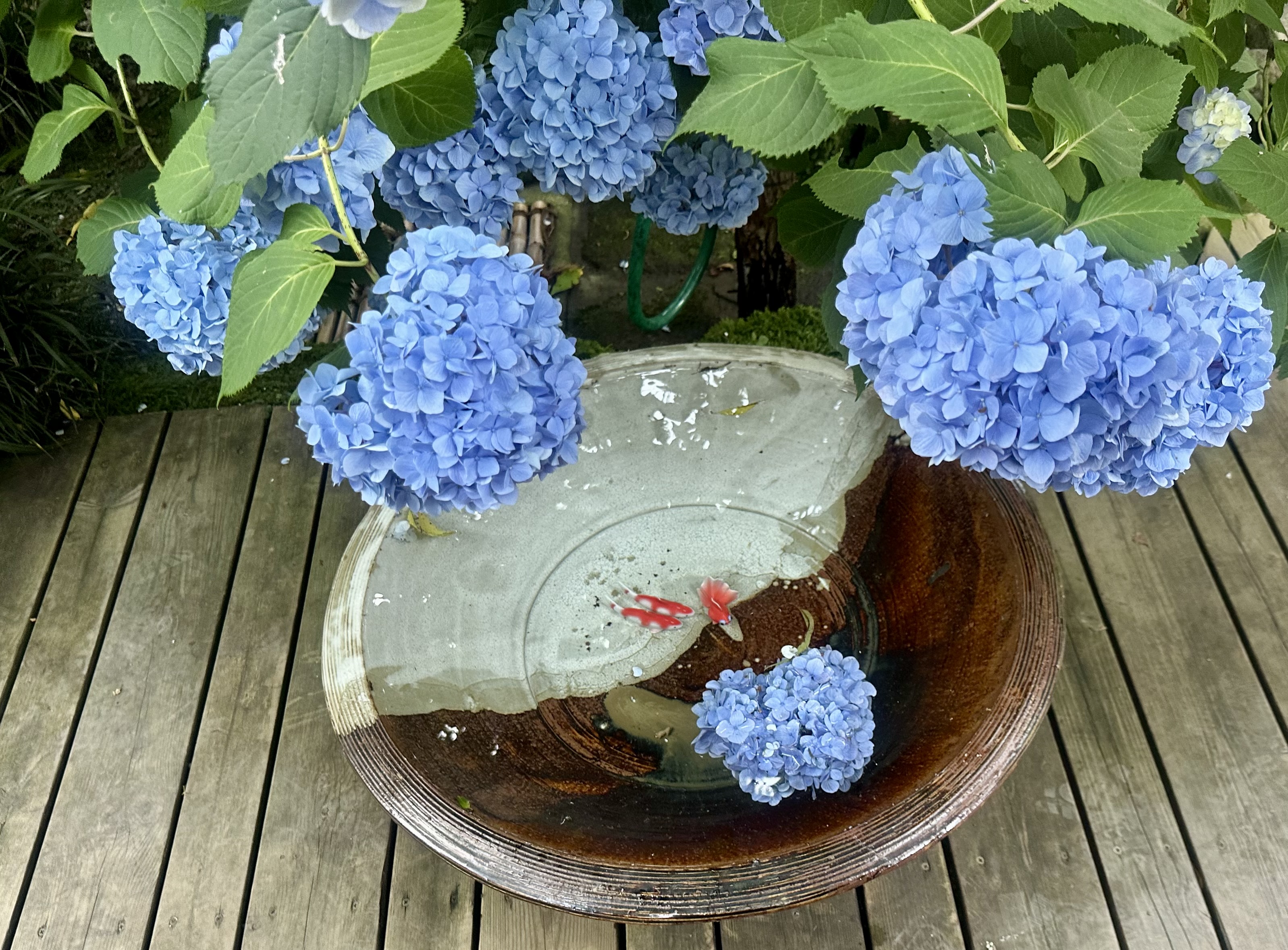
Most visitors treat tsuyu as the bad-weather month to schedule around. People who live here don't quite see it that way. It's the one season with its own flower, its own shelf of vocabulary, and its own small household rituals — a stretch of the year the country spends, more than anything, watching a single flower change color in the rain.
The rain that's named after a plum
Tsuyu isn't a vague "it rains more now." It's a specific machine: a stationary front where warm Pacific air leans against cooler northern air and parks itself over the archipelago — and over much of East Asia; China calls the same front méiyǔ, Korea jangma — from early June to mid-July. Western Europe and most of North America have no equivalent. Rain there is scattered across the whole year, never gathered into one humid season solid enough to earn a name.
And the name is odd even to Japanese people. 梅雨 is written with the characters for plum and rain — "plum rain" — because the season lands exactly when the ume plum swells and ripens on the branch. (A rival theory says it began as 黴雨, "mold rain," for the mildew the humidity breeds, and that the prettier "plum" character was swapped in later. Both are still taught.)
Because the rain stays long enough to be worth noticing, the language piled up words for it. Samidare, the old name for the long early-summer rain. Niwaka-ame, the shower that arrives out of nowhere. Yūdachi, the evening downpour that ends as abruptly as it starts. Rain you can name is rain you've spent real time with.
The flower that left Japan and came back a stranger
The hydrangea — 紫陽花 (ajisai) — is native to Japan, an ordinary roadside shrub here for most of its life. Its trip abroad is the surprising part: in the 1820s the German physician Philipp von Siebold carried specimens home from Nagasaki, and the name he is said to have given one — Hydrangea otaksa — is told to honor Otaki-san, the Japanese woman he lived with there. European nurseries fell hard for it, bred it into the big mophead forms now sold worldwide, and those came back. A good share of the showiest hydrangeas in a Japanese garden today are returnees — a flower that went to Europe, got reworked, and came home.
The blue itself is the soil talking. Ajisai is nicknamed 七変化 (shichihenge), "seven transformations," because the blooms shift with the ground they're in — and Japan's volcanic earth runs acidic, which turns them that deep blue rather than pink. It made certain temples into destinations for exactly these weeks: Meigetsu-in in Kamakura, so solidly blue in late June the shade has its own local name; Mimuroto-ji near Uji, tens of thousands of bushes. People go because it's raining — the flower is best wet, and the crush you'd fight on a sunny cherry-blossom day thins out under the drizzle.
The little ghost in the window asking for sun
In a window along the same street you might catch a small white figure swinging on a thread — a balled-up head of cloth or tissue, a hanging body, sometimes a face inked on. That's a てるてる坊主 (teru-teru-bōzu), literally "shine-shine monk." Children hang one under the eaves the night before something they need clear skies for — a school trip, a sports day, a festival — as a small charm to call off the rain.
It looks gentle. The nursery rhyme sung to it is not. The well-known third verse warns the doll that if it fails — if the sky clouds over and weeps anyway — I'll snip your head clean off. The custom is thought to descend from a Chinese figure, a paper girl with a broom sent up to sweep the rain clouds away, softened over the centuries into this round little monk. A charm against the very season everyone else is out admiring: the household quietly betting on sun while the temples fill with people who came for the rain.
Go for the blue, not against the rain
Next time you're eyeing a June trip to Japan and the forecast reads rain, rain, rain — that isn't a month to skip, it's a different month to plan for. Carry a clear umbrella like everyone else, and aim yourself at a hydrangea temple in the third or fourth week of June, when the blue is deepest and the steps are wet. Listen for which rain word people reach for. Check whether the blooms near you are blue or pink, and you'll know what the soil beneath them is doing. And if you pass a small white doll hanging in a window, you'll know that somewhere inside that house, someone is hoping for the exact opposite of what you came to see.
Related reads
culture
Shōgatsu — the Japanese New Year, when the entire country quietly resets in three days
The Japanese New Year isn't a party — it's three days of national stillness, family, and a specific lacquered box of food. Here's what happens.
culture
Hanami — the Japanese national ritual of sitting under temporarily-blooming trees, on purpose, with friends
Japan plans its early-April calendar around a flower that blooms for one week. The whole country gathers under it on purpose.
lifestyle
Gogatsubyō — Japan's 'May sickness' isn't laziness, it's a structural crash everyone schedules into their year
Around mid-May, Japanese people quietly tell each other they've got 'May sickness.' It's not weather. It's what happens when the country boots a new year in April and then takes a 10-day holiday a month later.
food
Sake — how to read the label, and what *daiginjo* actually means on a Japanese bottle
On a sake bottle, the smaller the number, the more rice was destroyed to make it. That's the premium signal.
lifestyle
Kotatsu — the Japanese low table with a heater under it that quietly redesigned the entire winter
A low table, a heater, a heavy blanket. The Japanese winter device that keeps the family warm — and gathered — in one square meter.
Tags
Sources
- 大辞林 第四版 (Daijirin, 4th ed.)
Last reviewed: 2026-06-03
Spotted something off?
Reveal Japan aims for accuracy. If you found a factual error or unclear passage, tell us via Contact. We update articles when readers correct us, and we credit the corrector by request.
Affiliate disclosure: Some links on this page are affiliate links marked rel="sponsored nofollow". If you click and make a purchase, Reveal Japan may earn a commission at no extra cost to you. This does not influence which sources or explanations we choose to feature.