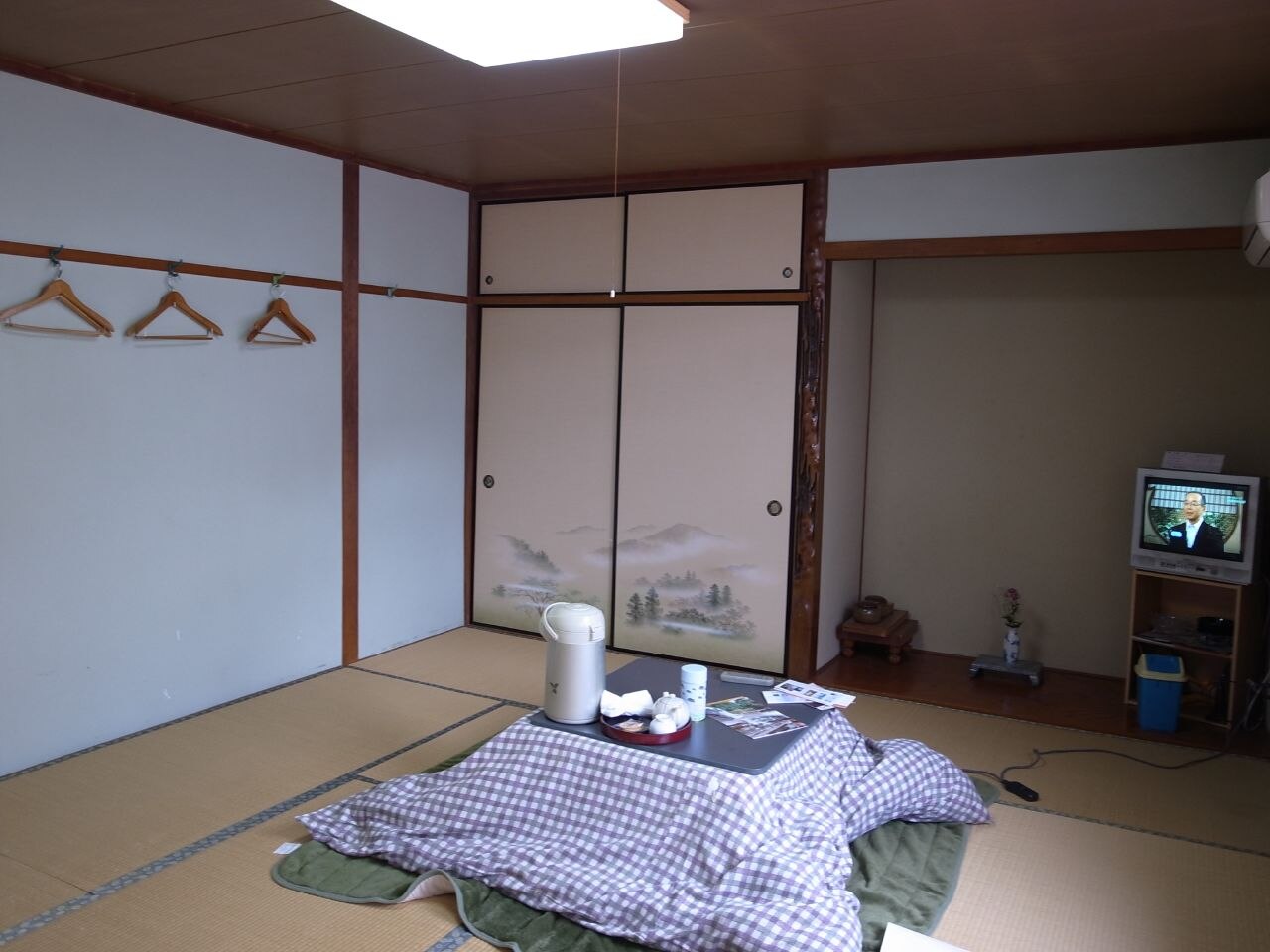
Kotatsu — the Japanese low table with a heater under it that quietly redesigned the entire winter
A low table, a heater, a heavy blanket. The Japanese winter device that keeps the family warm — and gathered — in one square meter.
It's 8 PM in mid-January in a small Japanese house. The room itself is cold — five, maybe six degrees. A low wooden table sits in the middle of the washitsu with a heavy quilted blanket draped over its sides, hanging down to the tatami. A father, a mother, two kids, and a quietly content cat are all sitting on cushions on the floor, with their legs tucked under the blanket and the table on top. Nothing else in the room is heated. Nothing needs to be. Inside the blanket, it's about thirty-five degrees Celsius, warm enough that the eight-year-old has fallen asleep with his cheek on the table edge, and the cat hasn't moved in two hours. A small bowl of mikan oranges sits on the tabletop. A soft variety show plays on the television. Nobody plans to leave the table for the next three hours, even though the bathroom is, technically, only five meters away. That's a こたつ (kotatsu). And calling it a heated table is a description that misses the social half of what it does.
A kotatsu has two parts: the table itself, with an electric heating element bolted to the underside; and a thick kotatsu-buton — a quilted blanket — draped between the tabletop and the frame to trap the warm air inside. You sit on the floor, you push your legs underneath, you stay there. And the entire Japanese family stays there with you.
What is a kotatsu? — the Japanese low table with a heater
The kotatsu grew out of an era when most Japanese homes were traditional wooden houses with sliding paper doors and minimal insulation — the bathroom was cold, the hallway was cold, the bedroom was cold. The heating idea wasn't to warm the building. It was to warm the people, in the place they actually were. Modern Japanese homes have proper heating now, but the kotatsu stuck around because the experience itself — the family gathered around one warm table — is what people kept.
A few details:
- The blanket traps the warm air completely. The legs of everyone at the table are essentially in their own personal warm room. The torso and head stay in the cooler air of the room — which is part of the experience, because it makes the warmth at the legs feel intense.
- A small bowl of mikan oranges (kotatsu-mikan) sits on the table. This pairing is so codified in Japanese winter that the phrase itself — "kotatsu and mikan" — is shorthand for the entire season.
- People stay there for hours. Conversations happen. Television gets watched. Homework gets done. Naps get taken. It is medically and culturally documented that you should not actually sleep in a kotatsu — your body overheats — but every Japanese person has done it anyway.
- The cat finds it within ten minutes of being installed. The cat does not leave it until April.
In summer, the blanket comes off and the kotatsu becomes a normal low table. The heater stays underneath, dormant, until the next cold morning.
Why a family stays in one warm square
A kotatsu doesn't really compete with modern heating; it does a different job. The kotatsu warms only the place the family is currently sitting, and so the family stays in one place, together, for the entire evening. That's not an accident. The kotatsu is, mechanically, a piece of furniture that pushes a Japanese family into a single shared space for the duration of the cold months.
If you watch a country whose winter domestic life is built around a kotatsu, you start to notice the side effects: meals get eaten at the kotatsu, homework gets done at the kotatsu, conversations between parents and teenage kids that wouldn't otherwise happen happen at the kotatsu — because the kid is reluctant to leave the warm pocket, and so is the parent. The heater under the table is doing two jobs: warming the legs, and quietly preventing the family from scattering into separate rooms.
Try one for an evening
Next time you're in Japan in winter, stay at a ryokan or a small Airbnb that has a kotatsu, and use it for at least one evening. Push your legs in. Pull the blanket up to your waist. Eat a mikan or two. Watch some television, even if you don't understand it. Stay there for three hours and notice that you didn't want to get up. If you live somewhere cold and you've been heating your whole apartment to keep one room warm, a kotatsu will quietly change how you spend your winter evenings.
Buying a kotatsu outside Japan
Two routes work for setting one up in your home:
- Best for most people — Japanese kotatsu table set (table + heater + futon) ($300–$500). A complete kit — low wooden table with the heater pre-mounted, plus the heavy quilted kotatsu-buton blanket. Plug it in, drape the blanket, you're done.
- Cheaper, if you already have a low table — kotatsu heater unit only ($80–$150). The under-table electric element on its own. Bolt it to your existing low coffee table, drape any thick quilt over the sides, add a tabletop on top. Less elegant; same warm pocket.
- The blanket alone — kotatsu futon blanket ($60–$120). If you find a kotatsu without a blanket, or want to replace a worn one.
The 80–100 watt heating element pulls less power than a hair dryer, so an ordinary 120V outlet handles it without complaint. Don't actually sleep under one overnight.
For more small Japanese everyday objects and language, see washlet, arigatou gozaimasu, and the wasabi most people eat outside Japan.
Reveal Japan is a participant in the Amazon Services LLC Associates Program. Links above may earn us a small commission at no extra cost to you.Frequently asked questions
- What is a kotatsu?
- A kotatsu is a low Japanese table with an electric heater bolted to the underside and a thick quilted blanket draped over the sides — used in winter, with people sitting on the floor with their legs tucked under the blanket. The legs stay warm in a ~35°C pocket while the rest of the room stays cool.
- How does a kotatsu work?
- An electric heating element (80–100 watts) under the tabletop warms the air inside the blanket-enclosed space. The blanket traps the warm air, and people's legs and lower body stay in a warm pocket while the surrounding room stays at room temperature.
- Can you sleep in a kotatsu?
- Medically not recommended — the body overheats and dehydrates — but nearly every Japanese person has fallen asleep at a kotatsu at some point. The standard advice is to nap briefly but not sleep through the night.
- How much does a kotatsu cost?
- Standard kotatsu sets (table + heater + blanket) cost roughly ¥15,000–¥40,000 (USD 100–300) in Japan. International shipping options run USD 200–400.
Related reads
lifestyle
Washlet — the Japanese warm-water bidet that quietly became standard
Washlet is the warm-water bidet that washes you after — TOTO's invention, now near-universal on Japanese toilets.
language
Arigato Gozaimasu Meaning — the Japanese 'thank you' that literally means 'rare to exist'
Arigato literally means 'rare to exist.' Japan's standard 'thank you' is rooted in 'what you've done for me is rare and precious' — here's how the etymology shapes daily use.
lifestyle
Japanese vending machines — four million quiet little statements about how safe the streets are
Vending machines on every corner, full of cash, working all night long. The reason that works is the part most foreigners miss.
lifestyle
Japanese trains — the rail system that runs to the second, in a country where on-time isn't a goal but a baseline
Japanese trains run to the second. The interesting part is what an entire society does on top of that assumption.
lifestyle
Japanese convenience stores — the civic infrastructure that just happens to sell sandwiches
Japan's convenience stores aren't really convenience stores — they're the country's everyday public infrastructure, awake at 3 AM, three minutes from anywhere.
Tags
Last reviewed: 2026-04-27
Tools
- Open on Amazon
Japanese kotatsu set - table, heater, comforter and rug
A complete kotatsu in one box: the low table, the under-table heater, the quilt that traps the warm air, and a mat to sit on.
- Open on Amazon
Kotatsu set with washable futon (80 cm square)
A square set with a washable kotatsu futon - a smaller-footprint option for an apartment or a two-person table.
Spotted something off?
Reveal Japan aims for accuracy. If you found a factual error or unclear passage, tell us via Contact. We update articles when readers correct us, and we credit the corrector by request.
Affiliate disclosure: Some links on this page are affiliate links marked rel="sponsored nofollow". If you click and make a purchase, Reveal Japan may earn a commission at no extra cost to you. This does not influence which sources or explanations we choose to feature.