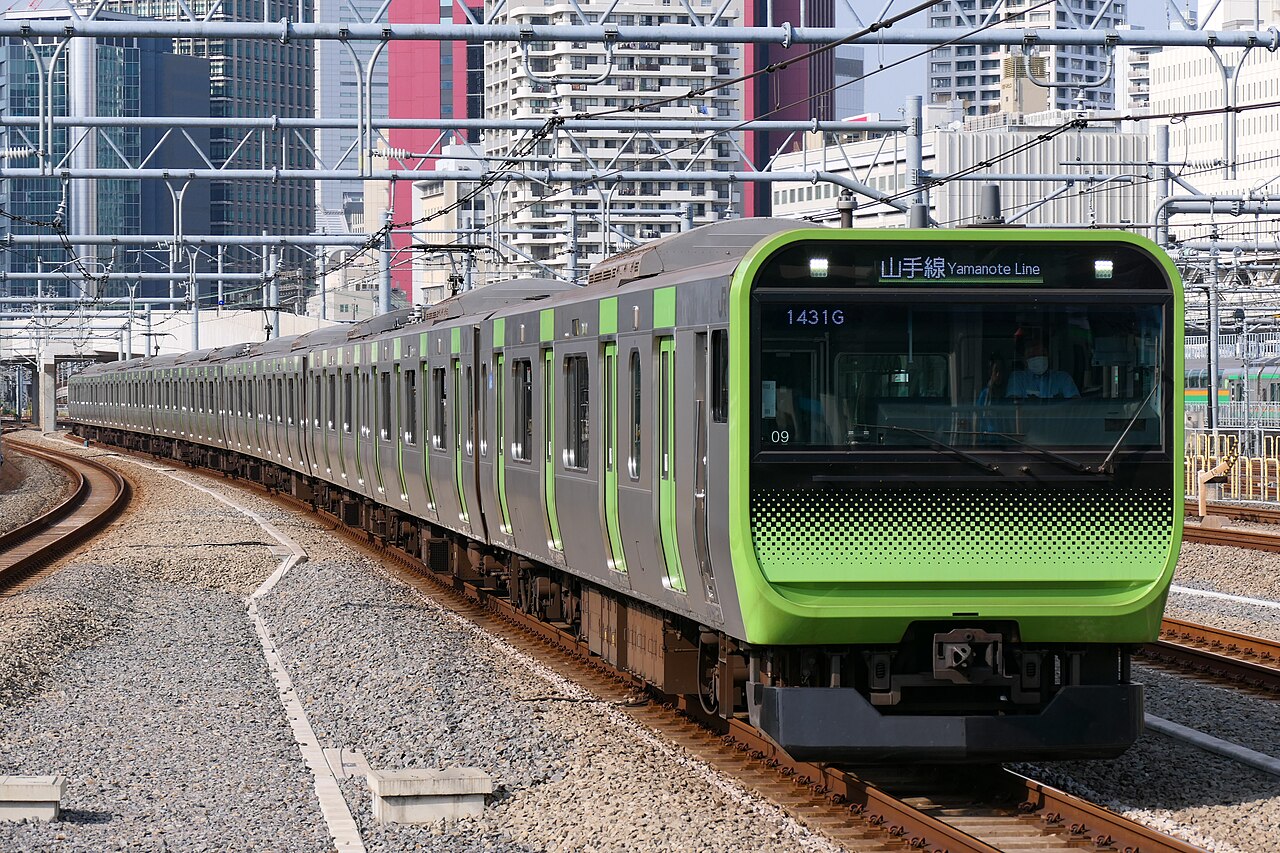
Japanese trains — the rail system that runs to the second, in a country where on-time isn't a goal but a baseline
Japanese trains run to the second. The interesting part is what an entire society does on top of that assumption.
It's 8:21 in the morning on a Tokyo platform. The Yamanote Line train is due to arrive at 8:22:00. Two yellow lines are painted on the platform exactly where the train doors will open. People stand silently behind those lines in two neat columns, leaving the middle clear for passengers to disembark. At 8:22:00, the train slides in, doors align with the painted lines within fifteen centimeters, doors open, the people inside step out down the middle, the people outside step in along the columns, doors close, the train leaves at 8:22:25 — and the next one is already due in three minutes. Nobody pushed. Nobody yelled. Nobody is late. The next train will do exactly the same thing. So will the train after that, every three minutes, all day, until the line closes around 1 AM. That's a Japanese commuter train. And the silent thing happening on the platform — that calm choreography — is half of what makes the country tick.
Japan runs trains to a different unit of measurement entirely.
How Japanese trains run
The headline number, the one that gets quoted everywhere: the average annual delay on the Tokaido Shinkansen — Tokyo to Osaka, hundreds of trains a day, fifteen years running — is well under a minute per train, often quoted at around 24 seconds. Commuter lines aren't quite that perfect, but the order of magnitude is the same: trains run to the second, and a delay of three minutes is announced over the loudspeaker as an apology. This is not a marketing claim — it's a baseline expectation that the entire country plans its mornings on.
What happens because of that baseline is the interesting part:
- Platforms are choreographed, not free-for-all. Every doorway has painted lines on the floor showing where the doors will open and where to queue. People queue in two columns, leaving the middle clear for passengers to exit. The columns dissolve, then reform for the next train.
- The cars are nearly silent. Phone calls are not done on board. People text, read, sleep, scroll. A baby crying briefly is the loudest thing you'll hear in twenty minutes.
- Disembark first, board second. This is the rule that catches most foreigners. The middle of each doorway stays clear until the people getting off are off. Only then do the columns flow in.
- Stations are staffed deeply. There's a station attendant at the platform, a station attendant in the booth, a station attendant by the gates. They're calm, they bow, they help foreign tourists with luggage. If you drop a coin onto the rails, an attendant will come down with a pickup tool to retrieve it for you.
- Delays produce slips of paper. If a train is even a few minutes late and you've used it to commute, you can request a chien shōmeisho — a delay certificate — at the gate, to show your boss why you arrived at 9:08 instead of 9:00. The gate attendant prints it without comment. It's an entire cultural institution built around the assumption that a delay needs explaining.
- The first train of the morning matters. The cleaning crew has already gone through the cars overnight. The seats feel just-cleaned.
It's not that any one of these things is dramatic. It's that all of them happen simultaneously, every weekday, on every line, in every city, and on the bullet train that crosses the country at 280 km/h.
Why trains shape Japan's daily rhythm
A society where the trains run to the second isn't really about the trains. It's about what becomes possible when you can build a whole country's morning around a piece of infrastructure you can fully trust. A Tokyo office worker leaves home at 7:51 because she knows the train at 8:02 will be at her platform at 8:02:00, and she'll be at her desk at 8:54. She doesn't pad her morning by thirty minutes "in case". The trains never need her to.
This compounds outward into the rest of the country's logistics: parcels arrive in the four-hour window the slip says, restaurants book reservations for 7:00 sharp because everyone arrives at 7:00 sharp, takkyubin delivers a chilled bento across the country to land at lunch the next day. Punctual trains aren't the goal. They're the foundation.
Ride one in rush hour
Next time you're in Japan, ride the Yamanote Line during the morning rush, just to watch. Stand on the platform fifteen minutes early, observe the painted lines, watch the queue form. Get on a train, ride three stops, get off, watch the disembark-then-board choreography from outside. Try the Shinkansen between Tokyo and Kyoto and notice that the seat back of the seat in front of you is reclined to within a millimeter of the same angle as everyone else's. If your train is ever delayed, ask the attendant for a chien shōmeisho just to receive one. And the next time you're somewhere in the world where the train comes when it comes, you'll notice the absence — and you'll know what an entire society is silently freed to do when its trains run to the second.
Related reads
lifestyle
Washlet — the Japanese warm-water bidet that quietly became standard
Washlet is the warm-water bidet that washes you after — TOTO's invention, now near-universal on Japanese toilets.
lifestyle
Japanese vending machines — four million quiet little statements about how safe the streets are
Vending machines on every corner, full of cash, working all night long. The reason that works is the part most foreigners miss.
lifestyle
Japanese convenience stores — the civic infrastructure that just happens to sell sandwiches
Japan's convenience stores aren't really convenience stores — they're the country's everyday public infrastructure, awake at 3 AM, three minutes from anywhere.
lifestyle
Kotatsu — the Japanese low table with a heater under it that quietly redesigned the entire winter
A low table, a heater, a heavy blanket. The Japanese winter device that keeps the family warm — and gathered — in one square meter.
lifestyle
Ramen — the Chinese noodle that became Japan's bowl after 1945
Ramen was Chinese until 1945. The postwar reinvention turned a Chinese noodle dish into Japan's regional bowl — and the world's most exported one.
Tags
Last reviewed: 2026-04-27
Spotted something off?
Reveal Japan aims for accuracy. If you found a factual error or unclear passage, tell us via Contact. We update articles when readers correct us, and we credit the corrector by request.
Affiliate disclosure: Some links on this page are affiliate links marked rel="sponsored nofollow". If you click and make a purchase, Reveal Japan may earn a commission at no extra cost to you. This does not influence which sources or explanations we choose to feature.