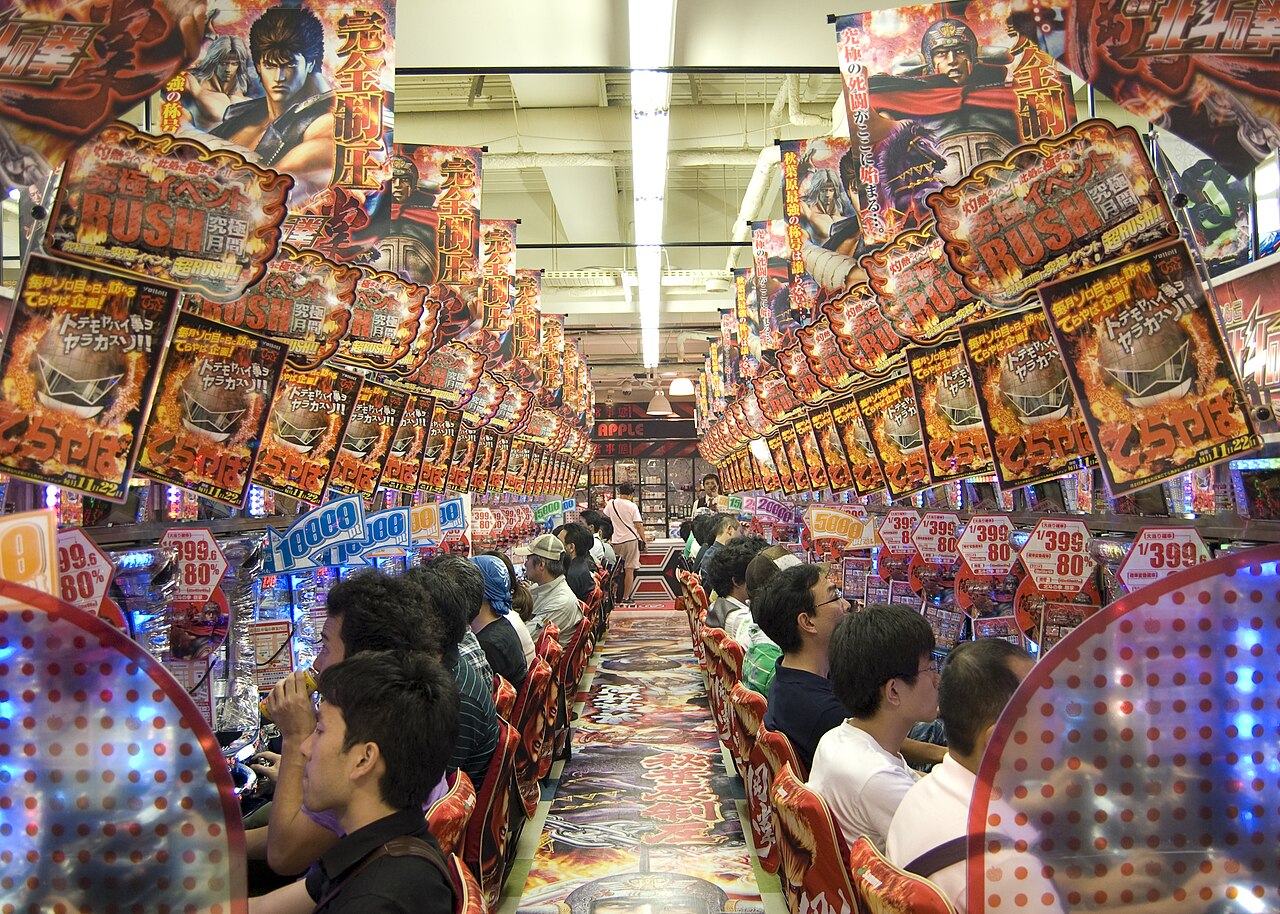
Pachinko — the Japanese vertical pinball-slot-machine that fills enormous parlors with deafening sound and small steel balls
Japan's vertical pinball-slot machine — played in vast deafening parlors with cascading steel balls, in a legal gray zone.
You walk past a large brightly-lit building near a Japanese train station. Above the entrance: a giant illuminated sign in flashing neon, often featuring an anime character or a brand mascot, with the words パチンコ in enormous letters. As the automatic doors slide open, a wall of sound hits you — a continuous overwhelming roar of cascading metal, electronic music, looping anime voices, alarm-style winning chimes, and the steady mechanical clatter of thousands of small steel balls bouncing through pin boards. The interior is bright with cigarette smoke (in older parlors) or scrubbed-clean LED light (in newer ones). Hundreds of identical machines stretch in long rows across the room. Most have a person sitting in front of them, holding a small handle, watching small steel balls cascade down a vertical board, occasionally winning a payout of more balls. That's a Japanese パチンコ (pachinko) parlor — the Japanese version of a slot machine, played at industrial scale across thousands of parlors nationwide, generating tens of billions of dollars in revenue annually, and existing in a uniquely Japanese legal arrangement around the country's gambling laws.
In Japan, casino-style gambling is technically illegal (with limited exceptions), but pachinko has been operating legally in plain sight for decades through a clever legal workaround. The result is one of the largest entertainment industries in Japan, hidden in plain sight from most foreign visitors.
Inside a pachinko parlor
Pachinko has a defined structure:
- The machine. A vertical board, about waist-to-chin height when seated, covered with hundreds of small metal pins arranged in geometric patterns. The player buys small steel balls (about 11 mm in diameter) and feeds them into the machine.
- The play. The player operates a single small lever at the bottom right that controls how forcefully the machine launches balls upward. The balls then cascade down the board through the pins, bouncing semi-randomly. The goal is to land balls in small "win" cups on the board — landing in a win cup triggers an electronic mini-game (usually a video slot animation on a built-in screen) that may award the player additional balls.
- The volume of balls. A successful session can produce hundreds of thousands of small steel balls, collected in plastic boxes by the player. The balls are noisy — the constant cascade of thousands of balls across hundreds of machines is the parlor's defining sound.
- The legal workaround. Direct cash payouts for pachinko balls are illegal under Japanese gambling law. Instead, players exchange their winning balls inside the parlor for special prizes (small stuffed animals, chocolates, or — most commonly — small token "prizes" containing nothing of intrinsic value). Players then take these tokens to a separate small "exchange shop" usually located around the corner from the parlor, where the tokens are exchanged for cash. The exchange shop is legally a separate business from the pachinko parlor — and this thin separation is what makes the entire industry legally operate. The arrangement is well-known to authorities and tolerated.
- The scale. Pachinko has historically been one of Japan's larger consumer entertainment categories, peaking in the 1990s and early 2000s. The industry has shrunk significantly since then — declining year over year due to demographic aging, regulation tightening, and competition from mobile games. Specific figures vary by source; what's clear is the trajectory and that pachinko is no longer the cultural fixture it was a generation ago.
Why this exists in the form it does
Pachinko's strange shape — vertical pinball machine, mass parlors, legal gray zone — comes from a specific Japanese history. Pachinko's roots go back to early-20th-century mechanical games derived from imported Western bagatelle, taking on its modern adult-entertainment form in the post-war years, and growing rapidly through the 1960s–1990s as a salaryman after-work pastime. The legal workaround for cash payouts developed during this growth period to allow gambling-style play under Japanese law that prohibited gambling.
The cultural fit was specific to a certain demographic moment: post-war Japanese salarymen needed a low-stakes, accessible-on-the-way-home, individually-paced entertainment that didn't require social commitment, didn't require alcohol, and didn't require reservations. Pachinko fit this slot exactly — open from morning to late night, individually played, infinitely scalable in time investment, present in every neighborhood, near every train station.
The pachinko industry has historically had strong ties to ethnic Korean communities in Japan — many of the largest pachinko chains were founded by Korean-Japanese entrepreneurs in the post-war years. This is one of the more documented sociological aspects of the industry.
The cultural reading of pachinko
Pachinko occupies a specific space in modern Japanese cultural perception. It is widely associated with declining demographics and old-school salaryman culture, and is increasingly perceived by younger Japanese as a habit of an aging generation. Pachinko addiction is also a real social problem in Japan, with addiction support groups and government regulation around the industry.
Foreign visitors usually find pachinko parlors fascinating from the doorway and overwhelming from inside — the sensory volume is hard to describe without experiencing it. Pachinko is also one of the unmistakable visual textures of Japan: bright neon signs near train stations, large parlors with elaborate facades, the constant sound of bouncing balls audible from outside.
Where pachinko fits in Japanese leisure
Pachinko sits in a small group of adult-oriented Japanese leisure activities accessible without reservation or social commitment: pachinko (vertical pinball gambling), karaoke (singing rooms, see karaoke), late-night izakaya, internet cafes (manga-kissa, see manga-kissa), and capsule hotels. All can be entered alone, used at any time, and serve as small individual escapes from daily life.
Pachinko is the gambling-flavored, sensory-overwhelming, demographically-aging member of this cluster. It's also the one most likely to disappear or radically transform in the next two decades, as Japan's demographics and entertainment patterns continue to shift.
Step inside one once
If you're curious, stand outside a pachinko parlor for a moment when the doors slide open — the wall of sound that hits you is the experience itself. Most parlors expect customers to sit and play, so casually wandering in to watch isn't really the move; the inside-the-parlor experience comes with a seat and a session.
Pachinko's bright neon facades near train stations are one of the more honest visual textures of modern Japan — the salaryman silhouettes inside, the pavement outside reflecting the sign. Even without going in, walk past one at night and you've encountered something the tourism industry doesn't usually package.
Related reads
lifestyle
Ramen — the Chinese noodle that became Japan's bowl after 1945
Ramen was Chinese until 1945. The postwar reinvention turned a Chinese noodle dish into Japan's regional bowl — and the world's most exported one.
lifestyle
Matcha — what the latte misses, and what Japan actually drinks
A matcha latte contains ~1g of matcha and ~50g of sugar. The Japanese drink it whisked, 2g + 70ml hot water, in 90 seconds of silence. Different drink, same name.
lifestyle
Gogatsubyō — Japan's 'May sickness' isn't laziness, it's a structural crash everyone schedules into their year
Around mid-May, Japanese people quietly tell each other they've got 'May sickness.' It's not weather. It's what happens when the country boots a new year in April and then takes a 10-day holiday a month later.
lifestyle
Washlet — the Japanese warm-water bidet that quietly became standard
Washlet is the warm-water bidet that washes you after — TOTO's invention, now near-universal on Japanese toilets.
lifestyle
Japanese vending machines — four million quiet little statements about how safe the streets are
Vending machines on every corner, full of cash, working all night long. The reason that works is the part most foreigners miss.
Tags
Sources
- 大辞林 第四版
Last reviewed: 2026-04-27
Spotted something off?
Reveal Japan aims for accuracy. If you found a factual error or unclear passage, tell us via Contact. We update articles when readers correct us, and we credit the corrector by request.
Affiliate disclosure: Some links on this page are affiliate links marked rel="sponsored nofollow". If you click and make a purchase, Reveal Japan may earn a commission at no extra cost to you. This does not influence which sources or explanations we choose to feature.