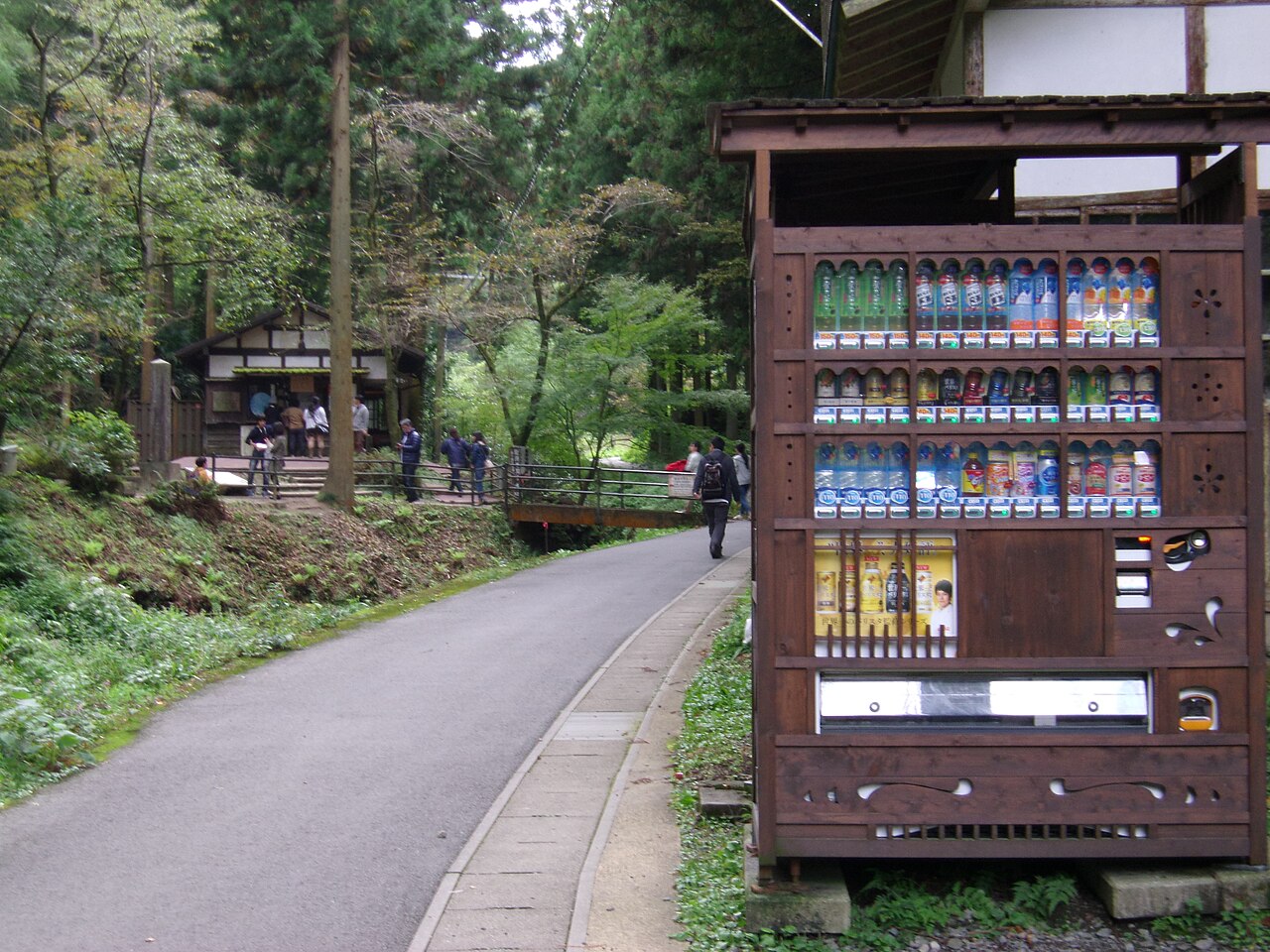
Japanese vending machines — four million quiet little statements about how safe the streets are
Vending machines on every corner, full of cash, working all night long. The reason that works is the part most foreigners miss.
You step out of a Japanese train station on a cold January morning, walk twenty meters toward the office, and pass three of them already: glass-fronted vending machines lit from the inside, lined up against the wall like small standing refrigerators. You stop at the second one, fish a 100-yen coin out of your pocket, press the button under a small can with the word HOT in red, and a moment later there's a warm aluminum can in your hand. The can is hotter than your skin — about 55 degrees Celsius. You hold it tightly all the way to the office, switching hands when one finger gets too warm. By the time you sit at your desk, your fingers haven't gone numb once.
That little machine, that warm can, and the obvious fact of an unattended box of cash standing on a public sidewalk all night — those three things together quietly explain something about Japan that's hard to see in any other country.
What sits inside one of these
There are millions of them across Japan — the highest density on the planet, by a wide margin. They sit everywhere a person might walk, then several places past where a person would normally walk: outside every train station, three to a corner; in the lobby of every office building; in the entryway of many elementary schools; at the trailhead of mountain hikes; at the top of mountain hikes; outside remote temple gates with no other building in sight; in the corridor of nearly every onsen ryokan; in the parking lot of every convenience store; under the overpasses of every Tokyo neighborhood.
What they sell, depending on the season and the corner:
- Cold drinks year-round — green tea, oolong, barley tea, water, soda, juice, energy drinks, fresh canned milk.
- Hot drinks from roughly October through April — canned coffee in five styles, hot lemon, hot ginger, milk tea, zenzai (sweet red bean broth). On the same canned-drink machines, a "HOT" label marks the warmed cans.
- In separate paper-cup vending machines (a different machine type): corn potage, drip coffee, hot soup — poured into a paper cup on demand.
- In some specialty machines: hot canned oden, fresh-pressed orange juice from a machine that contains actual oranges, frozen ice cream, hot cup ramen, sake, and beer.
- In a few neighborhoods: small toys in capsules, packaged batteries, umbrellas, fresh flowers, and (in farming areas) raw eggs and locally grown vegetables.
Every machine takes coins, bills, IC cards (Suica, Pasmo, ICOCA), and increasingly a tap of your phone. Every machine works at three in the morning. Every machine works in the rain. They get refilled once or twice a week by a driver in a small truck who knows every machine on his route by sight.
Why this works here and almost nowhere else
The simple version: a country can only have unattended cash machines in every alley if those machines are not robbed. Japan's vending-machine density is, more than anything else, a continuous public statement about the safety of Japanese streets. In a country where the density were lower or the safety were worse, the machines would simply get vandalized or emptied at night, and the operators would withdraw them. In Japan, they don't. They sit there, full of coins and bills and product, all night, in alleys, at the foot of mountains, at the back of empty parks — and almost nothing happens to them. So the operators install more.
The hot-drinks side of the machine is the second part of the answer. A hot can of coffee in your hand on a four-degree morning, paid for in fifteen seconds and warmed by the machine itself, is a small daily act of being looked after by your environment. Once you've had a few of those mornings — the warm weight in your hand, the small puff of steam when you crack the can open, the heat moving from your fingers up into your wrist as you walk — you start to understand why a country might want one of these things on every corner.
Buy a hot can in winter
Next time you're in Japan in winter, buy a hot canned coffee from the first vending machine you see in the morning and walk to your destination holding it in your bare hand. Try a few brands and find the one you actually like. While you're there, count how many machines you can see from a single intersection. Try something different each day for a week — the cold green tea on a hot July afternoon, the canned zenzai after a snowy walk, the corn potage in a paper cup at the trailhead of a mountain.
Bringing a piece of it home
You can't ship a real Japanese vending machine to your apartment. But there are two surprisingly satisfying substitutes:
- The miniature — Re-Ment Japanese vending machine collectible ($15–$30 each). 1/8-scale dollhouse-style replicas of real Japanese drink and snack machines, made by the same company that does the tiny food collectibles. Surprisingly accurate down to the warmed "HOT" labels. The shelf above your desk now has a small lit Suntory machine on it.
- The contents — Bokksu Japanese snack subscription box (around $50/month) or Sakuraco for traditional sweets. The closest you'll get outside Japan to the seasonal rotation of drinks and snacks that fills the country's machines — sent monthly with the rotating Japan-only flavors.
Neither is the same as walking out of a station at 6 AM with a warm can pressed against your fingers. But they bring a small piece of the texture into a kitchen that doesn't have a corner with three of them on it.
Reveal Japan is a participant in the Amazon Services LLC Associates Program. Links above may earn us a small commission at no extra cost to you.Frequently asked questions
- Why are there so many vending machines in Japan?
- Japan has the highest vending-machine density on the planet. They sit on every corner, at the foot of mountain hikes, and outside remote temple gates — possible only because the streets are safe enough that unattended cash machines don't get robbed or vandalized.
- What do Japanese vending machines sell?
- Cold drinks year-round (green tea, oolong, water, soda) and hot canned drinks from October through April (canned coffee, hot lemon, hot ginger, milk tea, sweet red bean broth). Specialty machines also sell hot canned oden, fresh-pressed orange juice, frozen ice cream, sake, beer, eggs, and locally grown vegetables.
- Are Japanese vending machines available 24 hours?
- Yes. Every machine works at three in the morning, in the rain, and at the trailhead of a mountain hike. They get refilled once or twice a week by a driver who knows every machine on his route by sight.
- How hot is a 'HOT' canned coffee from a Japanese vending machine?
- About 55 degrees Celsius — hotter than your skin. The can is warm enough that you switch hands while walking with it, but your fingers stay warm all the way to your destination on a cold morning.
- Can you pay with Suica or a phone at Japanese vending machines?
- Yes. Every machine takes coins and bills, and most also accept IC cards (Suica, Pasmo, ICOCA). An increasing number accept phone tap payments as well.
Related reads
lifestyle
Japanese convenience stores — the civic infrastructure that just happens to sell sandwiches
Japan's convenience stores aren't really convenience stores — they're the country's everyday public infrastructure, awake at 3 AM, three minutes from anywhere.
lifestyle
Washlet — the Japanese warm-water bidet that quietly became standard
Washlet is the warm-water bidet that washes you after — TOTO's invention, now near-universal on Japanese toilets.
lifestyle
Japanese trains — the rail system that runs to the second, in a country where on-time isn't a goal but a baseline
Japanese trains run to the second. The interesting part is what an entire society does on top of that assumption.
lifestyle
Kotatsu — the Japanese low table with a heater under it that quietly redesigned the entire winter
A low table, a heater, a heavy blanket. The Japanese winter device that keeps the family warm — and gathered — in one square meter.
lifestyle
Ramen — the Chinese noodle that became Japan's bowl after 1945
Ramen was Chinese until 1945. The postwar reinvention turned a Chinese noodle dish into Japan's regional bowl — and the world's most exported one.
Tags
Last reviewed: 2026-04-27
Tools
- Open on Amazon
Koolatron Coca-Cola retro vending mini-fridge (holds 10 cans)
You won't out-vend a country with one machine per 23 people - but you can put a push-button can dispenser on your own counter.
- Open on Amazon
Manovix refrigerated drink & snack combo vending machine (36 slots, bill/coin acceptor)
Or go all the way: an actual working refrigerated vending machine that takes coins and bills. The Japanese street corner, brought home.
Spotted something off?
Reveal Japan aims for accuracy. If you found a factual error or unclear passage, tell us via Contact. We update articles when readers correct us, and we credit the corrector by request.
Affiliate disclosure: Some links on this page are affiliate links marked rel="sponsored nofollow". If you click and make a purchase, Reveal Japan may earn a commission at no extra cost to you. This does not influence which sources or explanations we choose to feature.