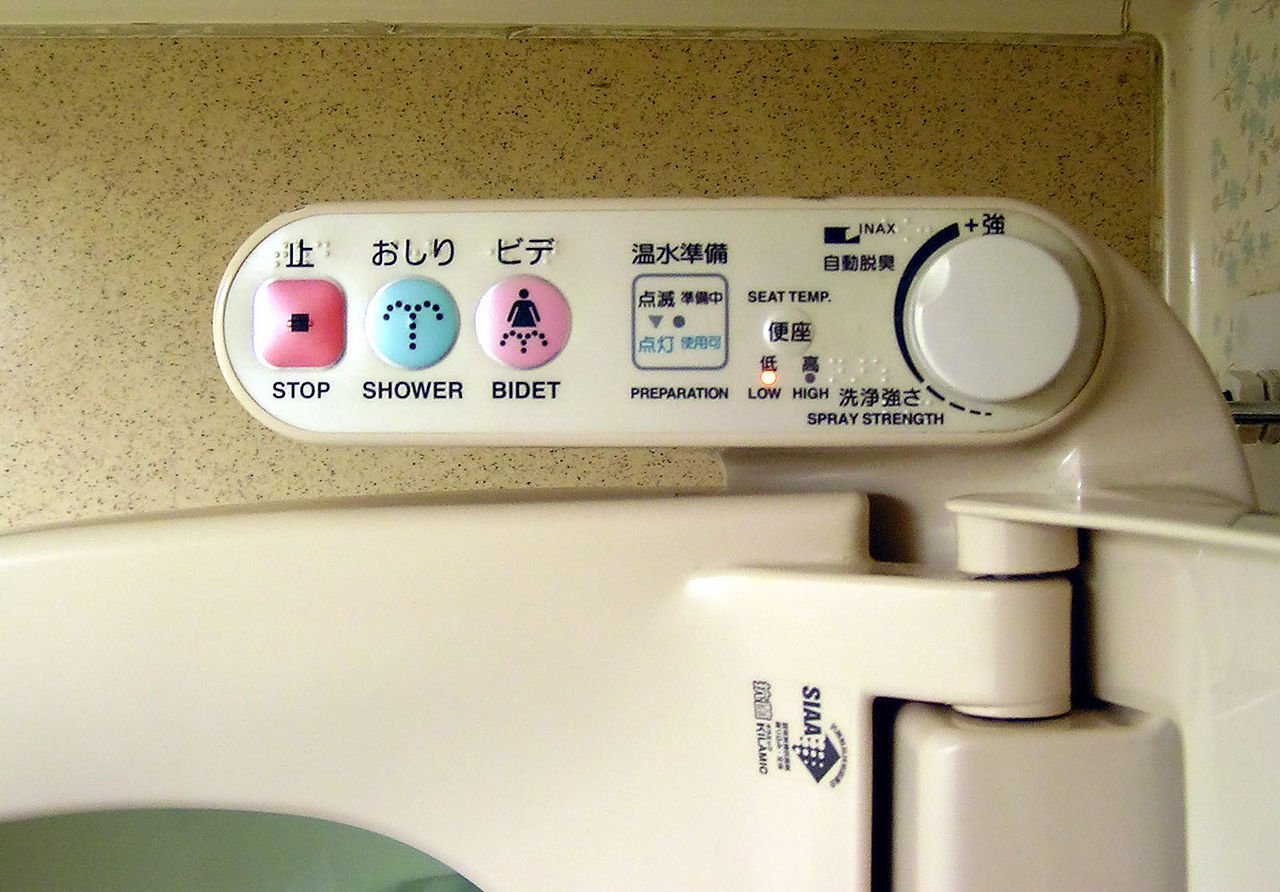
Washlet — the Japanese warm-water bidet that quietly became standard
Washlet is the warm-water bidet that washes you after — TOTO's invention, now near-universal on Japanese toilets.
You step into a small toilet room — in a Tokyo hotel, a friend's apartment, a chain convenience store, a public toilet at a train station, the toilet of a small soba restaurant — and find what looks at first like a normal toilet. (Japanese homes and most public buildings keep the toilet in its own small separate room, distinct from the bathroom that holds the bath and shower.) A small panel on the wall has buttons. Press the one labeled お尻 (oshiri, "bottom") and a small jet of warm water emerges from the back of the bowl, washing you with about ten seconds of soft warm spray. Press 止 (tomeru, stop) and it stops. That's a Japanese ウォシュレット (washlet). It's TOTO's brand for the warm-water bidet seat, and inside Japan the brand name has become the generic word for "the thing that washes you after you go."
In Japan, the warm-water bidet seat has quietly become standard: in most homes, every business hotel, every chain konbini, every department store, every train station, every airport. The toilet itself is often a separate concern — but the bidet seat on top of it is almost always there.
What is a washlet, and what does it actually do?
A washlet is, strictly, the warm-water bidet seat. The core function is the rear wash: a small jet of warm water aimed where it needs to go, with adjustable pressure and temperature. A separate softer jet (the bidet button) is intended for women's use. Some models add a warm-air dryer that you can use afterward instead of toilet paper. That's the washlet.
On Japanese toilets, the washlet seat is often bundled with — but distinct from — other comfort features that live on the same toilet:
- Heated seat. A separate feature: an electrically warmed seat surface, especially noticeable in winter. Often packaged with a washlet but technically a different mechanism.
- Sound-masking music (often labeled otohime, "sound princess"). A small speaker that plays a flowing-water sound to mask any noise — originally designed for women in office toilets who used to flush repeatedly to mask sound, wasting enormous amounts of water. A separate device, sometimes a separate wall-mounted unit.
- Automatic lid / sensor flush. Motion-sensor opening and closing of the lid, automatic flushing — features of the toilet itself, not the washlet.
- Deodorizer. A small built-in air-clearing function in some toilets.
Strictly speaking, none of those second-tier features are "washlet" — they're features of the modern Japanese smart toilet that washlet seats are usually installed on. In casual Japanese conversation, ウォシュレット often gets used loosely to mean the whole thing, but the proper meaning is just the bidet seat.
Where you'll find these:
- Almost every Japanese home built or renovated since the 2000s.
- Every business hotel, every chain hotel, every ryokan with modern plumbing.
- Every chain convenience store — Seven-Eleven, Lawson, FamilyMart all standard.
- Every department store, every train station, every shopping mall, every airport.
- Many small restaurants, kissaten, and even tiny noodle shops.
- Office buildings, school staff toilets, hospitals.
- Even the public toilets in some Tokyo parks (the recent Tokyo Toilet project commissioned designers like Tadao Ando and Shigeru Ban to redesign 17 public toilets in Shibuya).
Why a country made this its standard
Several overlapping reasons:
- Japanese plumbing matured at a different time than the West. When Japan was modernizing its bathrooms in the postwar era, the technology for warm-water bidets and electric toilet seats was already available, so the country installed them as standard rather than as luxury.
- Cleanliness as a deeply held value. Japanese culture has an unusual investment in personal cleanliness — see also: removing shoes at the entrance, washing before entering a bath, the temizu basin at every shrine. The washlet is the same value applied to the toilet.
- TOTO and a few major manufacturers operating at scale. Once the volume was there, the price came down. A modern washlet seat (retrofitted to an existing toilet) costs under 30,000 yen and can be installed by anyone.
- The hospitality industry insisted. A new hotel without a washlet would not compete. New office construction installed them by default. New homes too.
- Older generations adopted them late but enthusiastically. Once a grandmother spent a winter with a heated seat, the unheated one was no longer acceptable.
Where washlet sits in Japanese hygiene
The washlet sits inside the broader Japanese pattern of attention to personal cleanliness — the same pattern that has people removing shoes at the entrance, washing carefully before entering a bath, rinsing at a temizu basin at every shrine. Washing yourself with water — not just wiping — is treated as basic. Once a country had built that habit, the engineering of a small warm-water bidet was a natural fit, and TOTO's washlet from the 1980s onward gave it a packaged, plug-in form.
For many foreign visitors, the washlet ends up being one of the most memorable everyday discoveries of a Japan trip — a small, modest piece of design that quietly improves a private daily moment.
Reading a washlet control panel
Most washlet panels use the same handful of kanji labels, and once you can read them the panel becomes simple:
- お尻 (oshiri, "bottom") — rear wash, the main function. ビデ (bide) is the softer front jet.
- 止 (tomeru, stop) — stop the current wash.
- 乾燥 (kansou, dry) — warm-air dryer, used instead of toilet paper.
- 水勢 (suisei, "water power") — pressure adjustment, usually a pair of +/− buttons.
- 音姫 (otohime, "sound princess") — the masking-water sound, often a separate wall-mounted button.
Once you can recognize お尻 and 止, almost any Japanese washlet panel becomes readable. TOTO panels are the most common and other brands follow the same icon language.
Press the buttons
Next time you're in Japan, don't be intimidated by the panel — sit down, press お尻 for the rear wash or 止 to stop. The wash takes about ten seconds and adjusts itself; the dryer button (if there is one) replaces toilet paper. A retrofit washlet seat is sold at Bic Camera or Yodobashi Camera and installs on most existing toilets — many returning travelers cite it as one of the most-missed Japanese objects.
Buying one outside Japan
TOTO sells retrofit washlet seats directly in the US through Amazon, and they fit most standard Western toilets. If you've been on the fence since your last Japan trip, the three picks below cover most cases:
- Best for most people — TOTO Washlet C200 (around $500). Heated seat, rear and front wash, adjustable water pressure and temperature, side-mounted panel. The closest you'll get to what most Japanese chain hotels install.
- Step up — TOTO Washlet K300 (around $700). Adds automatic air deodorizer and a slimmer wireless-style remote.
- High end — TOTO Washlet S550e ($1,500+). Auto-flush, integrated warm-air dryer, app control, the lid that opens as you approach. This is what you'd see in a high-end Tokyo office building.
Installation is genuinely 30 minutes with one wrench. The only real obstacle is needing a standard electrical outlet near the toilet — if you don't have one, an electrician visit is the prerequisite.
For more small Japanese everyday objects and language, see kotatsu, arigatou gozaimasu, and the wasabi most people eat outside Japan.
Reveal Japan is a participant in the Amazon Services LLC Associates Program. Links above may earn us a small commission at no extra cost to you.Frequently asked questions
- What does washlet mean in Japanese?
- Washlet (ウォシュレット) is TOTO's brand name for the warm-water bidet toilet seat — the device that washes you with a warm-water jet after you go. Inside Japan, the brand name has become the generic word for any warm-water bidet seat.
- Is washlet a brand or a generic term?
- Originally a TOTO brand from 1980, but inside Japan it has become the generic word for any warm-water bidet toilet seat, regardless of manufacturer.
- How much does a washlet cost in Japan?
- A retrofit washlet seat costs under 30,000 yen (about USD 200) at electronics stores like Bic Camera or Yodobashi Camera, and installs on most standard toilets.
- Can a washlet seat be installed on a non-Japanese toilet?
- Yes, most washlet seats fit standard Western toilet bases with a water hookup, though the electrical voltage and water connection fittings need to match the destination country.
Related reads
lifestyle
Kotatsu — the Japanese low table with a heater under it that quietly redesigned the entire winter
A low table, a heater, a heavy blanket. The Japanese winter device that keeps the family warm — and gathered — in one square meter.
language
Arigato Gozaimasu Meaning — the Japanese 'thank you' that literally means 'rare to exist'
Arigato literally means 'rare to exist.' Japan's standard 'thank you' is rooted in 'what you've done for me is rare and precious' — here's how the etymology shapes daily use.
lifestyle
Japanese vending machines — four million quiet little statements about how safe the streets are
Vending machines on every corner, full of cash, working all night long. The reason that works is the part most foreigners miss.
lifestyle
Japanese trains — the rail system that runs to the second, in a country where on-time isn't a goal but a baseline
Japanese trains run to the second. The interesting part is what an entire society does on top of that assumption.
lifestyle
Japanese convenience stores — the civic infrastructure that just happens to sell sandwiches
Japan's convenience stores aren't really convenience stores — they're the country's everyday public infrastructure, awake at 3 AM, three minutes from anywhere.
Tags
Last reviewed: 2026-04-27
Tools
- Open on Amazon
TOTO WASHLET C2 (SW3074) - elongated, Cotton White
The value entry point: warm-water rear and front wash, heated seat, deodorizer. DIY install on a standard elongated toilet.
- Open on Amazon
TOTO WASHLET C5 (SW3084) - elongated, Cotton White
Mid-tier: adds PREMIST and EWATER+ wand self-cleaning. The most popular all-round pick.
- Open on Amazon
TOTO WASHLET+ S7 (SW4726) - elongated, Cotton White
Premium: instantaneous heating and a design that conceals the cord and hose for a seamless look.
Spotted something off?
Reveal Japan aims for accuracy. If you found a factual error or unclear passage, tell us via Contact. We update articles when readers correct us, and we credit the corrector by request.
Affiliate disclosure: Some links on this page are affiliate links marked rel="sponsored nofollow". If you click and make a purchase, Reveal Japan may earn a commission at no extra cost to you. This does not influence which sources or explanations we choose to feature.