Decoded
Bushido as the West knows it was written in English in California in 1899
Bushido as the West knows it — the seven virtues, loyalty unto death — was written in English in California in 1899, published in Pennsylvania in 1900, then translated into Japanese eight years later.
The bushido on the dojo wall poster
Open Netflix. Watch the FX Shōgun remake. Or pull up The Last Samurai, or any kamikaze documentary, or the dojo wall poster behind your local karate sensei. Same image, every time: a sword-bearing class governed by an ancient ethical code, a class that would die — cleanly, on its own blade — before it would betray its lord.
The mental picture has a fixed shape. Loyalty unto death. Honor over advantage. Seppuku over disgrace. A discipline so internalized that personal calculation simply doesn't enter the situation. And under it all, a list of seven virtues that recurs, in roughly the same order, in Western articles, executive-coaching slides, dojo wall scrolls, and Wikipedia paragraphs: rectitude, courage, benevolence, politeness, sincerity, honor, loyalty.
The seven virtues read familiarly because they are. Each one maps onto its 19th-century Western counterpart almost line for line — rectitude / courage / benevolence / politeness / sincerity / honor / loyalty sits next to a Victorian-era moral vocabulary of prudence / fortitude / charity / civility / sincerity / honor / fidelity the way a translation sits next to its source. The book they come from was not just naming Japanese virtues for an English audience. It was borrowing the list shape — seven slots, abstract nouns, hierarchical — from the European chivalric tradition. The Japanese virtues went in. The European structure stayed.
If you have ever heard the word bushido, that is almost certainly the mental picture you are reaching for — a pre-modern, pan-samurai operating system, a thousand-year-old warrior soul.
The list does come from a real book. Just not from where you think, and not from when you think.
What 武士道 actually was (and wasn't)
The samurai class existed for roughly seven hundred years — from the late Heian period through the Meiji Restoration in 1868. The code that supposedly governed them, in the form most non-Japanese readers would recognize, did not exist as a coherent system for almost any of that time.
The word bushidō (武士道, "way of the warrior") does appear in old texts. The earliest concentrated use is in the Kōyō Gunkan (甲陽軍鑑), a Takeda-school military chronicle compiled around 1616, where the term shows up more than thirty times. But it appears the way "the way we do things around here" might appear in a corporate handbook — descriptive, situational, about how warriors behaved. Not a numbered ethical system, not a creed. Nobody in 1616 was writing a manifesto.
Now look at what actual sword-carrying samurai were doing during the centuries the West thinks of as "the samurai era."
In the Sengoku period — the warring states, roughly 1467 to 1615, the time of Shōgun, Kagemusha, and most of the famous battles — warrior loyalty was contractual. The historian Karl Friday, who spent his career on early-medieval Japanese warfare, makes this clear: warriors recorded their services in writing, expected reward commensurate to risk, and switched lords when terms changed. Vassalage was a bargain, not a sacrament.
Examples are not rare. They are the operating logic.
In 1582, the man Oda Nobunaga trusted most burned his lord alive in the Honnō-ji temple. The single most famous moment in samurai history is a betrayal by a senior officer the lord had every reason to trust. Akechi Mitsuhide failed within thirteen days, and there is even an idiom for it — mikkatenka (三日天下), the three-day reign. The Japanese coined an idiom for the betrayal because they recognized the shape.
Or take Tōdō Takatora, who changed lords seven times across the late Sengoku and ended as a respected daimyo with castles to his name. If "selfless loyalty unto death" had been the operating norm, he would have been an unmarked corpse by his thirties. He was the model of how a competent warrior managed a career.
The most quoted line in the entire Western imagination of the samurai — "the way of the samurai is found in death" (武士道とは死ぬことと見つけたり) — comes from Hagakure (葉隠), dictated by a Saga-domain retainer who had never been in a battle. Yamamoto Tsunetomo served his lord through the longest peace Japan had ever had, and after his lord's death he became a Buddhist recluse, giving the line to a younger man. For the next two hundred years the manuscript stayed inside Saga, barely read even by Japanese.
The most famous samurai sentence in the Western imagination was an old peacetime retainer's nostalgia for a war he had never fought, and almost no one in his own country had heard of it.
How a Quaker in California exported it
The story of how the package crossed the ocean has a specific starting point — and it begins, of all places, with a Belgian asking a question on a walk.
In 1887, a young Japanese scholar named Inazō Nitobe was visiting the home of Émile de Laveleye (1822-1892), a distinguished Belgian jurist and economist. Their conversation turned to schools. De Laveleye asked, in something close to these words: "Do you mean to say that you have no religious instruction in your schools?" Nitobe answered no. De Laveleye, astonished: "No religion! How do you impart moral education?"
Nitobe could not give a satisfactory answer on the spot. He records the moment, a dozen years later, as the seed of his book.
Nitobe (1862-1933) was an unusual person to be answering for the soul of Japan: a Christian convert who became a Quaker, married into a Philadelphia Quaker family, and wrote his most influential book in English on a California beach. The man who explained the samurai to the West was answering from outside the country he was explaining.
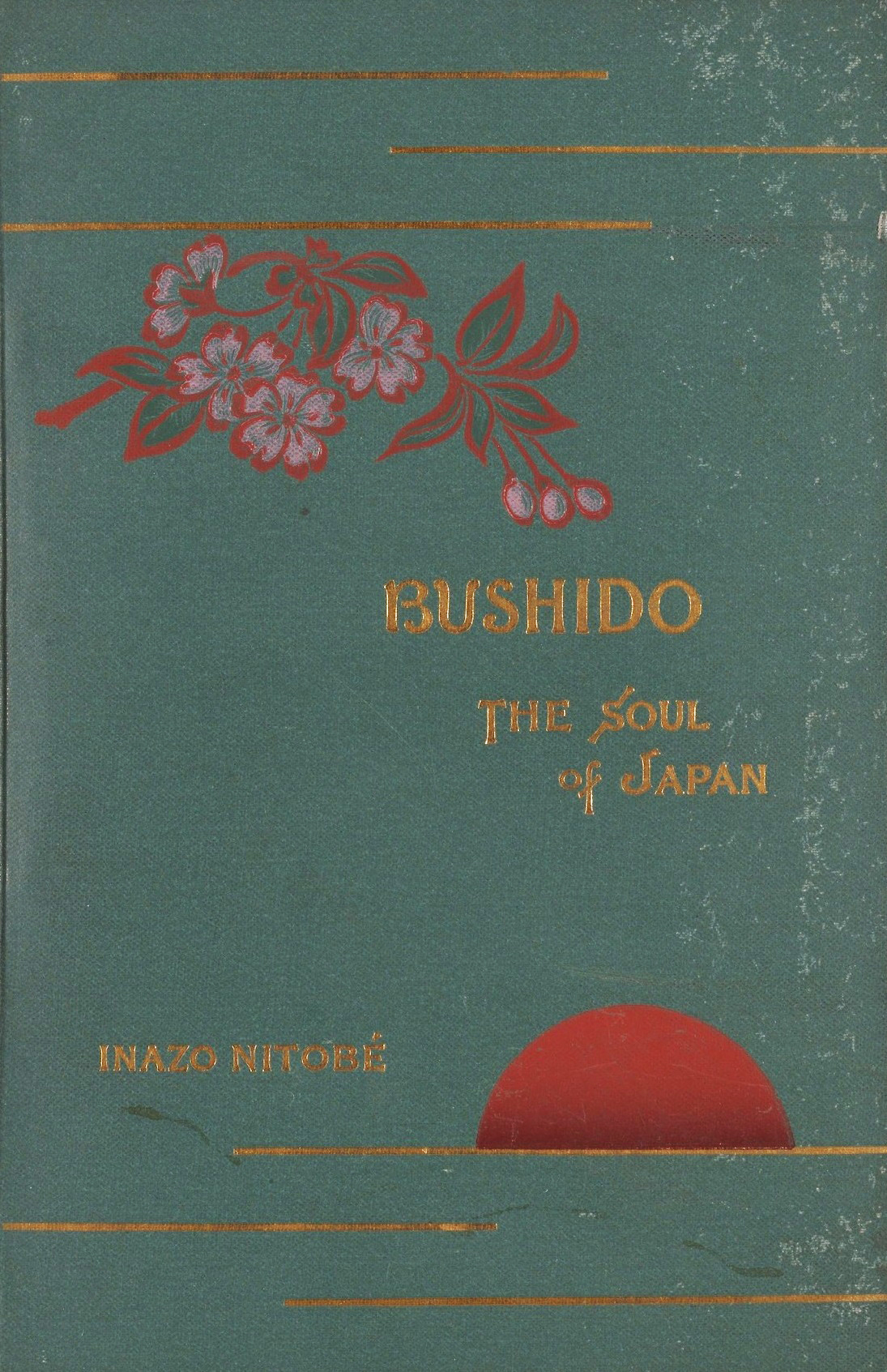
In 1899, recovering from illness in Monterey, California, he sat down to answer de Laveleye's question — a dozen years after the walk. He wrote it in English, structured around seven virtues with their European counterparts spelled out next to them, in the vocabulary of the Edwardian West. Leeds & Biddle in Philadelphia published it in 1900 as Bushido: The Soul of Japan. It was written in the wrong country, in the wrong language, for the audience it was actually for.
Nitobe was not alone. In the 1890s several Japanese writers were sharpening bushidō into a national-ethic concept that could stand opposite European chivalry — something a modernizing nation-state could be proud of in a vocabulary the imperial powers understood. Nitobe is the one whose version reached the West because he wrote his in English, in Monterey, for an American publisher.
Then Japan won a war. Between 1904 and 1905, Japan defeated Imperial Russia, and the Western press could not make sense of it. How could they? Bushido was the answer already on the shelf. President Theodore Roosevelt read the book and reportedly bought thirty copies, giving them out to friends and colleagues and recommending it as the key to Japanese character. For a few years, an American president was the single most influential promoter of "bushido" in the English-speaking world. The exporter shipped the package back as the reading list.
In 1908, Sakurai Hikoichirō translated Bushido into Japanese for the first time. The country read about its own national soul as a translation back from English. By the 1920s, the seven virtues were being taught in Japanese schools as if they had always been Japanese.
Then the loop tightened. In the 1930s, military ideologues reached further back — to a manuscript that had stayed inside Saga for two centuries — and turned the "death" passages into national doctrine. By 1944, tokkōtai pilots were going into missions trained on lines from a manuscript that, as recently as 1900, almost nobody in Japan had ever read.
After the war: Kurosawa, Mifune, dojo posters, Shōgun (Clavell, 1975), The Last Samurai (2003), executive-leadership seminars, Ghost of Tsushima (2020), the FX Shōgun remake (2024). The package keeps shipping.
Where to read the package
You do not have to throw the package away. You just need to know what it is. Four concrete ways in:
-
Open the Bank of Japan archive image of the Series D 5,000-yen note (1984–2007). It carried the face of Inazō Nitobe — the Quaker scholar who wrote Bushido in English on a California beach and saw it published out of Philadelphia. For twenty-three years, the country put on its own currency the man who had translated its self-image out — and then read it back in. Stare at the bill for a minute. The package began with this man, in English, in Monterey in 1899, in print in Philadelphia in 1900. The bill is the receipt.
-
Read Nitobe's Bushido: The Soul of Japan — but read it as a 1900 American bestseller, not as a Japanese historical document. Project Gutenberg has the full text, free. Start with the preface. Read where Nitobe says, in so many words, that the book exists because a Belgian asked him a question he could not answer. That framing — a Quaker convert in Pennsylvania, explaining his country to a dead Belgian jurist — is the entire context. The book is honest, often beautiful, and worth reading. It just isn't what its English title implies.
-
Read Hagakure knowing what it is. William Scott Wilson's English translation (Kodansha, 1979) is the standard. Read it as a peaceful 18th-century retired clerk's nostalgic dictation during the longest peace Japan had ever had — a meditation on inner attitude written by a man whose own country had moved on from war. The "found in death" line was about composure, not airplanes.
-
Visit Honnō-ji in central Kyoto and read the placard — then go to Sekigahara, the field in Gifu where the 1600 battle that decided early-modern Japan was won partly because Kobayakawa Hideaki defected mid-battle, switching sides in front of both armies because the math had changed. Stand on either site and ask honestly whether the modern Western idea of bushidō — selfless loyalty unto death — would have been possible in this room. The most decisive moment in early-modern Japan turned partly on a switch.
The seven virtues did not shape the samurai. The samurai shaped the seven virtues, in English, for an audience who was ready to be impressed. The actual men with swords were messier, hungrier, more contractual, and considerably more interesting than the package. Once you can see the package as a package, you can finally see the people underneath it.
Frequently asked questions
- Is bushido a myth?
- Largely yes, in the form the West encountered it. The seven-virtue code — loyalty unto death, rectitude, courage — was assembled by Nitobe Inazō for foreign readers in *Bushido: The Soul of Japan*, written in English in California in 1899 and published in Pennsylvania in 1900. Real samurai conduct over Japan's seven centuries of warrior class history was not unified by any single "code" — it was contractual, regional, and shifted with political reality. Treachery (the Honnō-ji Incident, the Seven Lords episode) and surrender for survival were as common as recorded loyalty. Bushido as a national ideal was crystallized in the Meiji era and amplified during World War II as state-sponsored ideology — a 20th-century construction projecting back onto the past.
- Is bushido still practiced in Japan today?
- Not as a living code anyone follows. In contemporary Japan, 武士道 appears mainly in three places: martial arts schools (judo, kendo, kyudo, aikido) reference it as an ethos for training discipline; corporate self-help and management books occasionally invoke it as a metaphor for loyalty; and historical fiction, manga, and anime use it as stylistic shorthand. Most Japanese adults today encountered the term first through Nitobe's name in school textbooks or through pop culture rather than from any tradition transmitted across the warrior generations. It functions more as a cultural reference than a behavioral prescription.
- What is *Bushido: The Soul of Japan* actually about?
- Nitobe Inazō wrote it in English in 1899 from Monterey, California, primarily for Christian readers — to argue that Japan, despite lacking Christianity, had its own moral framework derived from samurai tradition. The book lays out seven virtues (rectitude, courage, benevolence, politeness, sincerity, honor, loyalty) and traces their roots to Buddhism, Shinto, and Confucianism. It was a comparative-religion essay aimed at the Western Christian elite, not a manual for Japanese readers. The first Japanese translation didn't appear until 1908, eight years after the English original. Theodore Roosevelt liked the book and bought thirty copies, which helped its circulation in the US and ultimately shaped the Western view of samurai culture for the next century.
Sources
- Inazō Nitobe, *Bushido: The Soul of Japan* (Leeds & Biddle, Philadelphia, 1900) — Project Gutenberg #12096
- Oleg Benesch, *Inventing the Way of the Samurai: Nationalism, Internationalism, and Bushidō in Modern Japan* (Oxford University Press, 2014)
- Karl F. Friday, *Hired Swords: The Rise of Private Warrior Power in Early Japan* (Stanford UP, 1992)
- Yamamoto Tsunetomo / Tashiro Tsuramoto, *Hagakure* (dictated 1709-1716, Saga domain manuscript); William Scott Wilson trans. (Kodansha, 1979)
- *Kōyō Gunkan* (甲陽軍鑑, c. 1616), Takeda-school military chronicle
- Bank of Japan official record, Series D 5,000 yen note (1984-2007)
- *Honnō-ji Incident*, 21 June 1582 — *Shinchō-kōki* (信長公記)
Last reviewed: 2026-05-03
Tools
- Open on Amazon
Bushido: The Soul of Japan by Inazo Nitobe (AmazonClassics edition)
The 1899 book itself, written in English - the text that built the Western image of bushido. Read the source and judge it for yourself.
Related reads
Decoded
Ghost of Tsushima is set in 1274. Most of its samurai props arrived later.
Sucker Punch picked 1274 — one of the most specific years any samurai game has named — then borrowed three of Jin's most iconic moves from later centuries.
Decoded
Wabi-Sabi — the Bobby Hill rose your TikTok feed went viral over, and the two-mat tea room it was actually named for
Your TikTok 'it's got wabi-sabi' trend traces to a 2002 cartoon. The thing it borrowed the name from is a tea-room aesthetic forged by a man Hideyoshi later forced to commit seppuku.
Decoded
Bonsai — the small potted tree at the garden center is not what's meant by 盆栽
The 'bonsai' at the garden center is its own thing — a small potted tree as houseplant. 盆栽 in Japan is a sculptural practice measured in decades. Both exist; they're not the same craft.
Decoded
California Roll vs Sushi — what your local sushi place is actually serving you
The California Roll is an American invention from 1960s Los Angeles. The Japanese sushi (寿司) family it borrowed its name from is broader and built around vinegared rice in many forms.
Spotted something off?
Reveal Japan aims for accuracy. If you found a factual error or unclear passage, tell us via Contact. We update articles when readers correct us, and we credit the corrector by request.