Decoded
Ghost of Tsushima is set in 1274. Most of its samurai props arrived later.
Sucker Punch picked 1274 — one of the most specific years any samurai game has named — then borrowed three of Jin's most iconic moves from later centuries.
The samurai you fought as Jin Sakai
Pull up the screenshot any Ghost of Tsushima player has saved at least once. Jin Sakai is sitting on a hilltop in late afternoon light. A small composing prompt rises on screen. Bamboo creaks. The wind effect — the one Sucker Punch built an entire navigation system around, the one that won the studio its design awards — pulls a path through the grass. The player picks the first line, then the second, then the third, and the camera pulls back, and a quiet little 5-7-5 verse settles into the inventory. Some players ignore the haiku composing entirely. Some players track them down like collectibles. Either way, this beat is the single most-cited example of how respectfully the game treats its setting.
The game has earned that reputation. It opens in 1274 — one of the most specific historical years any AAA samurai game has named on the box — at the moment of the first Mongol invasion. The Mongol fleet has anchored off the western coast of Shimo-Tsushima. The defenders have ridden out to the beach. The cutscenes show Lord Shimura calling for an honorable charge, the Mongols breaking the duel, Jin watching his uncle taken. From there the player builds, over forty or eighty hours, the Ghost — the man who answers Mongol war by abandoning the samurai code. The game launched on PS4 in July 2020, sold roughly 8 million copies in its first months and has since climbed past 13 million, won Best Art Direction at The Game Awards, and got a full-blown sequel — Ghost of Yotei — confirmed for 2025 with a Hokkaido setting. Western press called it among the most reverent samurai depictions since Kurosawa. Japanese critics, with some friendly hedges, broadly agreed.
So the question worth holding still for a second is this. Of the things Jin actually does on screen — sits down to compose haiku, draws his katana for a stand-off duel, throws a black-powder bomb at a Mongol — how many of those existed on Tsushima in 1274?
Not many.
What 1274 actually looked like
To see what the props are doing, it helps to start with the actual battle.
The Mongol fleet that reached Tsushima in early November 1274 numbered tens of thousands across hundreds of ships — Mongol, Chinese, and Jurchen troops alongside Goryeo-Korean forces of around 8,000 soldiers and 7,000 sailors. The Sō Shi Kafu records the disembarkation on this stretch of coast at around 8,000 warriors from 900 ships, landing on the western shore of Shimo-Tsushima at the small bay of Komoda on 4–5 November 1274. The deputy military governor of Tsushima at that moment was Sō Sukekuni. He had eighty mounted samurai plus retainers. He rode out anyway. The first samurai arrow volleys hit the landing force hard, but the Mongols overwhelmed by mass. By nightfall Sukekuni was dead, killed alongside his son and a kinsman. The defenders were dead within hours of first contact. The Mongols then burned the buildings, killed inhabitants, and re-embarked for Iki Island and Hakata Bay.
That is the Tsushima the game is named after. Eighty men, a few hours, on a beach. Hold that picture. Now walk the props back through chronology.
The haiku. The standalone 5-7-5 verse Jin composes did not exist as a recognized poetic form in 1274. What did exist, and was popular among the literate Kamakura warrior class, was renga (連歌) — communal linked verse, alternating 5-7-5 and 7-7 stanzas, composed in groups around a single seat. A Kamakura nobleman did not sit alone on a hill writing seventeen syllables; he sat in a room with three or four other people taking turns. The opening verse of a renga sequence, the hokku (発句), eventually became the seed of standalone short verse, but the move took centuries. Matsuo Bashō lifted hokku into a self-sufficient art four hundred years after Tsushima fell. The actual name — haiku (俳句) — was coined by Masaoka Shiki at the end of the nineteenth century, six hundred years after Sukekuni died on the beach. There is also the small additional joke that observers including Lowyat.NET reviewers noticed at launch: the verses Jin actually composes don't even land in 5-7-5. They tend to fall closer to a 5-12-14 shape. The form-name is anachronistic, and the form is invented for the game.
The katana. What Sō Sukekuni and his eighty men actually carried at their belts was the tachi (太刀) — seventy to eighty centimeters of curved blade, slung edge-down from cords on the obi, designed to be drawn across the body of a horse and used as a sidearm to the bow. The straighter, shorter form worn edge-up through the obi in a quick-draw mounting — the uchigatana (打刀), the form Jin draws in the duel mechanic and the form Western imagination flatly calls "katana" — emerges as a battlefield weapon during the Muromachi period (1336-1573), more than a century after Tsushima. The actual primary weapon for Sukekuni's class was not any sword: the warrior class called itself the 弓馬の道 (kyūba no michi), "the way of the bow and the horse," and arrows dominated the wound counts of pre-modern Japanese battlefields. The standing-stance one-on-one katana duel Jin uses on screen is roughly seventeenth-century kenjutsu, projected backwards onto a thirteenth-century battle that was almost certainly missile-led and over fast. There is a small additional irony here. The Mongol invasions themselves drove the design changes that produced the later sword — Japanese smiths reportedly studied tachi blades that had broken or warped under massed contact and shifted to denser construction methods afterward. The katana in any meaningful sense is downstream of 1274. The game is using a weapon shaped by the encounter to fight the encounter itself.
The gunpowder bomb. This one reverses cleanly. The tetsuhau (鉄炮, "iron-fire-tube") were Chinese-origin gunpowder bombs the Mongols brought to the invasions. The intact specimens we have today were recovered from the seabed of the Takashima underwater archaeological site in Imari Bay, from a ship lost in the second invasion of 1281 — but they are the same weapon class the Mongols had introduced on Tsushima seven years earlier. X-ray analysis showed two filling types, one packed with gunpowder only and one packed with gunpowder plus square iron shrapnel. Until that morning on Komoda Beach, the Japanese had never seen gunpowder weapons of any kind. Matchlock muskets did not arrive in Japan until 1543, two hundred and seventy years later. So when Jin throws a black-powder bomb at a Mongol soldier in the game, he is throwing back at his enemy a technology his enemy had introduced him to, two and a half centuries early. The kanji compound 鉄炮 itself is the linguistic record: it is the same compound the Japanese later applied to the Tanegashima matchlock and is still applied to firearms in modern Japanese (teppō). Gunpowder weapons in Japan come into the language wearing the name the enemy fleet brought them under.
Land the section in three lines. The haiku is from the 1680s. The katana style is from the 1500s and after. The gunpowder belonged to the Mongols. Sucker Punch picked 1274 and then time-shifted in roughly the order of distance from the year.
Why the props feel right anyway
The compression is an artistic method, not a failure. Each of the three borrowings solves a specific game-design problem.
The hilltop haiku is the contemplative beat between combat encounters. A renga session needs other people in the room — which means either changing the scene staffing or dropping the form. Waka (5-7-5-7-7 court tanka) would have looked unfamiliar to Western players who have been trained by a century of Japanese-poetry exposure to recognize 5-7-5 as period-appropriate. Modern haiku is the form that reads as "thoughtful samurai" the same way a single shakuhachi line reads as "loneliness" in a film score. Sucker Punch picked the form audiences would recognize as period-appropriate, not the form that was period-appropriate. Bashō already wrote the lines the player thinks Jin is writing.
The standing-stance katana duel is the unit of action AAA games are built around — a thirty-second one-on-one encounter, fixed camera, two combatants. A historically accurate Sukekuni-class engagement would have been mounted, missile-led, and over in a handful of seconds. The duel mechanic borrows its silhouette from Kurosawa, who in turn had reached back through Nitobe's 1900 Bushido: The Soul of Japan for the moral spine (the bushido article walks the chain). The duel-and-honor package is a posthumous construction, layered over a thirteenth-century beach where there were no duels, only a volley.
The kunai and the gunpowder bombs give Jin a stealth-and-tactics arsenal the actual Sukekuni did not have. Without them, the gameplay collapses to "ride forward, shoot bow, die." Stealth as a primary verb of combat — the entire Ghost archetype — is conceptually closer to Edo-period kabuki ninja iconography than to anything documented at Komoda. Sucker Punch was open about the lineage; the studio called the black-and-white grain filter Kurosawa Mode. The intended ancestry was twentieth-century film, not thirteenth-century chronicle, and the Japanese press in 2024 retrospectives was warmest there: the studio was praised for not claiming historical authority.
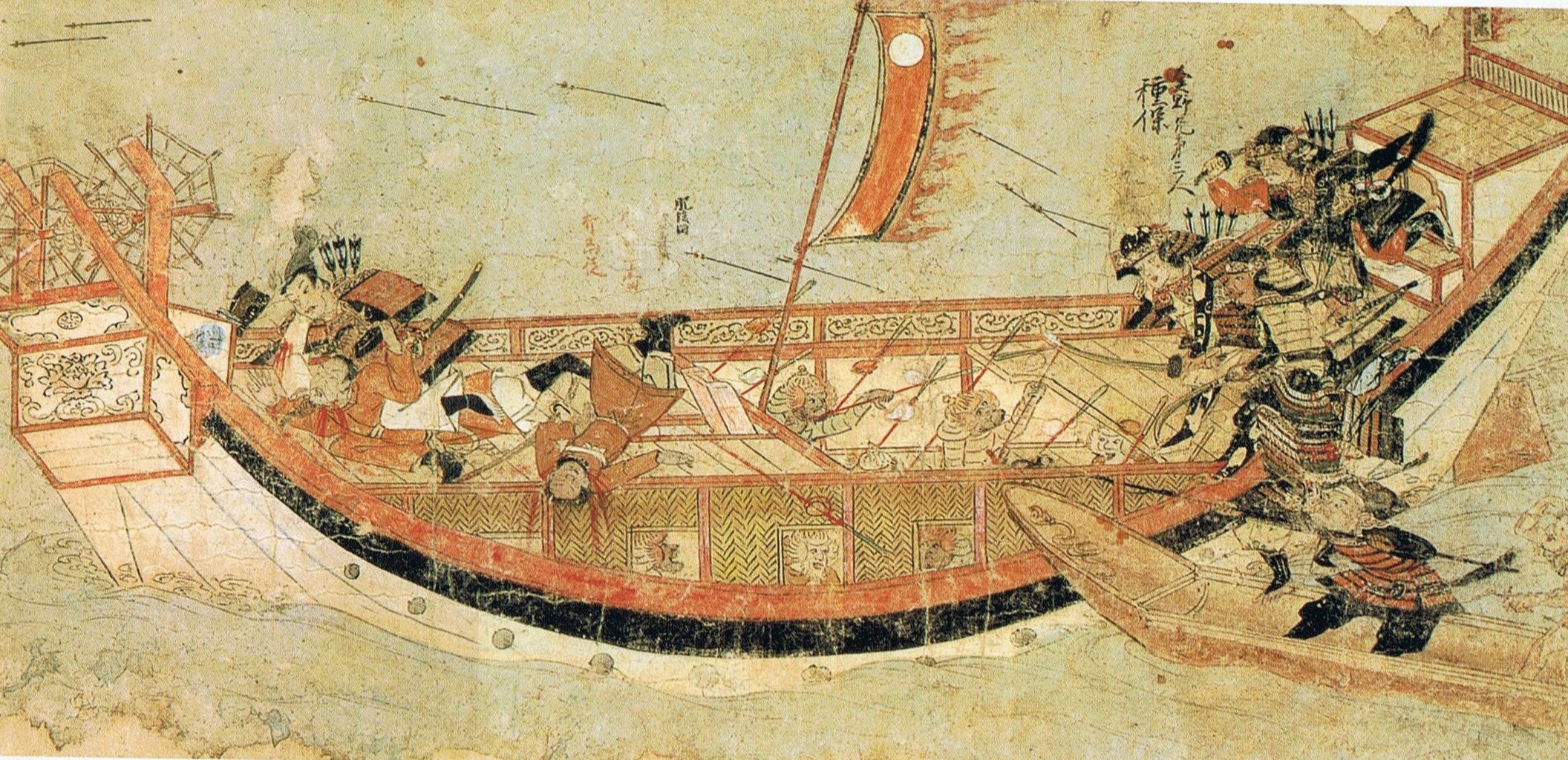
The deeper pattern under all of this is that the studio got the spiritual resonance of 1274 exactly right. The Mongol arrival genuinely did break the meinori (名乗り) duel ritual on this stretch of coastline. The Mōko Shūrai Ekotoba (蒙古襲来絵詞), the only contemporary illustrated record we have of the invasions, shows the moment in a single famous panel: a samurai riding forward to begin the announcement ritual, an unannounced volley of arrows already in flight before he can finish, a tetsuhau exploding under the flank of his horse. The story is right. The props are six centuries of compressed samurai iconography overlaid on top.
The game is most accurate when it forgets to be specifically samurai — when it just shows a man in lacquered armor, outnumbered on a beach, reaching for whatever still works. It is least accurate when it reaches for the recognizable surface codes — the haiku, the duel-stance katana, the explosive — because those codes mostly were not there yet.
Where 1274 still lives
Four ways in, ordered from your couch outward to a beach in Nagasaki Prefecture.
-
Replay the game as a Mongol-invasion lens, not a samurai fantasy. Notice that the most physically accurate weapon Jin holds is the longbow. Notice that the volley arrows that hit Lord Shimura's charge on the beach in the opening hour are exactly the move the Mōko Shūrai Ekotoba documents in 1293. Notice that "Lord Shimura" sits in the role the actual Sō clan held — and that the Sō family governed Tsushima for about six centuries, evolving from deputy-jitō under the Kamakura shogunate to acknowledged shugo by the late Nanboku-chō period and then Edo-period daimyo, until 1869. The thirteenth-century war is on the right beach. The game is more accurate than its anachronisms suggest, as long as you aren't looking at the props.
-
Look at the Mōko Shūrai Ekotoba. The late-Kamakura illustrated handscroll — its inner inscription dated 永仁元年 (1293), with the body itself likely produced across the late 1290s — is held in the Imperial Household Agency collection and digitized at high resolution on e-Museum (
emuseum.nich.go.jp). The scroll's most-reproduced panel — the volley arrows arriving before the samurai can finish his ritual announcement, a tetsuhau bomb bursting in the sand — is the same beat the Ghost of Tsushima opening hour stages in cinematic. Watch the original. The thirteenth-century brushwork has the moment first. -
Read the haiku on a different timeline. Bashō's Oku no Hosomichi (奥の細道, 1689) is the single text that did most to make the form Jin is writing in. Robert Hass's The Essential Haiku (Ecco, 1994) puts Bashō, Buson, and Issa side by side in English. After half an hour of those texts, the game's compositions land differently. They are not from Sukekuni's century. They are from a calmer one, four hundred years downstream.
-
Go to Komoda Beach. Komodahama Shrine (小茂田濱神社), in Tsushima City, Nagasaki Prefecture, is built on the spot where Sukekuni made his last stand. Local villagers raised a small memorial there immediately after 1274; it was relocated to its current site during the Nanboku-chō period and consecrated as the Sō clan's shrine of remembrance. The grand annual festival is held on the second Sunday of November, and the ritual includes a Warrior Procession (some participants in reproduction Kamakura armor) walking from the shrine to the beach, with ceremonial archery demonstrations on the sand — the actual kyūba no michi discipline performed where it was overrun seven hundred and fifty years ago. Sukekuni, his kin, and the named retainers — including Sukesada of the twenty-five-enemy account — are read at the rite. Tsushima is reached by ferry from Hakata Port (about two hours twenty minutes via Kyushu Yusen Jetfoil) or by short flight to Tsushima Yamaneko Airport from Fukuoka or Nagasaki. Komoda is on the western coast of Shimo-Tsushima, about a thirty- to forty-minute drive west of central Izuhara on the eastern coast.
Sō Sukekuni's grave-shrine has been reading his name for around seven hundred and fifty Novembers. The game gave him eighty hours and a katana he wouldn't have recognized. The beach got the count of eighty first.
Frequently asked questions
- Is *Ghost of Tsushima* based on a real story?
- The setting is real, the protagonist isn't. The Mongol invasion of Tsushima on 4 November 1274 — the opening event of the game — actually happened. The local jitō Sō Sukekuni led roughly 80 retainers against the Mongol landing force at Komoda Beach and was killed in the fighting; his death and the destruction of Tsushima island within a few days are documented in Kamakura-period chronicles and the Sō family record. Jin Sakai, the player character, is fictional — Sucker Punch invented him to give a single-protagonist arc to a campaign that was, historically, a brief and brutal massacre. Komodahama Shrine on Tsushima still memorializes the real defenders today, with an annual commemoration on the second Sunday of November.
- Was the katana the real samurai sword in 1274?
- Not in the form Jin Sakai swings. In 1274, samurai cavalry carried the 太刀 (tachi) — a longer, more curved sword worn edge-down on the belt and used primarily from horseback. The katana as it's recognized today (worn edge-up, drawn one-handed for close-quarters infantry combat) became the dominant form much later, mostly during the Muromachi-Sengoku period (15th–16th century), as warfare shifted from mounted archery to massed infantry. By 1274, mounted samurai still fought primarily as archers — bow first, blade as backup. The katana stances in the game are visually striking but anachronistic by roughly two centuries.
- Are the four stances in *Ghost of Tsushima* historically accurate?
- The stance system in the game (Stone, Water, Wind, Moon — each tuned against a different enemy archetype) is mechanics-driven game design, not historical reconstruction. Codified sword schools (流派, ryūha) with named stances — Itto-ryū, Niten Ichi-ryū, Yagyū Shinkage-ryū, and dozens of others — emerged centuries after 1274, with most consolidating in the 16th–17th century. Mounted samurai of the Kamakura period would have trained in archery (弓馬の道, kyūba no michi, "the way of the bow and horse") as their primary discipline, with sword work as a fallback. The four-stance system is internally elegant for gameplay; it isn't a 1274 sword tradition.
- What year is Ghost of Tsushima set in?
- Ghost of Tsushima opens in 1274, during the first Mongol invasion of Japan, on the western coast of Shimo-Tsushima. The November 1274 invasion is the same historical event the *Sō Shi Kafu* records. The sequel *Ghost of Yotei* (2025) is set in Hokkaido, not Tsushima.
- Are the haiku in Ghost of Tsushima period-accurate?
- No. The standalone 5-7-5 haiku form did not exist in 1274. What did exist was *renga* (linked verse) — communal compositions alternating 5-7-5 and 7-7 stanzas, written in groups. Matsuo Bashō (1644-1694) elevated the standalone short verse roughly 400 years after Tsushima, and Masaoka Shiki coined the term *haiku* in the late 19th century — about 600 years after Sō Sukekuni died on Komoda Beach.
Sources
- *Sō Shi Kafu* (宗氏家譜) — Sō clan family chronicle, account of Sukekuni's defense at Komoda Beach, 4 November 1274
- *Mōko Shūrai Ekotoba* (蒙古襲来絵詞), commissioned by Takezaki Suenaga of Higo Province, second-scroll year-mark Einin 1 (1293 CE) — Imperial Household Agency collection
- Mozai Torao (茂在寅男), Tokyo University engineering, Takashima underwater archaeology — *tetsuhau* recovery and X-ray analysis (from 1980)
- Karl F. Friday, *Hired Swords: The Rise of Private Warrior Power in Early Japan* (Stanford University Press, 1992)
- Suzuki Masaya (鈴木眞哉), 『「戦闘報告書」が語る日本中世の戦場』 (洋泉社, 2014 reissue) — *gunchūjō* casualty study
- Komodahama Shrine (小茂田濱神社), Izuhara, Tsushima City, Nagasaki Prefecture — annual commemorative festival, second Sunday of November
- Matsuo Bashō (1644-1694), *Oku no Hosomichi* (1689); Masaoka Shiki (1867-1902), Meiji-period coinage of *haiku* (俳句)
- Sō Yoshitoshi descent line — Tsushima-Fuchū Domain (100,000 koku) until 1869
- Lowyat.NET (2020), *Ghost of Tsushima* in-game verse format observation (5-12-14, not 5-7-5)
Last reviewed: 2026-05-03
Tools
- Open on Amazon
Ghost of Tsushima Director's Cut (PS5)
The game this piece is about. Knowing which samurai props are anachronistic doesn't spoil it - it just gives you a second layer to watch for while you play.
Related reads
Decoded
Bushido as the West knows it was written in English in California in 1899
Bushido as the West knows it — the seven virtues, loyalty unto death — was written in English in California in 1899, published in Pennsylvania in 1900, then translated into Japanese eight years later.
Decoded
Bonsai — the small potted tree at the garden center is not what's meant by 盆栽
The 'bonsai' at the garden center is its own thing — a small potted tree as houseplant. 盆栽 in Japan is a sculptural practice measured in decades. Both exist; they're not the same craft.
Decoded
California Roll vs Sushi — what your local sushi place is actually serving you
The California Roll is an American invention from 1960s Los Angeles. The Japanese sushi (寿司) family it borrowed its name from is broader and built around vinegared rice in many forms.
Decoded
Futon — the sofa-bed your American dorm called a futon, and what that name means in Japan
An American 'futon' is a wooden-frame sofa-bed. A Japanese 布団 is a thin mattress that lives in a closet and rolls out onto the floor for the night. Both are real things. The name traveled; the object didn't.
Spotted something off?
Reveal Japan aims for accuracy. If you found a factual error or unclear passage, tell us via Contact. We update articles when readers correct us, and we credit the corrector by request.