Decoded
Wabi-Sabi — the Bobby Hill rose your TikTok feed went viral over, and the two-mat tea room it was actually named for
Your TikTok 'it's got wabi-sabi' trend traces to a 2002 cartoon. The thing it borrowed the name from is a tea-room aesthetic forged by a man Hideyoshi later forced to commit seppuku.
The TikTok "celebrating the flawed" wabi-sabi
In November 2025, somewhere between the cooking videos and the cat clips, your TikTok feed probably served you a clip from a Texas cartoon that aired before the iPhone existed. A pre-teen boy in a baseball cap holds up a single, slightly off-center rose to his mustachioed father and says, with the gravity only a thirteen-year-old can summon: "Wabi-Sabi is an Eastern tradition. It's celebrating the beauty in what's flawed." The father is unconvinced. The internet was not.
Within a few weeks the audio was on tens of thousands of videos. Teens started filming their friends, pointing at one specific feature — a chipped tooth, an asymmetric haircut, a wonky eyeliner wing — and saying, "I love that about you. It's got wabi-sabi." By Thanksgiving, parents' magazines (She Knows, Yahoo Lifestyle) were running explainers warning that the trend had drifted into a polite-sounding insult: a nice way to roast someone, as one creator put it.
The rose-and-cartoon version of wabi-sabi has cousins. Walk into any Anthropologie or scroll any minimalist-interiors Pinterest board and you'll find the word stretched over white walls, hand-thrown ceramics, raw-linen sofas, gold-veined cracked bowls. Every interiors writer for the last decade has reached for the same three-word definition: imperfect, impermanent, incomplete. It's the kind of phrase that fits on an enamel pin.
The thing all of this is downstream of is a Japanese aesthetic, but it is not Japanese in the way "imperfect, impermanent, incomplete" makes it sound — and the route from a 16th-century tea room to a 2025 TikTok diss takes a few stops you might not expect.
What 侘 and 寂 actually mean
The first surprise is that wabi (侘) and sabi (寂) are two different words doing two different jobs.
Wabi, in classical Japanese, comes from the verb 侘ぶ (wabu) — and that verb is negative. To wabu was to suffer hardship, to fall into poverty, to grieve, to be desolate, to feel one's circumstances diminish. It was the word a courtier reached for when exiled to the provinces. Sabi, from 寂ぶ (sabu), meant to grow old, to weather, to fade, to chill. The leaves on a winter branch sabu. A neglected garden sabu. Both words started in the column of things you complain about.
The reframe — the move that built the aesthetic — happened in the late Muromachi period, in the orbit of Zen monasteries and the early tea cult. Murata Jukō, a 15th-century monk, began to move tea practice away from the lavish Chinese-import ware the elite were collecting and started mixing in rough, locally-made vessels. To deliberately wabu — to choose insufficiency on purpose — became, in his hands, a spiritual posture. Not "make do with less because you have to," but "select less, because the bowl with one chip teaches more than the bowl with none."
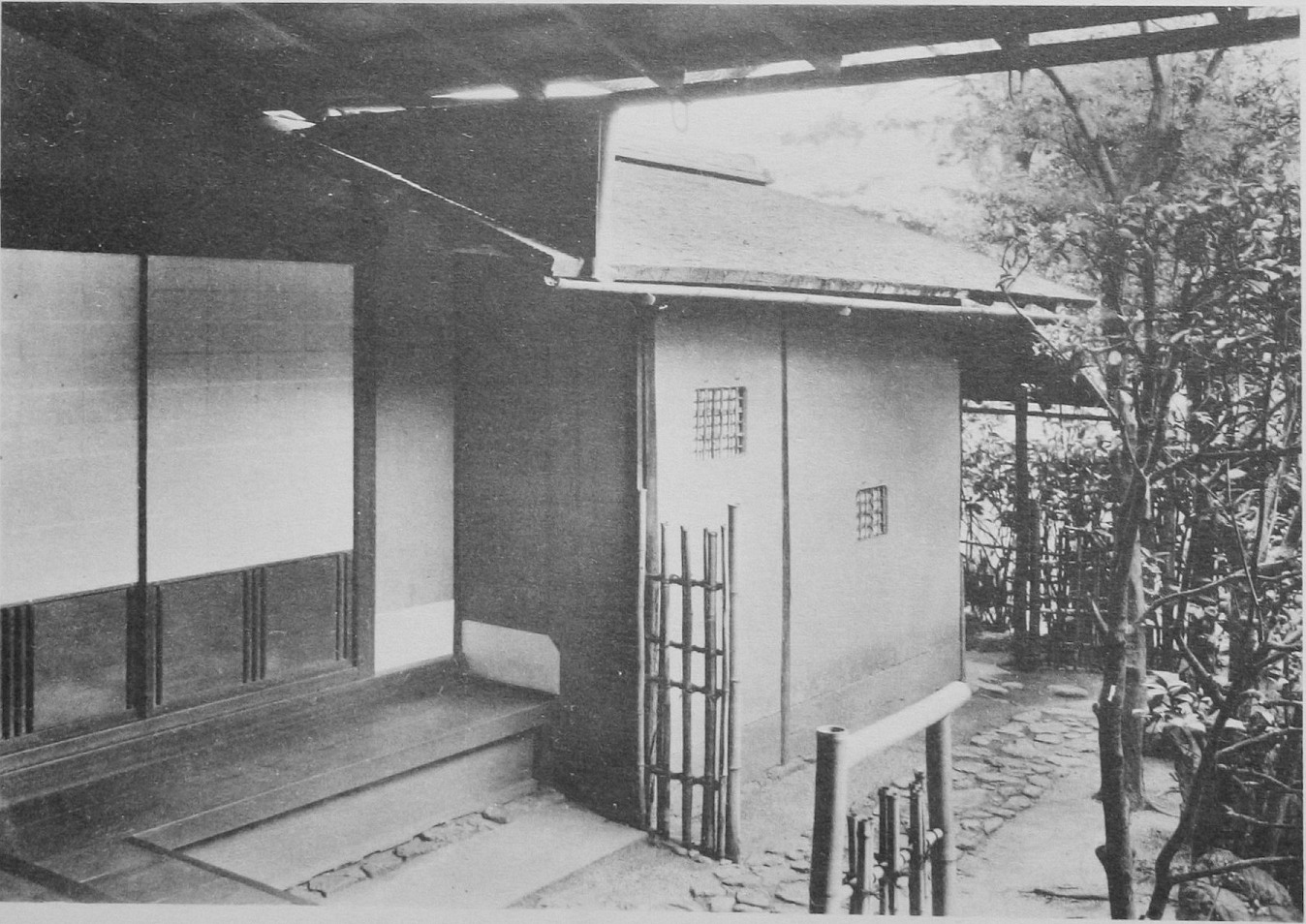
Two generations later, Sen no Rikyū crystallized the practice. He became tea master to Oda Nobunaga and then to Toyotomi Hideyoshi — a warlord who commissioned a portable tea room covered in gold leaf. Rikyū's answer was to build, around 1582, a tea house called Tai-an (待庵) in Yamazaki, just south of Kyoto. It is two tatami mats. The doorway is a low square crawl-hole — about 80 by 70 centimeters, large for a nijiriguchi but still low enough that every guest, daimyo or peasant, has to bend in on hands and knees. Tai-an still stands. It is a National Treasure. It is the only tea room that can be confidently attributed to Rikyū himself.
The most-told Rikyū story sits in the same key. Hideyoshi heard that Rikyū's morning-glory garden was in spectacular bloom and arranged a visit. When he arrived, the garden was bare — Rikyū had cut every flower. Inside the tea house, in the alcove, was one morning glory in a single vessel. That is wabi as a verb: an act of subtraction so severe it is almost confrontational. In 1591, Hideyoshi ordered Rikyū to commit seppuku. The reasons are debated; the aesthetic disagreement was part of the temperature.
Around the same time Rikyū commissioned a Kyoto tile-maker named Chōjirō (長次郎, ?–1589) to hand-form tea bowls — no wheel, no symmetry, fingerprint-marked, slightly heavier in the palm than you expect, glazed unevenly in blacks and reds that don't try to be uniform, fired one by one in a small kiln. These became raku-yaki (楽焼). Fifteen generations later the Raku family is still working in the same neighborhood of Kyoto, and the Raku Museum in Kamigyō-ku owns over 1,000 of their pieces.
A generation later, the same logic moved into a different room — repair. When a Raku bowl cracked, the wabi-cha circle did not throw it out, and they did not try to make the crack invisible. They mended the break with lacquer dusted in powdered gold, leaving the seam visibly brighter than the surrounding glaze. The technique, kintsugi (金継ぎ), was already centuries old in temple and palace metalwork; the wabi-cha world made it doctrine. The break is part of the bowl's biography. The gold is the way the biography is honored. Wabi's "leave one morning glory" became, in the workshop, "leave the scar but draw it in gold."
A century after Rikyū, Matsuo Bashō carried sabi into hokku — the form that would, two centuries later, be renamed haiku. Sabi, in Bashō's hands, is the chill at the rim of a still pond, the cicada cry stitched into the rocks at Risshaku-ji on a summer afternoon in 1689, the loneliness that is no longer suffering but a kind of attentive calm. Wabi lives in the practitioner's posture; sabi lives in the world's surface — patina, weathering, the texture left by time. The tea master's bowl has wabi; the same bowl, fifty years later with a hairline crack, also has sabi. They are paired but not interchangeable.
None of this is imperfect, impermanent, incomplete. That phrase came from somewhere else.
How three English words swallowed it
The first bridge to English was Tanizaki Jun'ichirō's In Praise of Shadows (1933) — a slim essay arguing to a Westernizing Japan that its own aesthetics lived in dimness and patina, not in the clean white modernism Tokyo was importing. Tanizaki himself didn't reach for the compound wabi-sabi. He gave the West the taste before naming it.
In 1994, an American designer named Leonard Koren published a small hardback called Wabi-Sabi for Artists, Designers, Poets & Philosophers out of Berkeley. He had spent years in Kyoto sitting in tea rooms, reading translations, and talking to potters. His book opens with a line that has shown up, lightly paraphrased, in nearly every English-language explanation of wabi-sabi for the next thirty years:
Wabi-sabi is a beauty of things imperfect, impermanent, and incomplete.
That sentence is not a Japanese definition. It is a 1994 English compression — three words and a meter — written by an American designer in Berkeley as a translation tool. It is excellent. It is also small. It does not carry the negative-to-positive flip in wabu, the ladder from Jukō to Rikyū, the architectural specificity of a low crawl-door, the fact that wabi and sabi are doing different work. It does what a translation has to do — it gets into the receiving language at all.
By the late 2000s, Koren's three words were everywhere. Restoration Hardware catalogues. Apartment Therapy posts. The first wave of Pinterest interiors. A 2017 Marie Kondo brand extension. By the early 2020s, "wabi-sabi" in English had drifted free of any tea room and was attached to whatever a designer wanted to call serene.
The TikTok phase has its own specific origin. On December 8, 2002, Fox aired King of the Hill Season 7 Episode 6, "The Son Also Roses" — the one where Bobby Hill, eighth-grader of Arlen, Texas, decides to enter a rose-growing competition. In the climactic scene Bobby holds up his slightly off-center rose and explains the term to his deeply skeptical father. The episode aired, twenty-three years went by, and in November 2025 somebody clipped the scene to TikTok. The audio was passed around, then re-cut, then deployed as a compliment, then drifted into being a way to point at someone's flaws while sounding kind. Twenty-three years of dormancy, then a compliment, then a sneak diss. Bashō would have a haiku for it.
Where to encounter real wabi
Four entry points, ordered from your kitchen counter outward to a Kyoto temple.
-
A kintsugi workshop, anywhere from Kyoto to your hotel room. Repairing broken pottery with lacquer dusted in real gold (kintsugi, 金継ぎ) is wabi-sabi as a hand practice — the visible scar honored, not hidden. Several Kyoto and Tokyo studios run half-day workshops in English (typically ¥8,000–¥15,000 for a beginner session); home kits with the actual urushi lacquer are also sold for international shipping. The point is not aesthetic theory. It is the four hours of your hands, a broken plate, gold dust, and slow drying time.
-
Raku Museum, Kyoto (Kamigyō-ku). Walking distance from the Imperial Palace, a few blocks from where the Raku family — fifteen generations on from Chōjirō — still produces bowls today. The museum rotates exhibits from a permanent collection of Raku-family pieces, including works attributed to Chōjirō (Rikyū's commissioned potter). Hand-shaped, ridge-irregular, warm to hold — the actual physical object the language was first attached to. Closed Mondays; small entry fee. Working raku-yaki tea bowls in Rikyū's idiom are sold at potters' shops nearby and at department-store ceramic counters in Kyoto and Tokyo, with usable everyday pieces beginning around ¥10,000.
-
A wabi-cha session at one of the three Sen schools. Urasenke (Konnichi-an, Kamigyō-ku, Kyoto), Omotesenke (Fushin'an, same neighborhood), and Mushakōjisenke (Kankyū-an) — the three direct lineages descending from Rikyū's three grandsons, all headquartered within a few blocks of each other. Urasenke runs the most accessible English-language guest sessions, both in Kyoto and through international branches in New York, Honolulu, and elsewhere. Reservations through the schools' offices or through Kyoto-based tea-experience operators (Camellia, En, Maikoya) for shorter ¥3,000–¥10,000 introductions if you want a single session rather than a course.
-
Tai-an at Myōki-an, Yamazaki, Kyoto. The tea house Rikyū built around 1582 is a National Treasure and is not a casual walk-in: visits are by written application to Myōki-an well in advance, typically tied to tea-school or research credentials, and viewing is from outside. Worth knowing it exists in a specific town you can reach in fifteen minutes from Kyoto Station on the JR Kyoto line. For a tea room you can actually enter on a normal trip, Daitoku-ji in northern Kyoto has several wabi-style sub-temple tea rooms (notably Jukō-in and the public-access pavilions at Kōtō-in) that follow Rikyū's idiom directly — Daitoku-ji is where Rikyū studied Zen and where his grave still sits.
A century before Bobby Hill held up his off-center rose, Sen no Rikyū cut a hundred morning glories and left one. Both gestures are about a single flower. Only one of them is wabi. The difference is the thousand quiet decisions on either side of the cut.
Frequently asked questions
- Is wabi-sabi a real Japanese word people use?
- It's a real Japanese aesthetic term, but it's not a word that comes up in casual conversation. 侘 (wabi) and 寂 (sabi) appear separately in classical poetry and tea-ceremony texts going back to the medieval period, and the compound wabi-sabi (侘寂 or 侘び寂び) is used in Japanese writing about tea, pottery, and traditional aesthetics. But you wouldn't hear someone in Tokyo describe a chipped coffee cup or a perfectly imperfect rose as having "wabi-sabi" the way the TikTok trend uses it. Inside Japan, the concept lives in specialist contexts — tea masters, ceramics writers, garden designers — not in everyday speech. The English-language "wabi-sabi" as a vibe word is largely a 1994 Western reframing in Leonard Koren's book.
- How is wabi-sabi different from kintsugi?
- They're related but distinct. Wabi-sabi is a 16th-century tea-ceremony aesthetic — a sensibility for the rustic, the asymmetric, and the modestly imperfect, lived out in two-mat tea rooms like Sen no Rikyū's Tai-an and in hand-shaped Raku tea bowls. Kintsugi (金継ぎ, "gold joinery") is a specific repair technique — broken ceramics rejoined with lacquer mixed with gold, silver, or platinum dust, leaving the seams visible as part of the object's history. Kintsugi is roughly 15th–16th century in origin and shares the wabi-sabi assumption that wear and damage can deepen rather than diminish a piece's value. But wabi-sabi is the worldview; kintsugi is one craft technique that lives inside it. You can have wabi-sabi without kintsugi (most tea bowls aren't repaired), and kintsugi presupposes wabi-sabi sensibility — without that sensibility, gold-veined cracks just look weird.
Sources
- Leonard Koren, *Wabi-Sabi for Artists, Designers, Poets & Philosophers* (Stone Bridge Press, Berkeley, 1994)
- Stanford Encyclopedia of Philosophy, *Japanese Aesthetics* (entry by Graham Parkes) — etymology of 侘 / 寂 as originally negative
- *King of the Hill*, Season 7 Episode 6, 'The Son Also Roses' (Fox, first aired 2002-12-08)
- Yahoo Lifestyle / Know Your Meme / The Tab — TikTok 'it's got wabi-sabi' viral coverage, November 2025–February 2026
- Myōki-an temple records, Ōyamazaki, Kyoto — Tai-an tea house (待庵, c. 1582), Japan's only confirmed surviving Sen no Rikyū tea house, designated National Treasure
- Raku Museum, Kyoto (上京区) — Chōjirō (?–1589) and the Raku family lineage of *raku-yaki* tea bowls commissioned by Sen no Rikyū from c. 1574
- *Nampōroku* (南方録), Edo-period record of Sen no Rikyū's wabi-cha teachings, attributed to Nambō Sōkei
- 松尾芭蕉『おくのほそ道』(*The Narrow Road to the Deep North*, traveled 1689, first printed 1702)
- 谷崎潤一郎『陰翳礼讃』(*In Praise of Shadows*, Chūō Kōronsha, 1933)
Last reviewed: 2026-05-03
Tools
- Open on Amazon
Wabi-Sabi for Artists, Designers, Poets & Philosophers by Leonard Koren (revised edition)
The slim 1994 book that introduced wabi-sabi to the West - and, unlike the TikTok version, takes it seriously. The place to go deeper than the vibe word.
Related reads
Decoded
Bushido as the West knows it was written in English in California in 1899
Bushido as the West knows it — the seven virtues, loyalty unto death — was written in English in California in 1899, published in Pennsylvania in 1900, then translated into Japanese eight years later.
Decoded
California Roll vs Sushi — what your local sushi place is actually serving you
The California Roll is an American invention from 1960s Los Angeles. The Japanese sushi (寿司) family it borrowed its name from is broader and built around vinegared rice in many forms.
Decoded
Ghost of Tsushima is set in 1274. Most of its samurai props arrived later.
Sucker Punch picked 1274 — one of the most specific years any samurai game has named — then borrowed three of Jin's most iconic moves from later centuries.
Decoded
Bonsai — the small potted tree at the garden center is not what's meant by 盆栽
The 'bonsai' at the garden center is its own thing — a small potted tree as houseplant. 盆栽 in Japan is a sculptural practice measured in decades. Both exist; they're not the same craft.
Spotted something off?
Reveal Japan aims for accuracy. If you found a factual error or unclear passage, tell us via Contact. We update articles when readers correct us, and we credit the corrector by request.