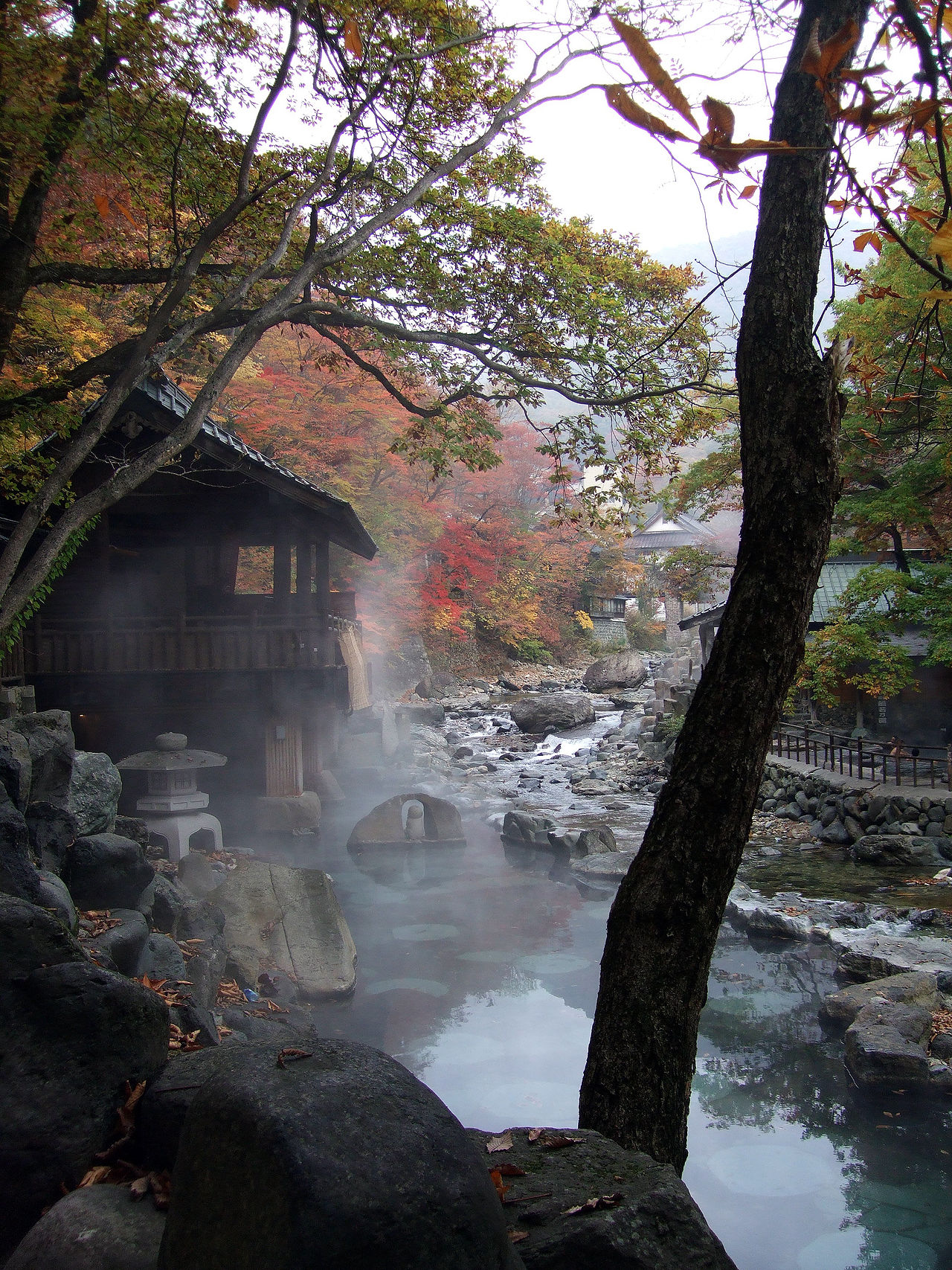
Onsen — the Japanese hot spring that the country has treated as half-sacred for over a thousand years
Over 27,000 natural hot springs in Japan, often outdoors with snow on the railings, treated as half-sacred. Here's why one winter soak changes everything.
It's a January evening high up in a small mountain town in central Japan. The air is around minus four. Snow is falling slowly against pine branches outside, and somewhere in the wooden corridors of the small ryokan, a hidden stone path leads down to a steaming pool open to the sky. You change out of your yukata in a small wooden hut, walk across freezing wooden boards in bare feet for ten meters, ease yourself into water that is forty-three degrees Celsius, and lower yourself in until only your head is above the surface. The hot water meets the freezing air at the line of your shoulders. Snow falls onto your hair and melts in two seconds. The mineral smell of sulfur drifts up from the surface. There is no one else in the bath. The only sound is the slow trickle of water entering the pool from a wooden pipe and snow landing on pine needles ten meters away. Forty minutes later, you walk back to your room with steam rising from every part of you. That's a Japanese 温泉 (onsen). And calling it a spa misses the half of it that's really happening.
In Japan, an onsen is closer to a sacred place that a thousand years of culture have wrapped a bath around.
How an onsen differs from a bath
Japan sits on top of one of the most volcanically active land masses in the world, and as a result has more natural hot springs than almost anywhere else: roughly 27,000 individual sources spread across nearly every prefecture. A spring is officially classified as an onsen if the water emerges at over 25 degrees Celsius and contains certain mineral concentrations — sulfur, sodium, calcium, iron, radium, and so on. Each spring's mineral profile gives its water a different color, smell, and reputed effect: cloudy white sulfur for skin, iron-red for circulation, faintly green calcium for joints. Locals at any onsen town can tell you what their water is supposed to do for you, and they take it seriously.
What's built on top of the spring is the part you notice as a visitor:
- Indoor baths and outdoor baths (rotenburo). Almost every onsen ryokan has both. The rotenburo is the one foreigners remember years later: a stone or wooden pool open to the sky, often with a view of forest, snow, valley, river, or sea.
- Wash before you enter, always. Same rule as a sentō. Sit on the small wooden stool, scrub your entire body, rinse twice, then enter the shared pool clean. The hot mineral water is for soaking, not for washing.
- Naked, no swimsuits. Bathing here is, by tradition, with nothing on. Men and women's baths are separate. A small towel can be carried in but is left on the side of the pool, never in the water.
- Cycle in and out, three or four times. Most people don't stay in the hot pool continuously. They soak for five to ten minutes, climb out, sit on the cold stone in the snow until their breath returns, and go back in. Each cycle goes deeper into the heat.
- The famous winter version: yukimi-onsen. A rotenburo in falling snow. Hot water below, cold air above, white silence in every direction. There is a category of Japanese travel that exists almost exclusively for this experience. Towns like Ginzan, Nyuto, Kusatsu, Hakone, Noboribetsu have made themselves famous around it.
- The visible steam. Yukemuri (湯けむり) — the visible white plume rising from the surface of an onsen pool against cold air — is one of the iconic sights of Japanese hot-spring towns. Walk through Kusatsu, Beppu, or any older onsen district in winter and the streets themselves are threaded with rising columns of steam from the public baths, the ground vents, the inn courtyards.
The whole experience is treated less as a service and more as a kind of restoration. People go to onsen towns to recover. The Japanese phrase for this — tōji — translates roughly as "hot-water cure," and historically people would stay in onsen towns for days or weeks, soaking three times a day, on doctor's recommendation. Some still do.
Why bathing is its own ritual
The onsen sits at the same place in Japanese culture that a sacred grove sits in some other cultures: a natural place that humans have not quite owned, where the right thing to do is to go quietly, sit, and let the place act on you. The shrine on the hilltop, the cedar forest of an old temple, the moss garden of a Kyoto temple, the public hot spring at the foot of a volcano — they're not the same, but they're related. What's continuous between them is that they're all places the country goes to be made smaller and quieter for an afternoon.
This is also why the onsen and the modern Western "spa" are not really the same thing. A spa is a service you buy. An onsen is a place you visit. The bath is the same temperature in both, but the cultural posture is opposite.
Find an outdoor onsen at dusk
Next time you can be in Japan in winter, stay one night at an onsen ryokan with a rotenburo. Pick somewhere small, somewhere mountainous, somewhere with snow. Soak in the outdoor pool at night, with snow on your hair. Soak again the next morning. Eat the kaiseki dinner in your room. Sleep on the futon. Walk back to the train station the next day with your skin still warm and your shoulders dropped two centimeters. And after, when someone asks you what surprised you most about Japan, you'll know.
Related reads
craft
Ryokan — the Japanese inn where the staff quietly take care of you for one night
Not a hotel. A one-night Japanese-style residence where the staff quietly take care of you. Here's what a ryokan actually is.
craft
Tatami — the Japanese floor where an entire household actually lives
The Japanese floor where the whole household actually lives — built to last fifty years of being lived on.
food
Sake — how to read the label, and what *daiginjo* actually means on a Japanese bottle
On a sake bottle, the smaller the number, the more rice was destroyed to make it. That's the premium signal.
culture
Tsuyu — Japan's rainy season isn't bad weather to wait out, it's the month the country spends watching one flower change color
Japan's rainy season isn't a month to skip — it's the one season with its own flower, its own words for rain, and a little doll hung in the window to beg for sun.
lifestyle
Kotatsu — the Japanese low table with a heater under it that quietly redesigned the entire winter
A low table, a heater, a heavy blanket. The Japanese winter device that keeps the family warm — and gathered — in one square meter.
Tags
Last reviewed: 2026-04-27
Spotted something off?
Reveal Japan aims for accuracy. If you found a factual error or unclear passage, tell us via Contact. We update articles when readers correct us, and we credit the corrector by request.
Affiliate disclosure: Some links on this page are affiliate links marked rel="sponsored nofollow". If you click and make a purchase, Reveal Japan may earn a commission at no extra cost to you. This does not influence which sources or explanations we choose to feature.