Tatami — the Japanese floor where an entire household actually lives
The Japanese floor where the whole household actually lives — built to last fifty years of being lived on.
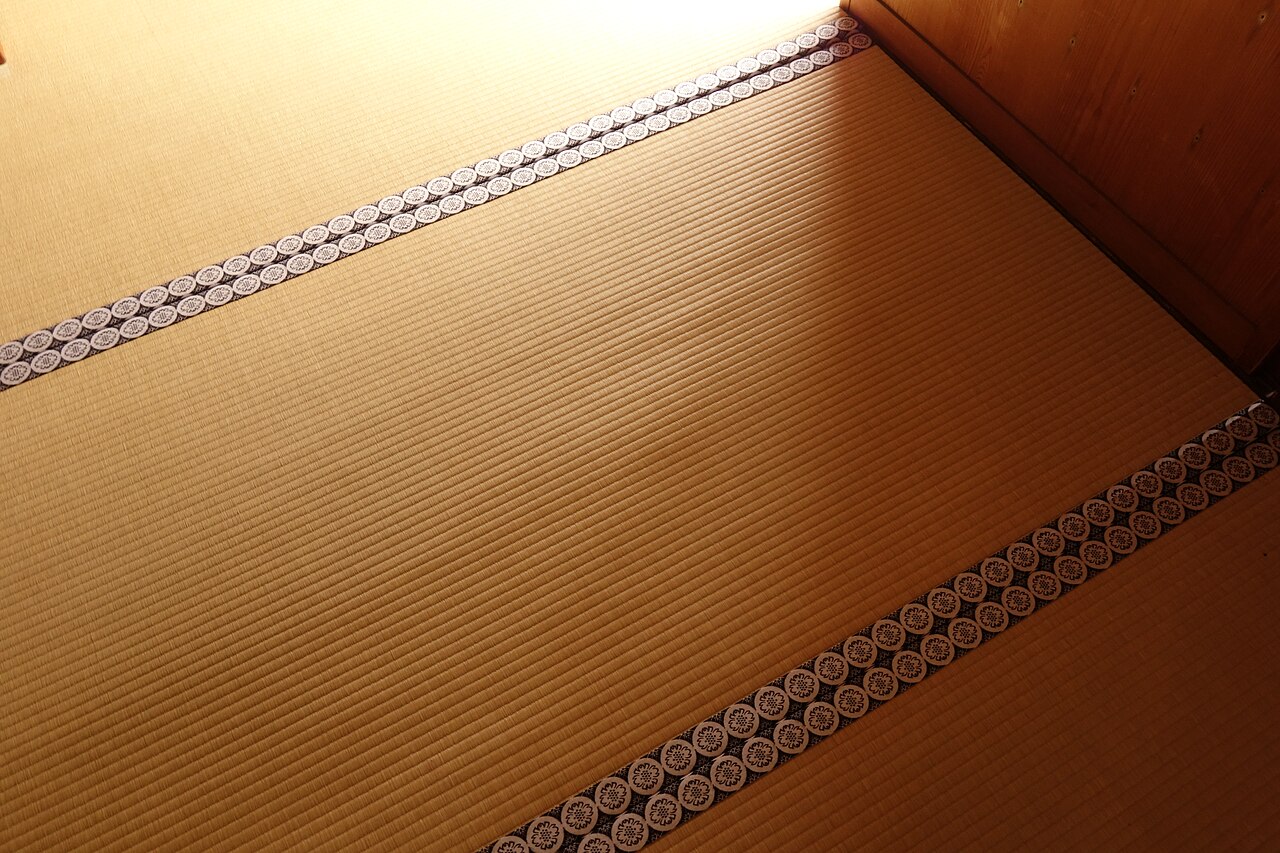
You step into a Japanese family home, leave your shoes at the entrance, and walk through a sliding paper door — 障子 — into a room that has no carpet, no hardwood, no vinyl. The entire floor is a soft, springy mat woven from dried igusa rush, about two inches thick, sectioned into rectangles edged with fabric trim. That's tatami. And in this room, that's not just the floor — it's where everything happens.
A boy is lying flat on his back on the tatami, one arm stretched out, reading manga. His grandmother sits at a low table on the same floor, pouring tea into small cups. The boy's father comes in, drops onto the mat without ceremony, lies on his side with his elbow propping his head up, and starts watching the news. By evening the table will be moved aside, futons will come out of a closet, and the same floor will become beds for the whole family. Nobody pulls up a chair. Nobody sits on furniture. The floor is the furniture.
Most modern Japanese homes are largely Western on the inside — wooden floors, beds, sofas. But it's still common for a house to keep at least one room with tatami: the washitsu. And inside that room, life happens completely differently from the rest of the house. Most foreign visitors only meet tatami in a ryokan and read it as "exotic accommodation." It isn't. For households that still have a washitsu, this is just where life happens — generation after generation.
A floor that lives an entire life on it
Think about what that floor goes through.
In houses that still keep a washitsu, a lot of family life slowly migrates onto the tatami. A grown adult flops onto it after work — for years. A toddler crawls across it, learns to walk on it, spills tea on it. Futons get unrolled and rolled up every morning and every night. Cousins arrive at New Year and twenty people sit on it eating from low tables. In some households, a baby's first crawl is on a tatami.
Here's the part most foreign visitors don't see coming: a single tatami floor is meant to last about fifty years of this.
Not by being precious. By being maintained. The mat has three layers — an inner core, an outer cover of woven igusa called the 表 (omote), and a fabric edge. Roughly every ten years, a 畳職人 (tatami-shokunin) from the local shop comes to the house, takes the mats out, peels off the omote, and stitches on a new one. Around the midpoint of the floor's life, they flip the omote over and use the unworn underside for a few more years. Only after about fifty years of being lived on does the whole mat get rebuilt from the core.
The shop that does this for a family's home often did it for the previous generation, too. A grandmother in Kyoto might point to the tatami in her sitting room and mention, in passing, that the same shop on the corner has been replacing the omote since her father's time. Nobody mentions this as a feat. It's just how the floor stays alive.
The Western floor and the Japanese floor are doing different jobs
In a Western house, the floor is mostly something you walk across to get to a chair, a sofa, a bed. The furniture is where life happens. The floor is the connector.
Inside a washitsu, that's reversed. The floor itself is the place. You sit on it, eat on it, sleep on it, raise children on it, host guests on it. The room has almost no furniture by Western standards — maybe a low table that gets moved when needed — because the room is the tatami, and the tatami is where you do everything.
Which is why a tatami is built and cared for the way it is. It isn't a flooring product you install and forget. It's the surface an entire family life rests on, literally — and the household, the craftsman, and the maker have a fifty-year quiet agreement to keep it whole.
Lie down on it
Next time you step into a washitsu — a tatami room, in a ryokan or in someone's home — don't treat the floor as the décor of an exotic experience. Lie down on it. Let your face touch the mat. Notice that the room has almost no furniture not because Japanese people own less, but because the floor itself is doing the job furniture does in your own home. If you're curious how it's actually made and kept alive, walk past a 畳屋 (tatami-ya) — they still have shopfronts on side streets in Kyoto, Nara, and most older Japanese towns — and you can watch the omote being stitched on, by hand. And next time you talk to a friend about Japanese homes, tell them this part: when a house keeps even one tatami room, that's where the family actually lives.
That floor under the boy reading manga, under the grandmother pouring tea, under the futons that come out at night — somewhere in Japan, that exact mat is being looked after by a shop that was already looking after it for the family before.
Related reads
craft
Ryokan — the Japanese inn where the staff quietly take care of you for one night
Not a hotel. A one-night Japanese-style residence where the staff quietly take care of you. Here's what a ryokan actually is.
craft
Onsen — the Japanese hot spring that the country has treated as half-sacred for over a thousand years
Over 27,000 natural hot springs in Japan, often outdoors with snow on the railings, treated as half-sacred. Here's why one winter soak changes everything.
food
Sake — how to read the label, and what *daiginjo* actually means on a Japanese bottle
On a sake bottle, the smaller the number, the more rice was destroyed to make it. That's the premium signal.
lifestyle
Kotatsu — the Japanese low table with a heater under it that quietly redesigned the entire winter
A low table, a heater, a heavy blanket. The Japanese winter device that keeps the family warm — and gathered — in one square meter.
culture
Tsuyu — Japan's rainy season isn't bad weather to wait out, it's the month the country spends watching one flower change color
Japan's rainy season isn't a month to skip — it's the one season with its own flower, its own words for rain, and a little doll hung in the window to beg for sun.
Tags
Sources
- 大辞林 第四版 (Daijirin, 4th ed.)
Last reviewed: 2026-04-27
Tools
- Open on Amazon
IKEHIKO igusa tatami mat, made in Japan
Note: this is a lightweight roll-up igusa mat, not a full 5 cm straw-core tatami - it gives you the real rush-grass surface and smell in a form that actually ships, but it is the light version, not a floor-grade tatami.
Spotted something off?
Reveal Japan aims for accuracy. If you found a factual error or unclear passage, tell us via Contact. We update articles when readers correct us, and we credit the corrector by request.
Affiliate disclosure: Some links on this page are affiliate links marked rel="sponsored nofollow". If you click and make a purchase, Reveal Japan may earn a commission at no extra cost to you. This does not influence which sources or explanations we choose to feature.