Ryokan — the Japanese inn where the staff quietly take care of you for one night
Not a hotel. A one-night Japanese-style residence where the staff quietly take care of you. Here's what a ryokan actually is.
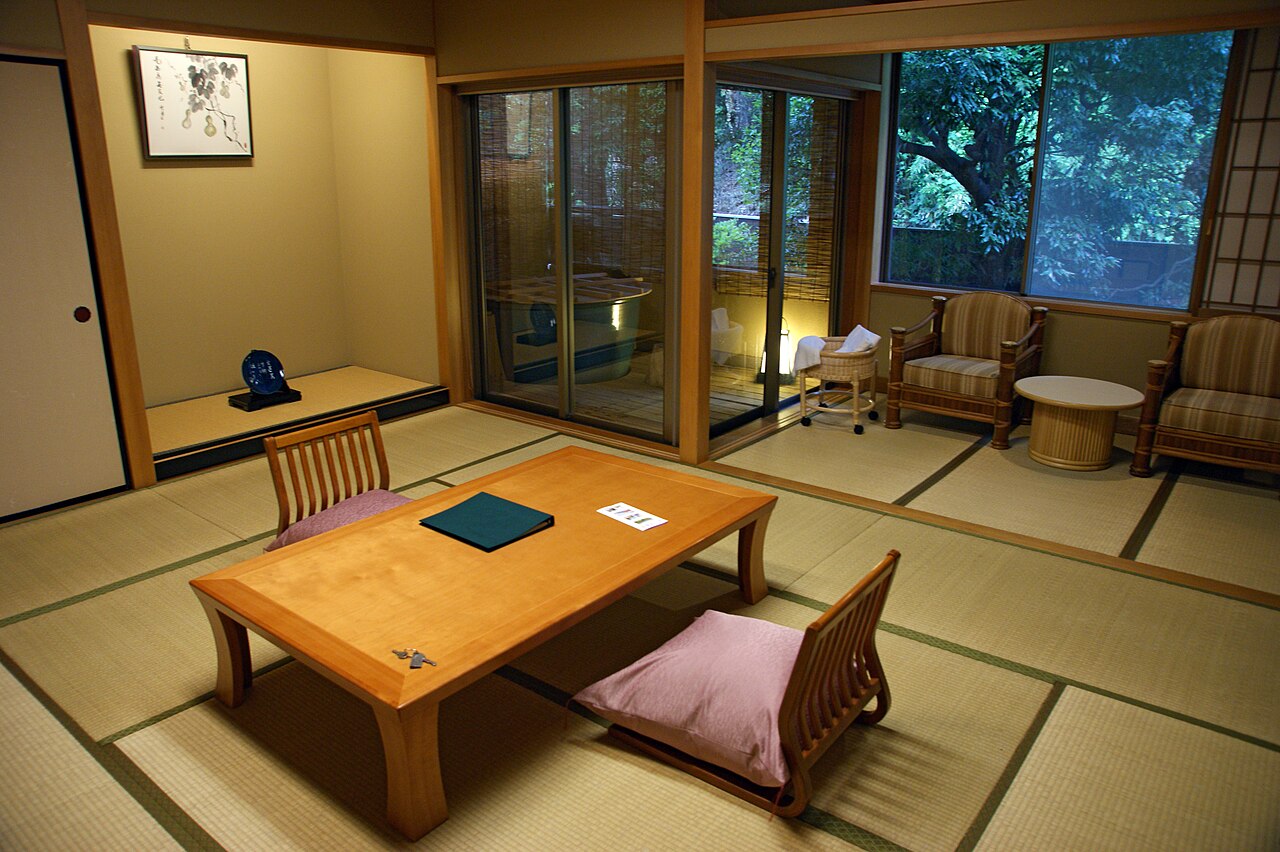
You step out of a taxi at 4 PM in front of an old wooden building in a small Kyoto side street. A woman in a kimono greets you at the wooden entrance, bowing deeply and saying 「いらっしゃいませ、お待ちしておりました」 — welcome, we have been waiting for you. You step out of your shoes onto the wooden step. She walks you to a tatami room overlooking a small garden, where a tray with a folded yukata and slippers is already prepared, and explains the schedule for the evening — bath, dinner, breakfast. She introduces herself as your 仲居 (nakai-san) — the staff member assigned to attend to your room — and quietly slides the door closed behind her. At dinner she'll bring courses to your room one tray at a time. After dinner she'll clear the dishes and lay out futons on the same tatami floor — the same room becomes a bedroom. The next morning, breakfast on the same table. That's a Japanese 旅館 (ryokan). And calling it a hotel is the same kind of category error as calling a kaiseki dinner a buffet.
A ryokan is a Japanese-style one-night residence with personal attention built into the choreography of the stay.
What a ryokan is, exactly
A serious traditional ryokan, especially in Kyoto, Hakone, Yufuin, or any old onsen town, is structured around personal attention to your room rather than a hotel-style front-desk operation. The structure of a typical one-night stay:
- Arrival around 3 to 4 PM. You're greeted personally, not at a counter. Your shoes come off. You're shown to your room rather than given a key card. The nakai introduces herself, explains the bath schedule and dinner time, points to the yukata and slippers prepared in the room, and leaves you alone.
- The bath, before dinner. You change into the yukata, walk down a wooden corridor to the communal onsen or in-house bath, soak for thirty to forty minutes, and walk back to your room with your skin steaming. The bath is the structural anchor of the whole evening.
- Dinner, served in your room. A multi-course 懐石 (kaiseki) meal arrives one small course at a time, brought by the nakai (or other staff). Sashimi, a clear soup, a grilled fish, a hotpot at your table, a tempura, a rice course, a small dessert — a generous number of small courses across roughly two hours. Each course is plated on a different small dish chosen for the season.
- Futons appear. While you go for a second bath after dinner, the staff clears the table and unfolds futons — thick warm bedding — directly on the tatami. The same room is now a bedroom. You come back, the futon is ready, the room smells faintly of fresh linen.
- Breakfast in the same room at 7 AM. Grilled fish, miso soup, rice, pickles, tofu, a small omelet, a few seasonal vegetables.
- You leave at 10 AM, fully fed, fully bathed, with skin glowing and shoulders that haven't carried any decisions for sixteen hours.
A ryokan stay is one of the most accessible ways to experience Japanese おもてなし (omotenashi) — the choreography of personal attention that the staff have practiced into the bones of the building.
Where ryokan sits in omotenashi
The ryokan model lives inside the broader Japanese category called おもてなし (omotenashi) — usually translated as "hospitality" but really meaning "anticipating what the guest needs before the guest knows they need it." Good nakai know when you'd like another cup of tea, when to refill the sake, when to leave you alone, when to close the shoji a few centimeters because the evening turned cool. The skill is in noticing without being asked. Many old Japanese ryokan, especially in Kyoto, have been refining this for generations.
Stay one night somewhere quiet
Next time you're in Japan, stay at one good ryokan, even just for one night. Pick somewhere classic — Kyoto, Hakone, Kinosaki, Yufuin, Beppu. Show up at check-in time, change into the yukata, take the early bath, eat the kaiseki dinner course by course, sleep on the futon, eat breakfast at 7. Notice the choreography. Notice that the staff seem to anticipate each next thing. That's omotenashi being practiced on you.
Related reads
craft
Onsen — the Japanese hot spring that the country has treated as half-sacred for over a thousand years
Over 27,000 natural hot springs in Japan, often outdoors with snow on the railings, treated as half-sacred. Here's why one winter soak changes everything.
craft
Tatami — the Japanese floor where an entire household actually lives
The Japanese floor where the whole household actually lives — built to last fifty years of being lived on.
food
Sake — how to read the label, and what *daiginjo* actually means on a Japanese bottle
On a sake bottle, the smaller the number, the more rice was destroyed to make it. That's the premium signal.
culture
Tsuyu — Japan's rainy season isn't bad weather to wait out, it's the month the country spends watching one flower change color
Japan's rainy season isn't a month to skip — it's the one season with its own flower, its own words for rain, and a little doll hung in the window to beg for sun.
lifestyle
Kotatsu — the Japanese low table with a heater under it that quietly redesigned the entire winter
A low table, a heater, a heavy blanket. The Japanese winter device that keeps the family warm — and gathered — in one square meter.
Tags
Last reviewed: 2026-04-27
Spotted something off?
Reveal Japan aims for accuracy. If you found a factual error or unclear passage, tell us via Contact. We update articles when readers correct us, and we credit the corrector by request.
Affiliate disclosure: Some links on this page are affiliate links marked rel="sponsored nofollow". If you click and make a purchase, Reveal Japan may earn a commission at no extra cost to you. This does not influence which sources or explanations we choose to feature.