Matcha — what the latte misses, and what Japan actually drinks
A matcha latte contains ~1g of matcha and ~50g of sugar. The Japanese drink it whisked, 2g + 70ml hot water, in 90 seconds of silence. Different drink, same name.
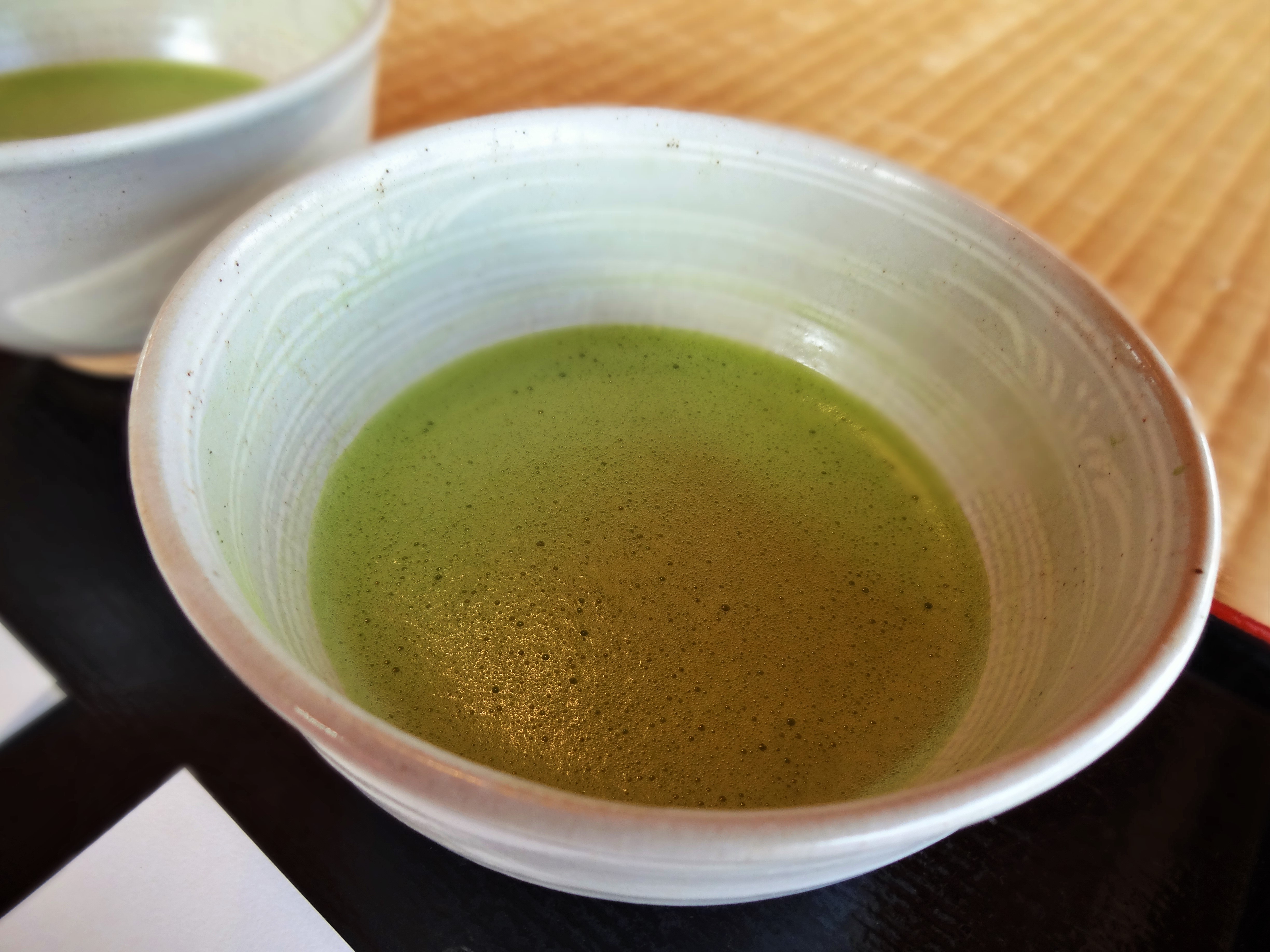
It's a Tuesday afternoon in Kyoto, and you're sitting on tatami in a small four-and-a-half-mat tea room behind a quiet street. The host has placed a single warm tea bowl in front of you, picked up a small bamboo scoop, lifted exactly two grams of matcha from a black-lacquered caddy, and tapped the powder into the bowl. 80°C water from a kettle, about 70 millilitres. Then she takes a bamboo whisk — a chasen, hand-cut from a single piece of bamboo into a hundred slim tines — and works the powder and water in a W motion for fifteen seconds. The liquid lightens, develops a fine foam, and stops. She turns the bowl twice and sets it in front of you. You drink it in three sips, in roughly forty seconds. No milk, no sugar, no honey, no syrup. That's a Japanese 抹茶 (matcha).
Outside Japan, matcha arrived already merged with milk and sugar. Starbucks matcha latte, matcha KitKat, matcha ice cream, matcha cheesecake, matcha cookies, matcha Frappuccino. The image abroad is bright green and sweet. Inside Japan, the bowl you just drank from is the same plant, the same powder, served by itself, and you can taste in three sips why the rest of the world found it easier to add sugar.
Powder, not leaf
Matcha is a powder, not a leaf. It is made from a specific kind of tea called 碾茶 (tencha): tea bushes covered with black shade cloth (or traditional reed mats) for the final three to four weeks before harvest. The shade slows photosynthesis, concentrates chlorophyll and L-theanine, and softens the flavor from grassy to umami-rich. The harvested leaves are steamed, dried, de-stemmed (only the soft leaf is kept), and finally ground between two stone mills at a pace of about 40 grams per hour. The stones turn slowly to avoid heating the leaf — heat oxidizes the aroma — and the resulting powder is fine enough to feel like talc.
No other tea works this way. Sencha, gyokuro, hojicha, oolong, Chinese green teas, Indian black teas — all are leaf teas, steeped in water with the leaves discarded. Matcha is the only major tea tradition where the leaf itself is the drink. Drinking matcha means drinking the whole plant, in suspension, every time.
Two faces — chadō and daily
The Japanese tea ceremony — 茶道 (chadō / sadō) — was formalized by 千利休 (Sen no Rikyū, 1522-1591) in the 16th century, building on 250 years of Japanese tea culture descended from 栄西 (Eisai, 1141-1215)'s 1191 introduction of tea from Song China, and refined through Murata Shukō (15th century) and Takeno Jōō. It uses two preparations:
- 薄茶 (usucha, thin tea) — 2 g of matcha in 70 ml of water, whisked to a fine foam. Drunk in three sips. The everyday register of the ceremony.
- 濃茶 (koicha, thick tea) — 4 g of matcha in 30 ml of water, kneaded (not whisked) into a thick paint-like consistency. Served from a single shared bowl to a small group, passed clockwise. The serious register, used for formal gatherings.
Outside the tea room, the daily face of matcha in Japan is the modern register — matcha ice cream, matcha mochi, matcha Kit Kats, and a wide rotation of seasonal sweets. This face is real Japan too: not a Western invention sold back to the country, but a 20th–21st-century domestication of the powder. The difference from the Western version is that Japanese matcha desserts tend to use a higher matcha-to-sugar ratio. The Western matcha latte, however, sits in a different category entirely — neither usucha nor Japanese daily matcha, but a third drink built around culinary-grade powder, dairy, and sugar.
Why the latte isn't really matcha
A typical Western matcha latte is 1 g of culinary-grade matcha + 200 ml of milk + 30–50 g of sugar — matcha as roughly 0.5% of the drink by weight, the rest sugar and dairy. Culinary-grade (¥5–¥15 per gram) is a coarser, later-harvest powder designed to hold flavor against sweetness.
A traditional usucha is 2 g of ceremonial-grade matcha (¥30–¥100 per gram) whisked into 70 ml of 80°C water — matcha at roughly 3% of the drink, with nothing else to mask it. The umami and chestnut-sweetness of shade-grown tea register directly.
These are two different drinks that share a name. The label "matcha" covers both, but they're built around different powders, different ratios, and different design intents.
From the latte back to the bowl
The path from the latte image back to the bowl Japan actually drinks from runs through three doors.
-
A tea ceremony experience. Kyoto and Uji are the historical center — most temples in the Daitoku-ji complex, and many small tea schools in central Kyoto, offer 30-to-60-minute chadō introductions for visitors at ¥2,000–¥5,000. You'll sit on tatami, the host will prepare usucha in front of you, you'll receive the bowl, turn it twice, drink in three sips. The whole shape of the room — the scroll, the seasonal flower, the silence — is the answer to the question "what is matcha really for?"
-
An Uji tea shop tasting. Uji (just south of Kyoto) has been Japan's premier matcha-producing region for 700 years. The two flagship shops — 一保堂 (Ippodō) in central Kyoto and 丸久小山園 (Marukyū-Koyamaen) in Uji proper — both have tasting counters where you can order a ceremonial-grade usucha prepared by the staff for ¥1,000–¥2,000, learn to read the grade ladder, and watch how the powder behaves. A small tin of starter ceremonial-grade matcha (20 g) for ¥1,500–¥3,000 will be enough for a month of home practice.
-
A bowl at home. A bamboo chasen, a small chashaku, a chawan, and a 20 g tin of ceremonial-grade matcha — total starter cost around ¥5,000–¥10,000 — let you make usucha yourself. Sift 2 g, pour 70 ml of 80°C water, whisk in a W motion for 15 seconds, drink in three sips. By the third bowl, you'll be tasting the umami and the slight grass-and-chestnut sweetness directly, with no sugar layer in the way.
There's nothing wrong with the matcha latte. It's a legitimate global drink, made with culinary-grade matcha, designed for dairy and sugar. But it's a different drink from the bowl a Kyoto tea host hands you in a small four-and-a-half-mat room. The two drinks share a name but not much else — keeping that in mind doesn't take anything away from either; it just adds a second drink to the world.
Frequently asked questions
- What is matcha?
- Matcha (抹茶) is a powdered Japanese green tea made from *tencha* — tea leaves grown under shade cloth for the final three to four weeks before harvest, then steamed, dried, de-stemmed, and ground in stone mills to a fine powder. Unlike steeped tea, matcha is drunk by whisking the powder directly into hot water — the entire leaf is consumed.
- Is matcha latte the same as matcha?
- Not really. A typical Western matcha latte contains around 1 g of matcha, plus 200 ml of milk and 30–50 g of sugar. The matcha component is roughly 0.5% of the drink by weight. A traditional Japanese *usucha* (thin tea) is 2 g of matcha whisked into 70 ml of 80°C water, with no milk or sugar — a different drink that happens to share a name.
- What is the difference between matcha and green tea?
- Both come from the same plant (*Camellia sinensis*), but the production diverges. Regular Japanese green tea (sencha, gyokuro, hojicha) is leaf tea — steeped in hot water and the leaves discarded. Matcha is *tencha* — shade-grown leaves de-stemmed and stone-ground to a powder — and is consumed whole. The shade growing concentrates chlorophyll and L-theanine, which is why matcha tastes denser and umami-richer than regular green tea.
- How do you make matcha at home?
- Sift 2 g of matcha into a *chawan* (tea bowl), pour in about 70 ml of water at 80°C, and whisk in a W or M motion with a bamboo *chasen* (whisk) for 15–20 seconds until a fine foam forms. Drink immediately, in two or three sips. A starter kit (chasen, chashaku, chawan, and a small tin of ceremonial-grade matcha) runs about ¥5,000–¥10,000 from a serious tea shop.
- What's the difference between ceremonial-grade and culinary-grade matcha?
- Ceremonial-grade matcha is made from the first spring harvest of the youngest leaves, ground slowly enough to stay cool (preserving aroma), and intended to be drunk as *usucha* or *koicha*. It costs roughly ¥30–¥100 per gram. Culinary-grade is made from later harvests or coarser leaves, less expensive (¥5–¥15 per gram), and intended for baking, latte-making, and ice cream — its flavor would feel weak if drunk as straight matcha but holds up against sugar and dairy.
Related reads
food
Sake — how to read the label, and what *daiginjo* actually means on a Japanese bottle
On a sake bottle, the smaller the number, the more rice was destroyed to make it. That's the premium signal.
lifestyle
Ramen — the Chinese noodle that became Japan's bowl after 1945
Ramen was Chinese until 1945. The postwar reinvention turned a Chinese noodle dish into Japan's regional bowl — and the world's most exported one.
lifestyle
Gogatsubyō — Japan's 'May sickness' isn't laziness, it's a structural crash everyone schedules into their year
Around mid-May, Japanese people quietly tell each other they've got 'May sickness.' It's not weather. It's what happens when the country boots a new year in April and then takes a 10-day holiday a month later.
lifestyle
Washlet — the Japanese warm-water bidet that quietly became standard
Washlet is the warm-water bidet that washes you after — TOTO's invention, now near-universal on Japanese toilets.
lifestyle
Japanese vending machines — four million quiet little statements about how safe the streets are
Vending machines on every corner, full of cash, working all night long. The reason that works is the part most foreigners miss.
Tags
Sources
- Eisai (栄西), *Kissa Yōjōki* (喫茶養生記, 1211) — earliest Japanese tea text
- Sen no Rikyū (千利休, 1522-1591) — formalization of *wabi-cha*
- 一保堂茶舗 (Ippodō, Kyoto, since 1717) — *Ceremonial-Grade Matcha* product reference
- 丸久小山園 (Marukyū-Koyamaen, Uji, since 1704) — koridashi-cha grade ladder
Last reviewed: 2026-05-18
Tools
- Open on Amazon
Ippodo Ummon-no-mukashi ceremonial matcha (40 g)
Kyoto's Ippodo (since 1717), named above - a rich, robust ceremonial grade meant for usucha and koicha, not for lattes.
- Open on Amazon
Marukyu-Koyamaen Aoarashi ceremonial matcha (40 g)
Uji's Marukyu-Koyamaen, the other house named above - a smooth, umami-forward ceremonial grade.
- Open on Amazon
TEANAGOO 7-piece matcha set (chawan, chasen, chashaku, sifter)
A complete starter kit - bowl, bamboo whisk, scoop, whisk stand and sifter - enough to whisk usucha at home.
Spotted something off?
Reveal Japan aims for accuracy. If you found a factual error or unclear passage, tell us via Contact. We update articles when readers correct us, and we credit the corrector by request.
Affiliate disclosure: Some links on this page are affiliate links marked rel="sponsored nofollow". If you click and make a purchase, Reveal Japan may earn a commission at no extra cost to you. This does not influence which sources or explanations we choose to feature.