Ramen — the Chinese noodle that became Japan's bowl after 1945
Ramen was Chinese until 1945. The postwar reinvention turned a Chinese noodle dish into Japan's regional bowl — and the world's most exported one.
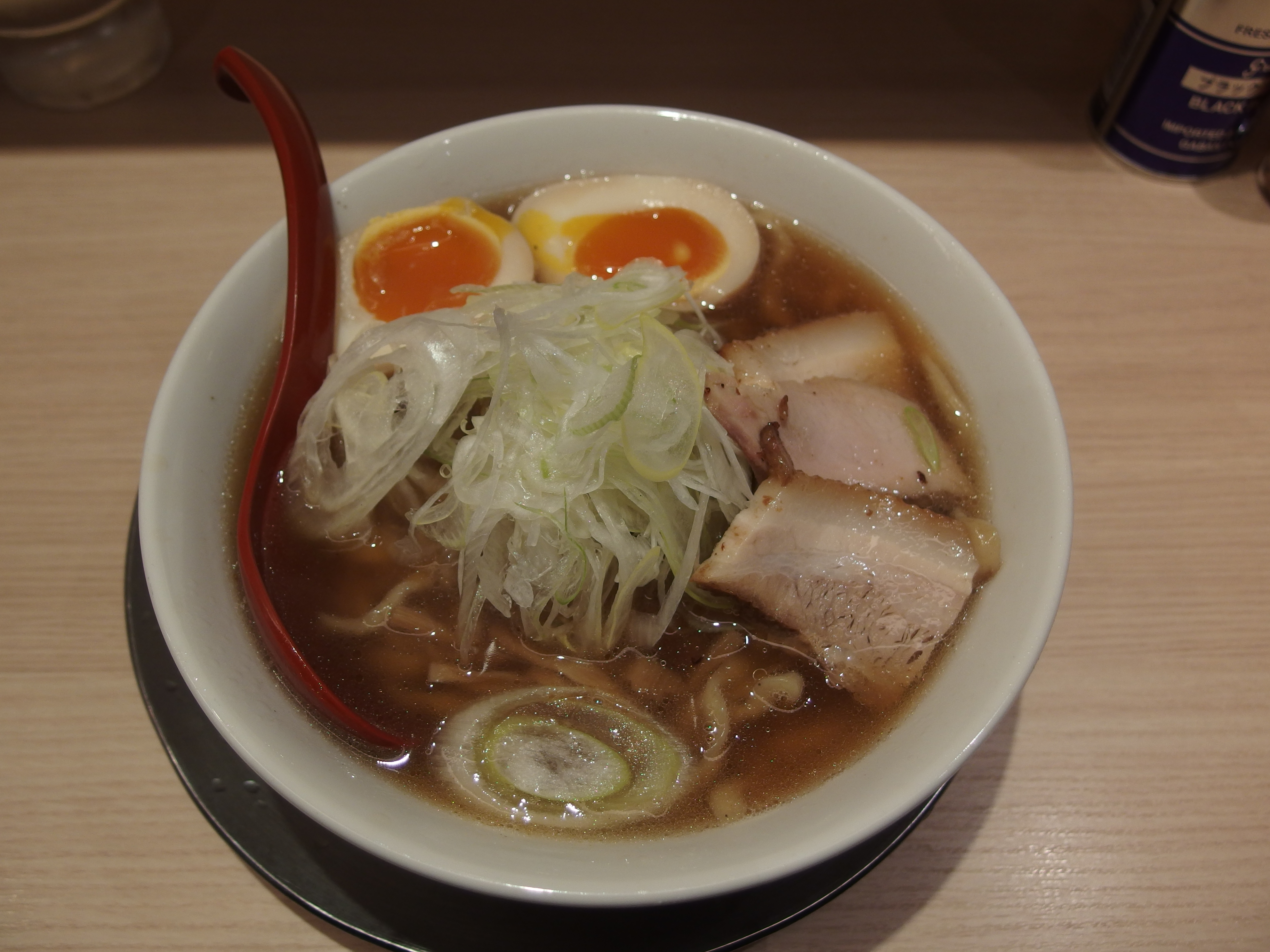
It's 11 PM on a weekday in Shinjuku and a small ramen shop on a side street still has every counter seat filled. The door slides open and the steam from the kitchen hits you before you see anything else — the sharp top-note of charred negi oil and the heavier base of pork bone broth that has been simmering since morning. A salaryman in a wrinkled suit is finishing his bowl in silence, slurping the noodles the way the heat demands; the cook lifts a wire basket from the boiling water with a single practiced flick, drains it against the rim, and slides the noodles into a waiting bowl of dark soy-tinted broth. A slice of chashu, a knot of green onion, half a soft-boiled egg, a sheet of nori leaning against the rim. No music. Counter only. Eleven minutes from your seat to the bottom of the bowl, and then you stand up so the next person can sit down. That's a Japanese ラーメン shop. And the bowl in front of you, the one that feels so deeply Japanese, was treated as Chinese food in this country until your parents were born.
Outside Japan, "ramen" arrived already labeled Japanese — the dish on the menu at Ippudo in New York, the heavy tonkotsu with the perfectly halved egg on Instagram, the Tampopo movie still that introduced a generation of foreign viewers to the noodle. Inside Japan, the same dish was, well into the postwar decades, called 中華そば — chuka soba, literally "Chinese noodles." The shift from one to the other is the most interesting thing about ramen, and the part the international image quietly skips.
Inside a Japanese ramen shop
The Japanese ramen shop the country actually eats at is small. Ten to fourteen counter seats, sometimes a table or two at the back, a single cook visible behind the counter, a hand-written wooden plaque or a paper menu taped to the wall listing the four or five bowls the shop makes. You order by buying a ticket from a vending machine at the entrance, hand the ticket to the cook, and sit. The bowl arrives in four to six minutes. You finish it in under fifteen. The total cost is roughly ¥900–¥1,400 for the bowl plus a small side, and the lunchtime line moves at a rhythm that assumes everyone is also on a one-hour lunch break.
The ingredients sit in four columns, and shops differ on which column they specialize in:
- The broth (スープ) — pork bone (tonkotsu), chicken (tori), seafood (niboshi, kaisen), or a hybrid. Simmered six to twelve hours, sometimes longer.
- The tare (タレ) — a concentrated soy, salt, or miso seasoning that sits at the bottom of the bowl and meets the broth at serve time. The four classic categories (shoyu / shio / miso / tonkotsu) are really tare-and-broth combinations.
- The noodles (麺) — wheat noodles cut to a thickness the shop has chosen to suit its broth, often supplied by a specific seimensho (麺製造所) that the shop has worked with for years.
- The toppings — chashu (braised pork), menma (fermented bamboo), negi, nori, ajitama (marinated egg), moyashi, sometimes a single piece of naruto.
There are around 30,000 ramen shops in Japan, and the everyday register of ramen — the workday lunch, the late-night bowl, the weekend family stop — is built around these counter shops, not the elaborate multi-page-menu places that have come to represent ramen abroad.
From chuka soba to ramen — a postwar reinvention
The dish arrived in Japan from China around the turn of the 20th century. The Tokyo establishment most commonly credited is 来々軒 (Rairaiken), which opened in Asakusa in 1910 as a Chinese restaurant serving Nankin soba — wheat noodles in soy broth, recognizably the ancestor of today's Tokyo shoyu ramen. Through the prewar decades, ramen-like noodles were a niche dish, generally categorized in Japan as Chinese food.
Two postwar pressures reshaped it. The people: around six and a half million Japanese soldiers and civilians were repatriated from China, Korea, Manchuria, and Southeast Asia after 1945; many had spent years in Chinese kitchens, and some set up noodle stalls in the black markets and bombed-out commercial districts of postwar Tokyo, Yokohama, and Osaka. The skill was already in the country; postwar precarity supplied the market. The wheat: with the 1945–50s rice supply thin, US occupation wheat aid prompted a national shift toward bread and noodle dishes — school lunches built around bread, noodle stalls subsidized in cities. A Chinese-origin wheat noodle dish became politically useful to eat.
Through the 1950s and 1960s, the regional styles that now define ramen were invented one by one, independently, in different cities:
- Sapporo miso ramen — credited to 大宮守人 (Ōmiya Morito) at 味の三平 (Aji no Sanpei) in Sapporo around 1955, when he experimented with adding miso to a pork-based broth to suit Hokkaidō's cold winters.
- Hakata tonkotsu — the cloudy pork-bone broth style that emerged in Fukuoka stalls in the 1940s and was codified through the 1950s–60s.
- Yokohama iekei — founded in 1974 by 吉村実 (Yoshimura Minoru) at 吉村家 (Yoshimura-ya) in Yokohama, a pork-bone-and-soy hybrid built around thick straight noodles.
- Jiro-style — born 1968 at the original ラーメン二郎 in 三田, founded by 山田拓美 (Yamada Takumi), defined by a mountain of boiled bean sprouts and cabbage piled on thick noodles in a heavy fat-and-soy broth.
And, between Sapporo's miso and Hakata's tonkotsu, the single invention that shifted ramen's global trajectory: 1958, Andō Momofuku (安藤百福), Taiwanese-born founder of Nissin Food Products, releases Chicken Ramen — the first commercial instant ramen. Cup Noodle follows in 1971. The word ramen, until then a minority alternative to chuka soba, becomes the brand name printed on hundreds of millions of packages, and from the late 1980s onward replaces chuka soba as the default Japanese term for the dish.
By the time the 1985 film タンポポ (Tampopo) makes ramen a cinematic image, the bowl is no longer Chinese food in Japan. It's the most quietly nationalized dish in the country.
What the global ramen image leaves out
The ramen that foreign visitors arrive with in mind — heavy tonkotsu, milky-cloudy broth, a perfectly halved soy-marinated egg, two slices of fatty pork, served in a wide black bowl at a polished counter — is a specific subgenre, made internationally famous by chains like Ippudo (一風堂) that began their overseas expansion in the 2000s and especially through the 2010s. It's an authentic Japanese style, but it's one of six or seven, and arguably not the everyday one.
The clear shoyu chuka-soba — thin straight noodles, a clean soy broth made from chicken or seafood, three slices of chashu, a strip of menma, a piece of nori, ¥900 — is one register Japan eats day to day, alongside Sapporo's heavy miso, Hakata's tonkotsu, Yokohama's iekei, Jiro-style for its dedicated fans (some of whom eat only Jiro), and the tsukemen dipping-noodle format that emerged in 1961 at 東池袋大勝軒. Each is a complete, independent register of the dish, and the country switches between them by region, season, time of day — and the kind of ramen eater you are.
Three ways to taste the lineage
If you want to feel what ramen actually is in Japan, three rough paths cover most of it.
-
A regional / style crawl. Sapporo miso, Hakata tonkotsu, classic shoyu chuka-soba, Yokohama iekei, Jiro-style — five bowls (or browse 新横浜ラーメン博物館, the Shin-Yokohama Ramen Museum that opened in 1994 and clusters representative shops from major regions in one basement floor). After the fifth bowl, the idea that these are all "ramen" stops feeling obvious — they're independent inventions sharing wheat noodles and a postwar moment, more than a single tradition.
-
A late-night counter bowl in a small Tokyo shop. Pick a 12-seat counter shop near a station you happen to be at. Order whatever's on the recommended sign. Eat it in twelve minutes. Pay ¥1,000. Walk back to the train. This is the register most ramen gets eaten in. Not the famous shops with the queue down the block — the ordinary one that two thousand salarymen pass on the way home.
-
A supermarket shelf in Japan. Walk into any Japanese supermarket and the instant ramen aisle is a full wall. Nissin Chicken Ramen is still sold (the package design has been retained since 1958). Sapporo Ichiban miso. Maruchan Seimen. Regional bag noodles. Cup ramen of every regional style. Buy three or four, take them home, and notice that the difference between Sapporo-style miso bag noodles and Hakata-style tonkotsu cup noodles is visible from the package. The country sells the entire regional ladder in dry form, off a shelf, for ¥150–¥250 a portion.
There's no obligation to chase the "real" version of ramen, because there are six of them and a 1958 instant ramen is genuinely as Japanese as any of them. Knowing that this dish was Chinese food in Japan a single generation ago, and that the country reinvented it region by region during the years its grandparents were rebuilding their cities, doesn't take anything away from the bowl in front of you. It just lets you taste the work in it.
For what it actually feels like to eat at a Japanese ramen shop — the 15-minute solo counter ritual, the ticket machine, the slurp — see ramen-ya.
Frequently asked questions
- Is ramen Chinese or Japanese?
- Ramen originated as a Chinese noodle dish — *chuka soba* (中華そば, 'Chinese noodles') — that arrived in Japan in the early 20th century. After 1945, returning soldiers and civilians from China, US wheat aid, and the postwar black markets reshaped it into a Japanese dish. Today ramen is fully Japanese cuisine; the regional varieties (Sapporo miso, Hakata tonkotsu, Yokohama iekei, Jiro-style) are all postwar Japanese inventions.
- When did ramen become Japanese?
- Roughly between 1945 and the 1980s. The Chinese origin name *chuka soba* stayed in common use into the 1980s. The word *ramen* (ラーメン) was popularized partly by Nissin's 1958 Chicken Ramen, the first instant ramen. By the time *Tampopo* (1985) made ramen an international image, the dish had been re-anchored as Japanese.
- Who invented instant ramen?
- Andō Momofuku (安藤百福), the Taiwanese-born Japanese founder of Nissin Food Products, invented Chicken Ramen in 1958. Cup Noodle followed in 1971. Instant ramen is now consumed at roughly 100+ billion servings per year worldwide.
- What are the main regional styles of ramen?
- Five common reference points: Sapporo miso (creamy miso broth, born around 1955 at 味の三平 in Sapporo), Hakata tonkotsu (cloudy pork-bone broth, Fukuoka), classic shoyu (the chuka-soba style), Yokohama iekei (1974, 吉村家, pork-bone-soy hybrid), and Jiro-style (1968, 三田, mountain of vegetables on thick noodles). Each is an independent postwar invention, not branches of a single tradition.
Related reads
lifestyle
Matcha — what the latte misses, and what Japan actually drinks
A matcha latte contains ~1g of matcha and ~50g of sugar. The Japanese drink it whisked, 2g + 70ml hot water, in 90 seconds of silence. Different drink, same name.
lifestyle
Gogatsubyō — Japan's 'May sickness' isn't laziness, it's a structural crash everyone schedules into their year
Around mid-May, Japanese people quietly tell each other they've got 'May sickness.' It's not weather. It's what happens when the country boots a new year in April and then takes a 10-day holiday a month later.
lifestyle
Washlet — the Japanese warm-water bidet that quietly became standard
Washlet is the warm-water bidet that washes you after — TOTO's invention, now near-universal on Japanese toilets.
lifestyle
Japanese vending machines — four million quiet little statements about how safe the streets are
Vending machines on every corner, full of cash, working all night long. The reason that works is the part most foreigners miss.
lifestyle
Japanese trains — the rail system that runs to the second, in a country where on-time isn't a goal but a baseline
Japanese trains run to the second. The interesting part is what an entire society does on top of that assumption.
Tags
Sources
- Hayamizu Kenrō (速水健朗), *Ramen and the Japanese Nation* (ラーメンと愛国, 2011)
- George Solt, *The Untold History of Ramen* (University of California Press, 2014)
- 大辞林 第四版 entries 拉麺・ラーメン・中華そば
- Nissin Food Products archive — 安藤百福 (Andō Momofuku) and Chicken Ramen, 1958
- 新横浜ラーメン博物館 (Shin-Yokohama Ramen Museum) opening 1994, regional ramen exhibits
Last reviewed: 2026-05-18
Tools
- Open on Amazon
Official ICHIRAN take-home ramen kit (Hakata tonkotsu, imported from Japan)
A real ramen-ya's recipe at home - Ichiran's concentrate broth and dried Hakata-style thin straight noodles, the closest thing to the counter bowl.
- Open on Amazon
Nissin RAOH tonkotsu instant ramen (6-pack)
The premium everyday register: air-dried, non-fried noodles that hold their texture - the best of the supermarket instant tier.
Spotted something off?
Reveal Japan aims for accuracy. If you found a factual error or unclear passage, tell us via Contact. We update articles when readers correct us, and we credit the corrector by request.
Affiliate disclosure: Some links on this page are affiliate links marked rel="sponsored nofollow". If you click and make a purchase, Reveal Japan may earn a commission at no extra cost to you. This does not influence which sources or explanations we choose to feature.