Kaiten-zushi — the Japanese conveyor-belt sushi that quietly turned the most expensive food in the country into family dinner
Japan's conveyor-belt sushi chains turn sushi into casual family dinner — touchscreen ordering, color-coded plate prices, and a long belt of small plates rolling past your seat.
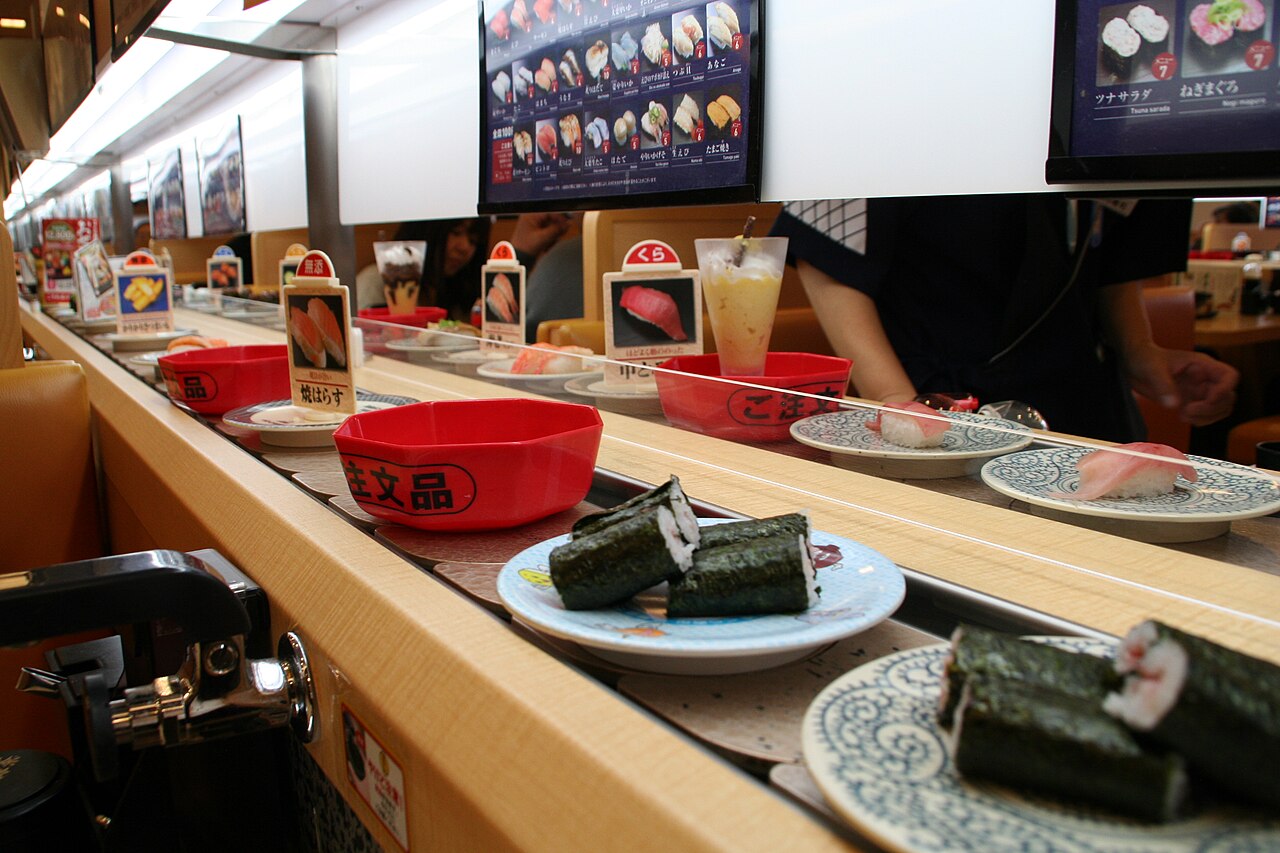
A family of four — two parents, a five-year-old, an eight-year-old — walks into a Japanese kaiten-zushi chain on a Saturday evening. The host taps a tablet, prints a small slip with their seat number, and they slide into a booth along a long conveyor belt. The belt is moving slowly past their table, carrying small plates of sushi: salmon, tuna, shrimp, egg, corn-mayonnaise, fried chicken nuggets, fries, soft-serve ice cream. Each plate is a different color, and each color matches a different price tier. The eight-year-old reaches out and lifts a plate of salmon off the belt without asking. The parents tap a touchscreen built into the wall of the booth and order a tuna, a salmon, a hot tea, and a kid-sized bowl of udon. A short while later, a small tray slides up a separate elevated lane and stops at exactly their table — their order, just for them. Two hours, two beers, twenty-something plates, one melon soft-serve, and a manageable bill later, they walk out. The kids loved it; for them, kaiten-zushi is its own kind of special-feeling outing — the moving belt, the touchscreen, the color-coded plates. That's a Japanese 回転寿司 (kaiten-zushi).
Alongside the high-end sushiya — the white wooden counter, the master behind it, the meal you save up for — Japan also built this parallel rail: a casual, family-shaped, repeatable version of sushi.
Inside the conveyor belt
A modern kaiten-zushi chain is a piece of restaurant engineering as much as it's a restaurant. The sushi is partly hand-made, partly machine-formed; ordering is mostly touchscreen; the pricing is color-coded so a four-year-old can read it; payment happens via the touchscreen at the end. Every variable that used to make sushi feel formal has been redesigned for casual repeated use.
What that gets you, on a typical evening:
- Plates start around 120-150 yen on the lowest tier, with premium plates running 300-500 yen or more. A family of four with drinks lands somewhere between 5,000 and 8,000 yen depending on appetite — meaningfully cheaper than a traditional sushiya, but not pocket change.
- The slow conveyor belt has impulse plates — grab-and-eat sushi, fried sides, desserts. Children love this part. They start to pull plates without asking.
- A separate higher express lane delivers your specifically-ordered items, sometimes shaped like a delivery tray, sometimes — at certain chains like Kura Sushi — like a tiny bullet train. The order arrives within about a minute, hot if it's hot, fresh-cut if it's fresh.
- A touchscreen in your booth orders everything. Many chains have multilingual interfaces — English, Chinese, Korean.
- Some chains add a slot-machine animation every five plates dropped into an in-booth plate slot, with a small prize if you hit it (a tiny capsule toy). Children become very motivated to eat one more plate of cucumber roll.
The whole experience is engineered to make sushi a normal, family-friendly outing — without losing the small "we're going somewhere fun tonight" feeling for the kids.
Where kaiten-zushi fits in Japanese food
The beautiful traditional sushiya, with its hinoki wood counter and a master who's spent twenty years on the technique of pressing rice — that still exists, and that's a meal you save up for. The kaiten-zushi is the parallel rail that runs alongside it: the casual, family-friendly, repeatable Saturday-evening dinner that a family can afford every couple of weeks.
Japanese kids grow up eating sushi often enough that it's a normal thing in the family rotation. The country took its most precious food and built a casual format around it — without flattening the high-end original.
Sit at the counter once
Next time you're in Japan, don't only go to a high-end sushiya. Spend one Saturday lunch at a Sushiro, a Kura Sushi, or a Hama Sushi — the three big chains, all roughly equivalent. Order from the touchscreen. Take a few plates off the conveyor belt that catch your eye. Try the salmon (every chain does it well), the uni if you see it, the tamago (sweet egg), and one weird thing you can't translate. Watch the bullet-train tray slide up to your table. Stack your plates carefully and look at the price by color. Pay around 2,000 yen per person and walk out. Then, separately, save up for one beautiful traditional sushiya meal too — they're not the same experience and they're not supposed to be.
Related reads
food
Ramen-ya — the Japanese 15-minute solo dining ritual that isn't really like eating pasta
A 15-minute solo ritual at a counter — Japanese ramen isn't really like eating pasta, and the slurping is required.
food
Onigiri — the Japanese rice ball that's been a portable meal since before Japan had restaurants
The Japanese rice ball — a thousand-year-old portable meal that lives in every convenience store, every lunchbox, and every Japanese childhood.
food
Izakaya — the Japanese place that isn't a bar, isn't a restaurant, and quietly does what neither does
Not a bar. Not a restaurant. The Japanese institution that quietly hosts most of the country's serious socializing.
food
Sake — how to read the label, and what *daiginjo* actually means on a Japanese bottle
On a sake bottle, the smaller the number, the more rice was destroyed to make it. That's the premium signal.
lifestyle
Ramen — the Chinese noodle that became Japan's bowl after 1945
Ramen was Chinese until 1945. The postwar reinvention turned a Chinese noodle dish into Japan's regional bowl — and the world's most exported one.
Tags
Last reviewed: 2026-04-27
Spotted something off?
Reveal Japan aims for accuracy. If you found a factual error or unclear passage, tell us via Contact. We update articles when readers correct us, and we credit the corrector by request.
Affiliate disclosure: Some links on this page are affiliate links marked rel="sponsored nofollow". If you click and make a purchase, Reveal Japan may earn a commission at no extra cost to you. This does not influence which sources or explanations we choose to feature.