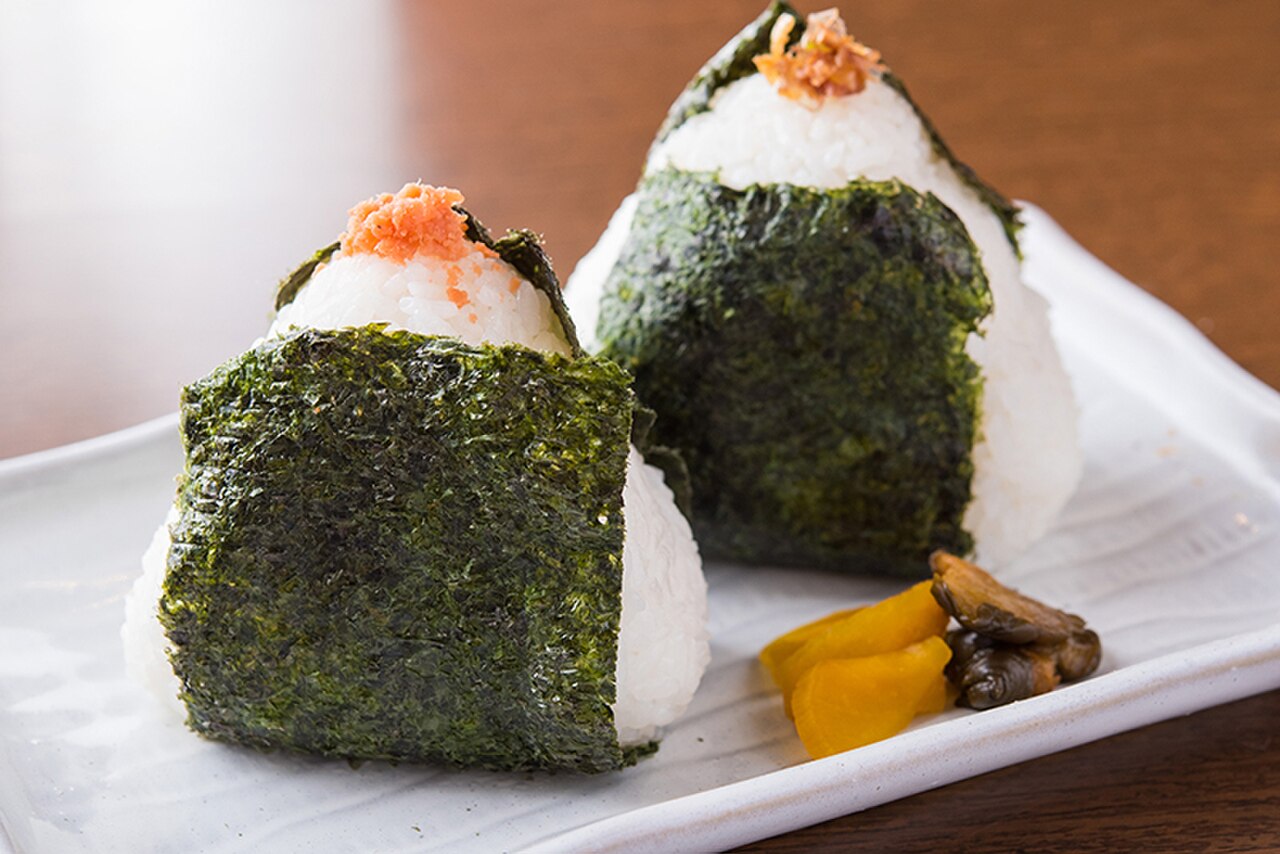
Onigiri — the Japanese rice ball that's been a portable meal since before Japan had restaurants
The Japanese rice ball — a thousand-year-old portable meal that lives in every convenience store, every lunchbox, and every Japanese childhood.
A Japanese office worker stops at a convenience store on the way to work at 7:45 AM. He walks past the hot food counter and the rice bowls and the pre-packaged sandwiches and stops in front of a wall of small triangular packages: rows and rows of onigiri, each in a clear plastic wrapper with a neat white-and-colored label indicating the filling. Tuna mayo. Salted salmon. Umeboshi (pickled plum). Kombu (simmered kelp). Mentaiko (spicy cod roe). Karaage (fried chicken). Fifteen to twenty varieties. He picks two — a salmon and an umeboshi — and a small green tea, pays ¥350, and is back on the street within ninety seconds. He'll eat them at his desk in a few hours. A few miles away in a kindergarten, a mother is hand-shaping the same triangular form for her daughter's lunchbox: white rice, a small pickled plum buried in the center, a strip of nori wrapped neatly around the bottom, packed in a small plastic case with a tomato and a piece of sausage. That's a Japanese おにぎり (onigiri) — the rice ball that has fed Japan as a portable, hand-held meal for over a thousand years.
In Japan, rice can also be a hand-held finger food — formed by hand into a defined shape, with a filling inside, wrapped in seaweed for grip, and carried anywhere. It's the country's portable rice format, and its presence in modern Japanese life is so total that it's almost invisible.
What's actually inside an onigiri
Onigiri has a few defined components:
- The rice. Short-grain Japanese rice, freshly steamed, slightly seasoned with salt and sometimes a touch of vinegar. The rice must be sticky enough to hold its shape when pressed but not mushy. Cold supermarket onigiri use special rice formulations to stay soft when chilled; freshly hand-made onigiri are best eaten warm or at room temperature.
- The shape. The classic shape is triangular — formed by pressing the rice between the palms of cupped hands into a flattened triangle. Round and oval shapes also exist (sometimes called omusubi, an alternative name with regional and stylistic associations). The triangle is dominant in modern commerce.
- The filling. A small pocket of filling is buried in the center of the rice ball before forming. Classic fillings:
- Umeboshi (whole pickled plum, intensely sour and salty)
- Salmon flakes (salted, broken into pieces)
- Tuna mayo (canned tuna mixed with mayonnaise)
- Kombu tsukudani (sweet-savory simmered kelp)
- Mentaiko or tarako (spicy or plain cod roe)
- Pickled vegetables (such as takuan)
- The nori. A strip of nori (dried seaweed) is wrapped around the bottom or middle of the onigiri. Convenience store onigiri use a brilliant packaging design that keeps the nori dry and crisp until the moment of eating — pulling a tab opens the wrapper in three steps that wraps the nori around the rice exactly when you bite it. This is one of the great unsung packaging engineering achievements of modern Japan.
- Variations.
- Yaki-onigiri (grilled onigiri) — brushed with soy sauce or miso and grilled until crispy on the outside.
- Tenmusu — onigiri with shrimp tempura inside, a Nagoya specialty.
- Bonito-flake onigiri (okaka) — bonito flakes mixed with soy sauce.
Why a rice ball is so beloved
Onigiri's role in Japanese life is immense for a simple reason: it's the easiest, cheapest, most portable, most customizable form of rice — and rice is the central food of Japan. A convenience store onigiri costs ¥150–¥250, takes one hand to eat, requires no utensils, no plate, no reheating (though it tastes better warm), and provides a real meal of carbohydrates and protein in a wrapper that fits in a coat pocket.
It's also the central food of the Japanese childhood lunchbox. Almost every Japanese person grew up eating mother-made onigiri in their school bento, often with cute decorative touches — eyes made of nori, a face on the front, the rice slightly colored with mixed-in vegetables. Mother-made onigiri are deeply nostalgic for Japanese adults, and many bring back vivid memories the moment they're mentioned.
And in disasters, it's the food. After major Japanese earthquakes (Kobe 1995, Tohoku 2011, Noto 2024), volunteer kitchens, the SDF, and convenience store chains immediately produce and distribute onigiri to displaced survivors. It's the country's emergency food and comfort food simultaneously.
Where onigiri fits in Japanese eating
Onigiri sits at the center of a category of rice-based portable foods: onigiri (rice balls), bento (full lunch boxes with rice and sides), makizushi (rolled sushi), inarizushi (rice in sweet tofu pouches). Of these, onigiri is the most informal and most everyday, the one any Japanese person can make at home in three minutes, the one that lives in every convenience store cooler.
Onigiri is also part of the Japanese cultural attachment to white rice as the central definition of a meal. A meal in Japan is properly anchored on rice; the side dishes are okazu — accompaniments to the rice. Onigiri is rice that has been promoted to portable form, with the okazu moved inside and made compact.
Eat one in a park
In Japan, onigiri is one of the most reliable and affordable foods you can buy in any city, any town, any train station. Convenience stores (7-Eleven, FamilyMart, Lawson) all stock 15–25 varieties; try several, including ones you don't recognize the kanji for. Shake the umeboshi onigiri to make sure your taste tolerance is ready (intensely sour). Try yaki-onigiri at an izakaya if you see it on the menu — the grilled crust is wonderful.
If you have access to a kitchen in Japan, make onigiri yourself with leftover rice. Wet your hands lightly with salted water, press a small ball of rice flat in your palm, place a teaspoon of filling in the center, fold the rice over and press into a triangle between cupped hands. Wrap with a strip of nori. It's one of the most satisfying and ancient simple things you can do with food.
Related reads
food
Ramen-ya — the Japanese 15-minute solo dining ritual that isn't really like eating pasta
A 15-minute solo ritual at a counter — Japanese ramen isn't really like eating pasta, and the slurping is required.
food
Kaiten-zushi — the Japanese conveyor-belt sushi that quietly turned the most expensive food in the country into family dinner
Japan's conveyor-belt sushi chains turn sushi into casual family dinner — touchscreen ordering, color-coded plate prices, and a long belt of small plates rolling past your seat.
food
Izakaya — the Japanese place that isn't a bar, isn't a restaurant, and quietly does what neither does
Not a bar. Not a restaurant. The Japanese institution that quietly hosts most of the country's serious socializing.
food
Sake — how to read the label, and what *daiginjo* actually means on a Japanese bottle
On a sake bottle, the smaller the number, the more rice was destroyed to make it. That's the premium signal.
lifestyle
Ramen — the Chinese noodle that became Japan's bowl after 1945
Ramen was Chinese until 1945. The postwar reinvention turned a Chinese noodle dish into Japan's regional bowl — and the world's most exported one.
Tags
Sources
- 大辞林 第四版
Last reviewed: 2026-04-27
Tools
- Open on Amazon
Inomata triangle onigiri mold (made in Japan)
A Japanese-made press for the classic triangle shape - useful while your hand-pressing technique is still finding the form.
- Open on Amazon
East & Else Koshihikari short-grain rice (Product of Japan, 2.2 lb)
Japan-grown Koshihikari - the sticky short-grain that holds a pressed shape without turning mushy.
- Open on Amazon
Yamamotoyama yaki nori, half sheets (100 ct)
Roasted nori from Yamamotoyama (a Tokyo nori-and-tea house since 1690); half sheets are the right size to wrap a rice ball.
Spotted something off?
Reveal Japan aims for accuracy. If you found a factual error or unclear passage, tell us via Contact. We update articles when readers correct us, and we credit the corrector by request.
Affiliate disclosure: Some links on this page are affiliate links marked rel="sponsored nofollow". If you click and make a purchase, Reveal Japan may earn a commission at no extra cost to you. This does not influence which sources or explanations we choose to feature.